Here is a fact most OnlyFans creators discover too late:
earning money on OnlyFans does not just create a federal tax obligation. It also creates a state tax obligation — and the rules vary dramatically depending on where you live. Understanding OnlyFans state taxes by state is one of the most overlooked parts of creator tax planning in the United States, and missing it can mean a surprise tax bill, penalties, or both.
The good news is that nine US states have no state income
tax at all. For creators living in those states, state income tax simply does not exist. However, for the other 41 states — and Washington, D.C. — state income tax applies to self-employment income just as it applies to any other earnings. Rates, rules, and filing requirements differ significantly by state.
In this complete 2026 guide, you will learn which states tax
OnlyFans income, which states are completely tax-free, how to handle multi-state situations, the most common state tax mistakes creators make, and how to build a compliant, optimized state tax strategy. Let us start with the fundamentals.
Understanding OnlyFans State Taxes by State: The Basics
OnlyFans state taxes by state refers to the state income tax obligations that content creators face based on their state of legal residence. Because OnlyFans creators are classified as self-employed individuals — earning income reported on IRS Schedule C — they are subject to both federal and state income taxes on their net earnings.
State income tax is separate from federal income tax.
It is assessed by individual state governments at their own rates, with their own rules, deductions, and filing deadlines. Just because you have already handled your federal taxes does not mean your state obligation is resolved.
Why State Taxes Matter Specifically for OnlyFans Creators
State tax obligations are especially important for content creators because they are not withheld automatically. Traditional employees have both federal and state taxes withheld from each paycheck. OnlyFans creators, however, receive their earnings without any withholding. That means the full state tax liability accumulates throughout the year — and arrives as a lump sum at filing time unless the creator makes quarterly estimated state tax payments.
Additionally, some states have particularly aggressive income
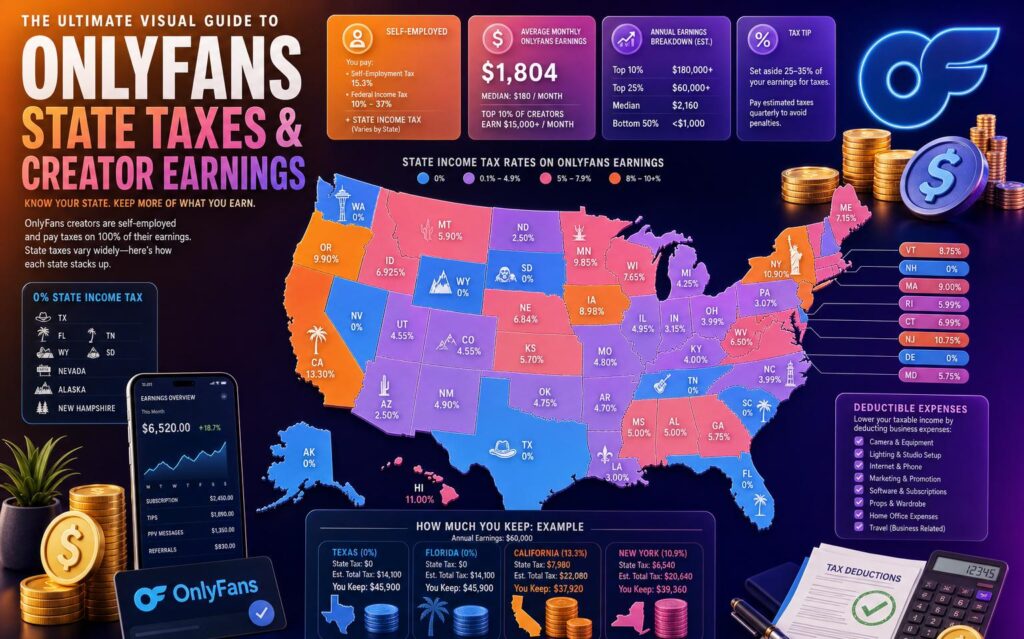
tax rates for self-employed individuals. California, for example, imposes a top marginal rate of 13.3%, which is the highest state income tax rate in the United States. A California-based OnlyFans creator earning $100,000 in net income could owe $10,000 to $13,000 in state income tax alone — on top of their federal obligation. Planning for this reality from the start of each year is essential.
How States Define and Tax Self-Employment Income
Most states that impose income tax apply it to all forms of income earned by residents, including self-employment income from content creation. Self-employment income means income earned by working for yourself rather than as an employee. For OnlyFans creators, this includes subscription revenue, tips, pay-per-view content sales, direct messages, and any other platform earnings. States generally calculate tax on net income — meaning gross OnlyFans earnings minus allowable deductions — though each state has its own rules about which deductions are permissible.
Which States Have No Income Tax? A State-by-State Breakdown for Creators
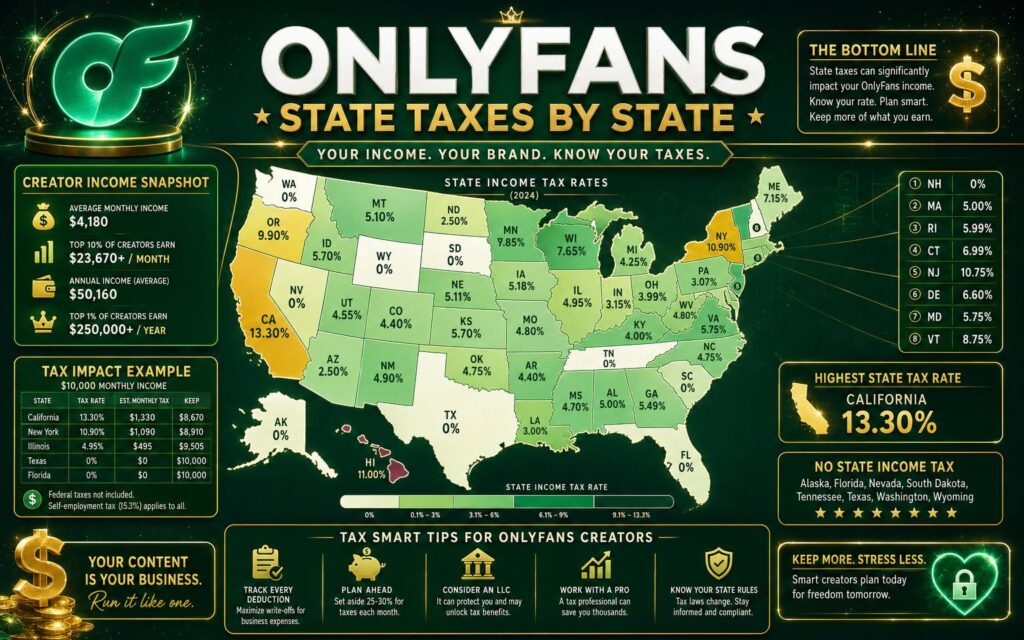
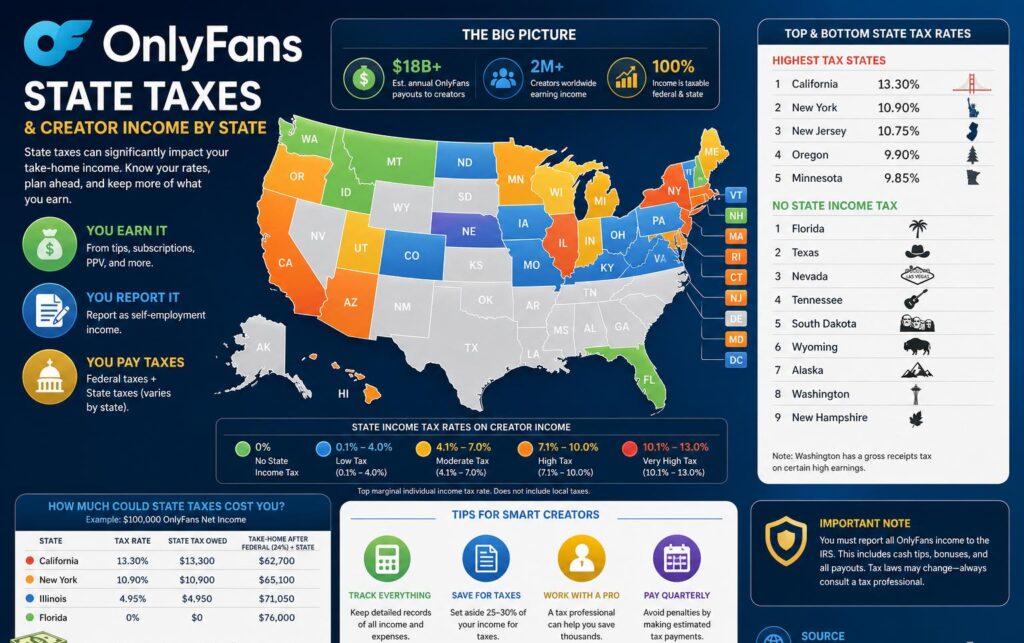
Nine US states currently impose no state income tax on earned income. Creators living in these states owe only federal taxes on their OnlyFans earnings — resulting in a significantly lower overall tax burden compared to high-tax states.
The Nine No-Income-Tax States
The following nine states do not impose a state income tax on personal income, including OnlyFans earnings: Alaska, Florida, Nevada, New Hampshire (no tax on earned income as of 2025), South Dakota, Tennessee (no tax on earned income), Texas, Washington, and Wyoming. Creators living in these states benefit considerably — a Florida creator earning $80,000 net pays zero in state income tax, while a California creator with the same earnings could owe $7,000 to $10,000.
However, moving to a no-tax state for tax purposes
is not as simple as updating your mailing address. Tranzesta.com States audit residency claims carefully, particularly for high-income individuals. You must establish genuine domicile — meaning a permanent primary home, a driver’s license, voter registration, and the majority of your time physically spent in the state. Attempting to claim Florida residency while primarily living in New York, for example, can result in a residency audit and back taxes owed to New York.
State Income Tax Rates: A Reference Table for OnlyFans Creators
The table below shows selected states and their income tax treatment for self-employed content creators. Rates shown are approximate top marginal rates for 2025 and are subject to change.
Common State Tax Mistakes OnlyFans Creators Make — and How to Avoid Them
State tax errors are surprisingly common among content creators — especially those who are new to self-employment or who have recently moved. These mistakes can trigger penalties, interest, and in some cases, multi-state audits. Here are the five most costly errors to avoid.
Mistake 1: Ignoring State Estimated Tax Payments
Most states that impose income tax also require self-employed individuals to make quarterly estimated state tax payments — similar to the IRS quarterly payment schedule. Creators who skip these payments face underpayment penalties when they file. For example, California requires quarterly estimated payments if your expected state tax liability exceeds $500. Missing those payments results in a 5% penalty on the underpaid amount, compounding quarterly. Set up a state estimated tax schedule at the start of each year, matching your federal quarterly payment dates.
Mistake 2: Claiming False Residency in a No-Tax State
Some creators hear that Florida or Texas has no income tax and simply update their mailing address — without genuinely relocating. This is a serious mistake. States like New York, California, and New Jersey aggressively audit residency claims. New York, in particular, applies a 183-day rule: if you spend more than 183 days per year in New York while also maintaining a permanent place of abode there, you owe New York state income tax regardless of where you claim to be domiciled. Fraudulent residency claims can result in back taxes, penalties, and interest going back multiple years.
Mistake 3: Failing to File in Multiple States After a Move
If you move from one state to another during a tax year, you typically owe state income tax in both states — as a part-year resident in each. Many creators either file only in their new state or only in their old state, creating a gap that can trigger a notice or audit. For example, a creator who lived in Texas for six months and then moved to California for the second half of the year owes California state tax on the income earned during the California residency period. Both part-year returns must be filed correctly.
Mistake 4: Overlooking City and Local Income Taxes
Several US cities impose their own local income taxes on top of state income tax. New York City residents pay an additional city income tax of up to 3.876% on top of the New York State rate. Philadelphia imposes a wage and earnings tax on self-employed individuals. Columbus, Cleveland, and other Ohio cities impose municipal income taxes. Creators living in these cities often do not realize the local obligation exists — especially if they are new to self-employment.
Mistake 5: Not Deducting State-Allowable Business Expenses
Most states that impose income tax allow self-employed individuals to deduct business expenses before calculating state taxable income. However, not every state conforms exactly to federal tax law. Some states do not allow the federal Section 199A QBI deduction. Others cap or modify depreciation deductions. Assuming that your federal deductions translate perfectly to your state return is an error. A creator tax specialist reviews state conformity rules and ensures you are claiming every allowable state deduction.
Step-by-Step Guide to Managing Your OnlyFans State Taxes by State
Take these concrete steps to bring your state tax obligations under control — whether you are filing for the first time or cleaning up a situation that has gotten complicated.
Step 1: Confirm Your State of Domicile
Your domicile is your permanent legal home — the state where you intend to live indefinitely. This is the state that has the primary right to tax your worldwide income. Confirm your domicile by reviewing where you have your driver’s license, voter registration, primary bank accounts, and the majority of your physical presence. If there is any ambiguity, work with a specialist to document your domicile clearly before a state tax authority raises the question first.
Step 2: Identify Your State’s Income Tax Rate and Rules
Look up your state’s current income tax rate for self-employed individuals. Determine whether your state uses graduated rates (tax brackets that increase at higher income levels) or a flat rate. Also confirm whether your state requires quarterly estimated payments and what the payment thresholds and deadlines are. Most state tax authorities publish this information on their official .gov websites.
Step 3: Set Aside State Tax Reserves Throughout the Year
Because OnlyFans income is not withheld, you must set aside state taxes yourself. A practical approach is to reserve a percentage of every payment received for state taxes. For high-tax states like California, New York, or New Jersey, a reserve of 10–13% of gross income is advisable. For flat-rate states like Illinois or Pennsylvania, 5–6% is typically sufficient. Open a dedicated savings account for tax reserves and do not touch it until payment time.
Step 4: Make Quarterly Estimated State Tax Payments
If your state requires quarterly estimated payments, set calendar reminders and pay on time. Most states align their quarterly deadlines roughly with the IRS schedule: April 15, June 15, September 15, and January 15. However, some states have slightly different dates — confirm your specific state’s schedule. Paying on time avoids underpayment penalties and prevents a large lump-sum bill at filing time.
Step 5: Track All Deductible Business Expenses
Your state taxable income starts with your federal Schedule C net income — which already reflects your allowable business deductions. However, review your state’s specific conformity rules. Some states add back deductions that are allowed federally but not at the state level. Keeping thorough records of all business expenses — equipment, software, platform fees, home studio costs, internet — ensures you start from the lowest possible taxable income figure at both the federal and state level.
Step 6: File Your State Return Accurately and On Time
Most states set the same filing deadline as the federal return: April 15. However, some states have different deadlines or extension rules. File your state return on time to avoid late-filing penalties. If you moved during the year, file part-year resident returns in each applicable state. If you have any uncertainty about multi-state filing obligations, consult a specialist before the deadline — not after.
OnlyFans State Taxes by State: Expert Tips for 2026
Here are the insider strategies that Tranzesta uses with content creator clients to manage state tax obligations efficiently and minimize unnecessary payments.
If You Are Considering Moving, Analyze the Tax Math First:
Moving from California to Texas on $100,000 net income saves roughly $10,000 to $13,000 in state income tax per year. Over five years, that is $50,000 to $65,000 — enough to justify significant relocation costs. Run the actual numbers with a specialist before deciding.
New York Creators: Document Your Days Carefully:
New York’s 183-day rule is aggressively enforced. If you travel frequently, keep a travel log that documents which days you spend outside New York. This log is your primary defense if the state ever questions your non-residency claim.
California Creators: Claim Every Allowable Deduction:
California is one of the highest-tax states in the USA, but it allows substantial deductions for self-employed individuals. Home office costs, equipment, internet, and professional services are all deductible. A specialist review of your California Schedule CA can uncover significant savings.
Check Your City or Municipality Too:
If you live in New York City, Philadelphia, Detroit, Columbus, or any other city with a local income tax, make sure you are filing and paying local returns as well. Many creators do not realize these obligations exist until they receive a notice.
Use a Business Bank Account to Simplify State Tax Documentation:
Separating business and personal finances makes it dramatically easier to calculate your state net income, track deductible expenses, and respond to any state-level inquiry. This one step reduces bookkeeping time and protects your deductions.
Plan Your Quarterly State Payments Around Your Peak Earning Months: Many creators earn more in certain months — for example, around holidays or after a major promotion. If your income is seasonal, work with a specialist to front-load estimated payments in high-earning quarters and reduce them in slower periods, avoiding both underpayment penalties and cash flow crunches.
For authoritative IRS guidance on self-employment income and federal tax obligations for creators, visit IRS.gov — Self-Employed Individuals Tax Center
Conclusion: Know Your State, Know Your Obligation, Keep More of Your Money
The three most important takeaways from this guide are clear. First, OnlyFans state taxes by state vary enormously — nine states impose no income tax at all, while others charge rates as high as 13.3%. Where you live has a direct and significant impact on your total tax bill. Second, state taxes are not withheld from your OnlyFans earnings, which means the responsibility to track, reserve, and pay them falls entirely on you. Third, multi-state situations — from mid-year moves to false residency claims — are among the most costly and legally risky errors a creator can make.
Whether you live in a no-tax state and simply want
to confirm your situation, or you are navigating a high-tax state like California or New York and want to minimize your liability within the law, the right tax expertise pays for itself many times over.
Ready to get expert help? Email us at hello@tranzesta.com or visit Tranzesta.com to schedule your free tax strategy session today.
FAQs
Yes, OnlyFans creators must pay state income tax in most US states. Because OnlyFans creators are classified as self-employed, their earnings are subject to state income tax just like any other form of self-employment income. However, nine states — including Florida, Texas, Nevada, and Washington — have no state income tax, meaning creators in those states owe zero state income tax on their OnlyFans earnings. In all other states, creators must file a state return and pay the applicable tax rate on their net business income.
The best US states for OnlyFans creators from a tax perspective are those with no state income tax: Alaska, Florida, Nevada, New Hampshire, South Dakota, Tennessee, Texas, Washington, and Wyoming. Among these, Florida and Texas are the most popular relocation destinations for creators because they combine no state income tax with large populations and established creator communities. However, establishing legitimate residency — with a real physical presence, driver’s license, and voter registration — is required to benefit from a no-tax state.
The amount an OnlyFans creator should set aside for state taxes depends entirely on their state of residence and income level. Always calculate reserves based on net income after deductions and consult a tax specialist for precision.
Yes, most states require self-employed individuals — including OnlyFans creators — to make quarterly estimated state tax payments if their expected annual state tax liability exceeds a threshold set by the state. For California, the threshold is $500. For New York, it is $300. Missing quarterly state estimated payments results in underpayment penalties and interest. Payment deadlines generally align with the IRS schedule: mid-April, mid-June, mid-September, and mid-January. Confirm your specific state’s thresholds and due dates on your state’s official tax authority website.
If an OnlyFans creator moves from one state to another during the tax year, they typically owe state income tax in both states as a part-year resident. Each state taxes only the income earned during the period of residency in that state. The creator must file a part-year resident return in each applicable state, allocating income between the two residency periods. Failing to file in both states can trigger notices, penalties, and interest. A content creator tax specialist can prepare both part-year returns accurately and ensure no obligation is missed.