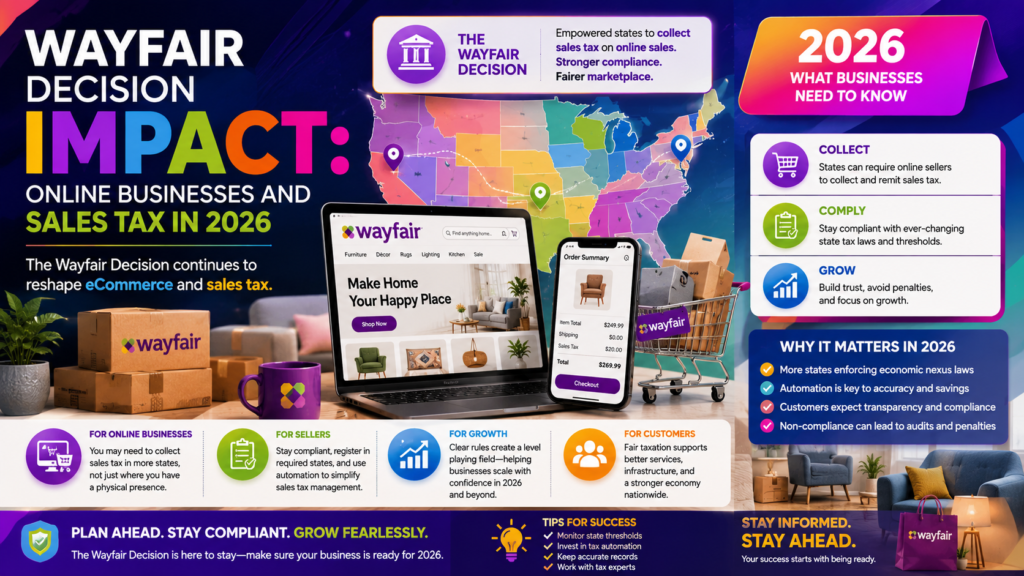
Before June 2018, millions of online businesses across
the United States operated under one simple assumption: if you had no physical office, warehouse, or employee in a state, you owed that state no sales tax. One Supreme Court decision — South Dakota v. Wayfair, Inc. — erased that assumption permanently. Understanding the Wayfair decision online business sales tax impact is now a baseline requirement for every US e-commerce seller, digital product creator, SaaS company, and online service provider.
In this guide, you will learn exactly what the Wayfair ruling changed,
how economic nexus works in 2026, which states present the greatest compliance risks, the most dangerous mistakes online businesses make, and a step-by-step action plan to get and stay compliant. Whether you sell physical goods, digital downloads, or online services, this resource gives you the complete picture.
What Is the Wayfair Decision and How Does It Affect Online Business Sales Tax?
The Wayfair decision — formally South Dakota v. Wayfair, Inc., decided by the US Supreme Court on June 21, 2018 — held that states can require out-of-state online sellers to collect and remit sales tax even without physical presence in that state. This ruling overturned the longstanding physical presence rule established by Quill Corp. v. North Dakota (1992) and fundamentally changed how online business sales tax works across all 50 states.
For online businesses,
this means that crossing a state’s economic nexus threshold — typically $100,000 in sales or 200 transactions in a state per year — creates a legal obligation to collect sales tax there, regardless of where the business is located. In 2026, all 45 states with a statewide sales tax enforce some version of economic nexus rules based on the Wayfair framework.
What Was the Physical Presence Rule Before Wayfair?
Before the Wayfair ruling, the physical presence standard from Quill Corp. v. North Dakota protected remote sellers from collecting sales tax in states where they had no tangible presence. A business needed an office, warehouse, employees, or inventory in a state before that state could impose a collection obligation. This rule was established in an era of mail-order catalogs and telephone sales — long before e-commerce became a multi-trillion-dollar industry in the United States.
The result was a massive competitive imbalance.
Brick-and-mortar stores collected sales tax on every transaction, while online competitors frequently did not — effectively giving large online retailers a built-in price advantage of 5% to 10% on every sale. States estimated losing more than $13 billion annually in uncollected sales tax by 2017, which directly motivated South Dakota’s legal challenge and ultimately the Supreme Court’s 5-4 ruling.
Why the Wayfair Ruling Still Matters in 2026
Many online business owners mistakenly believe the Wayfair decision is old news. In reality, 2026 presents a more complex compliance environment than ever before. States have spent eight years refining their economic nexus rules, lowering thresholds, expanding taxable product categories, and increasing audit activity. Additionally, the IRS and state tax agencies are now using sophisticated data-matching tools — including third-party payment platform data — to identify non-compliant sellers. Ignoring Wayfair in 2026 is riskier than it was in 2018.
How Does Wayfair Economic Nexus Work for Online Businesses in 2026?
Economic nexus — the standard created by the Wayfair decision — means that an online business creates a sales tax collection obligation in a state by exceeding a specified level of economic activity there, with no physical presence required. Each state sets its own threshold, measurement period, and taxable product definitions.
The Standard $100,000 / 200-Transaction Threshold
The most widely adopted threshold across the United States is $100,000 in gross sales OR 200 separate transactions in a state during the prior or current calendar year — the same model South Dakota used in the law that prompted the Wayfair case. States using this standard include Florida, Illinois, Ohio, Colorado, Michigan, Georgia, and dozens more. Once either threshold is crossed, the obligation to register, collect, and remit sales tax begins — usually from the next transaction or the first day of the following month, depending on the state.
States With Modified or Stricter Thresholds
Several significant states deviate from the standard model in ways online sellers frequently overlook:
California: $500,000 in sales only — no transaction threshold. Largest e-commerce market in the USA.
New York: $500,000 AND 100 transactions — both conditions must be met simultaneously.
Texas: $500,000 in sales only — transaction threshold eliminated in 2020.
Kansas: Economic nexus applies to ANY level of sales — no minimum threshold as of 2021.
Alaska: No statewide sales tax but 100+ local jurisdictions apply the Alaska Remote Seller Sales Tax Code ($100,000 / 200 transactions).
Montana, Oregon, New Hampshire, Delaware: No statewide sales tax — no economic nexus concern at the state level.
Therefore, a small online business with $150,000 in total US annual sales could easily be compliant in California and New York but legally required to collect sales tax in 30 or more other states. This asymmetry is one of the most common sources of unintentional non-compliance for growing online businesses in 2026.
Taxability of Digital Products and Services After Wayfair
The Wayfair decision created nexus obligations — but taxability rules determine what you actually collect. Not all products and services are taxable in every state, even if you have nexus there. Physical goods are generally taxable with exemptions for groceries, clothing, and prescription drugs in select states. Digital products — including e-books, software, online courses, streaming subscriptions, and downloadable templates — are taxable in some states and exempt in others. Services are generally not taxable in most US states, but there are significant exceptions, particularly for software-as-a-service (SaaS), information services, and digital advertising in states like Texas, New York, and Washington.

Common Mistakes Online Businesses Make After the Wayfair Decision
Eight years after the Wayfair ruling, online businesses in the United States still make the same preventable compliance errors. These mistakes generate back-tax assessments, interest, and penalties that often dwarf the original tax liability.
Mistake 1: Assuming the Ruling Only Affects Large Businesses
Many small online sellers assume the Wayfair decision only applies to large retailers like Wayfair, Amazon, or major e-commerce brands. This is incorrect. The $100,000 / 200-transaction threshold is low enough that a part-time Etsy seller, a freelance digital product creator, or a small Shopify store can easily trigger nexus in multiple states within a single year. Additionally, the threshold applies per state — so a business with $20,000 in sales to 10 different states is still obligated wherever it crosses that state’s threshold.
Mistake 2: Not Tracking Sales by Destination State
To know when you cross an economic nexus threshold, you must track gross sales by the customer’s destination state — not by your location. Many online businesses track total revenue but do not provide state-by-state breakdowns. As a result, they cross thresholds in multiple states simultaneously without realizing it and accumulate months of uncollected tax liability. Most major e-commerce platforms — Shopify, WooCommerce, BigCommerce, Squarespace — provide destination-based sales reports, but they must be enabled and reviewed regularly.
Mistake 3: Relying on Marketplace Facilitator Rules Without Verification
Most US states have enacted marketplace facilitator laws that require large platforms like Amazon, Etsy, and eBay to collect and remit sales tax on behalf of third-party sellers. Many small sellers assume this means they have zero sales tax obligations. However, marketplace facilitator rules typically only cover sales made through that specific platform. Sales made through the seller’s own website, direct invoicing, or other platforms remain the seller’s responsibility entirely. Mixing marketplace and direct sales without tracking them separately is a common compliance failure.
Mistake 4: Registering in the Wrong States or With the Wrong Information
When businesses do attempt to register for sales tax permits after the Wayfair ruling, they sometimes register in states where they do not actually meet the threshold — while missing states where they genuinely have nexus. Additionally, registering with incorrect business information, the wrong business entity type, or an incomplete description of products sold can lead to misclassification of taxable versus exempt products and inaccurate remittances. Every registration requires careful verification of thresholds before proceeding.
Mistake 5: Filing Returns Without Accounting for Local Tax Rates
Many online sellers collect only the state-level sales tax rate and remit that amount — completely overlooking local county, city, and special district rates stacked on top. In states like Louisiana (300+ local jurisdictions), Colorado (hundreds of home-rule municipalities with independent tax rates), and California (combined state and local rates ranging from 7.25% to 10.75%), this omission leads to significant underpayment and audit exposure. Accurate rate calculation requires address-level precision, not state-average estimates.
How to Comply With Wayfair Decision Online Business Sales Tax Rules: Step-by-Step
Getting compliant after the Wayfair decision requires a deliberate, documented process — not a rushed reaction when a state sends a notice. Follow these steps to build a defensible, sustainable sales tax compliance program.
Step 1: Run a Multi-State Nexus Analysis
Pull your sales data from every selling channel — your website, marketplace platforms, invoicing software, and payment processors — and sort gross revenue by customer destination state for the past 12 to 24 months. Compare your sales volume in each state against that state’s economic nexus threshold. Tranzesta.com Flag every state where you have already crossed the threshold and every state where you are within 20% of it. This nexus analysis is the non-negotiable first step in any Wayfair compliance program.
Step 2: Analyze Taxability of Your Products in Each Nexus State
Nexus tells you where you must register — taxability tells you what you must collect. Before registering in a state, confirm that your specific products or services are actually taxable there. For example, if you sell online courses, confirm whether that state taxes digital educational content. If you sell SaaS software subscriptions, check whether the state taxes electronically delivered software. Taxability analysis must happen product by product and state by state — there is no universal rule.
Step 3: Determine Whether Past Liability Exists and Consider Voluntary Disclosure
If your nexus analysis shows you should have been collecting sales tax in prior years, you have retroactive liability. Most US states offer a Voluntary Disclosure Agreement (VDA) program that limits the look-back period to three or four years, waives penalties, and sometimes reduces interest for sellers who come forward proactively. Filing a VDA before a state contacts you is almost always less expensive than defending an audit. Contact a sales tax specialist before approaching any state on your own.
Step 4: Register for Sales Tax Permits in All Current Nexus States
Once you have completed your nexus and taxability analysis, register for a sales tax permit — sometimes called a seller’s permit or certificate of authority — in every state where you have current nexus and taxable sales. Most states offer online registration through their Department of Revenue website. Registration is typically free or costs less than $100. Do not begin collecting sales tax before your registration is approved, as doing so without a valid permit is illegal in most states.
Step 5: Configure Your Selling Platform for Address-Level Rate Accuracy
Connect your e-commerce platform, invoicing software, or POS system to a sales tax rate engine that calculates combined state, county, city, and special district rates at the buyer’s delivery address. Tools like TaxJar, Avalara, and Vertex integrate with Shopify, WooCommerce, BigCommerce, and most major platforms. Manual rate lookups using state-average rates are not accurate enough for multi-jurisdiction compliance. Set up automated rate calculation before your next sale in a newly registered state.
Step 6: File Returns Accurately and on Time in Every State
Each state assigns a filing frequency — monthly, quarterly, or annually — based on your sales volume in that state. Mark every deadline on a compliance calendar. Even if you collected zero sales tax in a period, most states require you to file a zero return to keep your permit active. Late or missed returns trigger automatic penalties and interest that accumulate quickly across multiple states. Consider using a sales tax compliance service or software to automate filing if you are registered in more than five states.
Step 7: Monitor Thresholds and Law Changes Quarterly
The Wayfair landscape continues to evolve. States modify thresholds, expand taxable product categories, and update their marketplace facilitator rules regularly. Review your state-by-state sales totals at least quarterly. Subscribe to state revenue department updates for every state where you are registered or approaching nexus. If your business grows rapidly — through a viral product, new marketing channel, or seasonal spike — re-run your nexus analysis immediately rather than waiting for year-end.
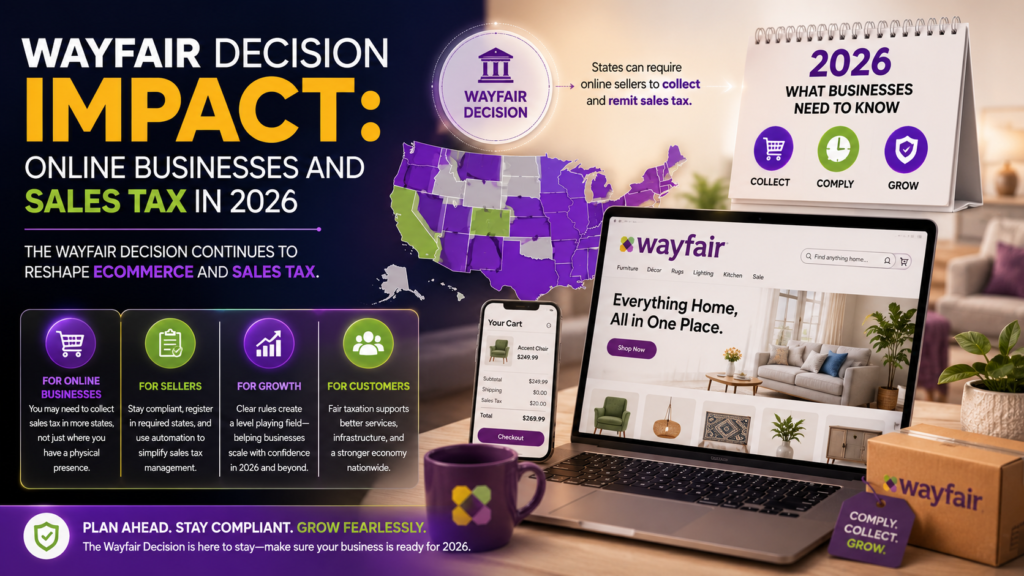
Wayfair Decision Online Business Sales Tax: Expert Tips for 2026
These advanced strategies from Tranzesta’s tax team help online businesses minimize risk, reduce compliance costs, and build scalable sales tax programs in the post-Wayfair environment:
Prioritize high-risk states first. California, Texas, New York
Florida, and Illinois represent the largest e-commerce markets in the United States — and the greatest audit risk for non-compliant sellers. If you can only address nexus in a few states at a time, start with these five.
Use the VDA window proactively.
Many online sellers have years of unaddressed Wayfair liability sitting on their books. The VDA programs in most states offer meaningful penalty abatement — but only before the state initiates an audit. Every month you wait narrows your options and increases your exposure.
Separate marketplace sales from direct sales in your records from day one.
Marketplace facilitator rules protect you for Amazon or Etsy sales but not for your own website. Keeping these streams clearly separated in your bookkeeping prevents double-counting and ensures you accurately identify where your direct-sale nexus obligations lie.
If you sell internationally and ship to US customers, Wayfair applies to you.
Non-US businesses selling to American consumers are subject to the same economic nexus rules as US-based sellers. Many international brands discovered this only after receiving multi-state audit notices.
Review your product taxonomy annually.
States regularly expand their list of taxable digital goods and services. A product that was exempt in a state last year may be taxable this year. Annual taxability reviews are as important as annual nexus studies.
Consider the total cost of non-compliance before deciding to delay registration.
Back taxes plus penalties plus interest — calculated daily in many states — can easily equal 30% to 50% of the original uncollected tax amount over three years. For high-volume sellers, this compounds into six-figure liabilities quickly.
Conclusion
The three most important takeaways from this guide are: first, the Wayfair decision permanently replaced physical presence with economic nexus as the standard for online business sales tax obligations across all 45 US sales tax states; second, every online seller must know their state-by-state sales volumes and compare them against each state’s specific threshold — there is no single national rule; and third, retroactive liability is real and growing, but Voluntary Disclosure Agreement programs offer a meaningful resolution path for businesses that act before a state reaches out first.
Additionally, taxability — not just nexus
determines what you collect, and the rules differ by product type and state. Building a compliant, scalable sales tax program in 2026 requires a nexus study, taxability analysis, accurate rate configuration, and disciplined ongoing monitoring.
Ready to get expert help with your Wayfair decision sales tax compliance? Email us at hello@tranzesta.com or visit Tranzesta.com to schedule your free tax strategy session today. Tranzesta’s US business tax team is ready to help you get compliant, protect your business, and keep growing with confidence.
FAQs
The Wayfair decision — South Dakota v. Wayfair, Inc. (2018) — changed online business sales tax by replacing the physical presence rule with economic nexus. Before the ruling, an online business only owed sales tax in states where it had offices, warehouses, or employees. After the ruling, online businesses must collect sales tax in any state where they exceed that state’s economic nexus threshold — typically $100,000 in sales or 200 transactions per year — regardless of whether they have any physical presence in that state.
Yes, the Wayfair decision applies to small online businesses in the United States. The economic nexus thresholds are low enough — most commonly $100,000 in sales or 200 transactions per state per year — that small e-commerce stores, digital product sellers, Etsy shops, and solo online service providers can easily trigger obligations in multiple states within a single tax year. There is no small-business exemption from economic nexus rules under the Wayfair framework, though some states have small-seller safe harbors at lower thresholds.
If you sell exclusively through a registered marketplace facilitator such as Amazon or Etsy, the platform is typically required to collect and remit sales tax on your behalf in most US states under marketplace facilitator laws. As a seller, you generally have no additional sales tax collection obligation for those marketplace sales. However, if you also sell directly through your own website, independent store, or other channels, those direct sales are your responsibility — and the Wayfair economic nexus thresholds apply to your combined sales activity.
A Voluntary Disclosure Agreement (VDA) for sales tax is a formal program offered by most US states that allows businesses with unregistered, unreported sales tax liability to come forward proactively and settle their obligations on favorable terms. VDAs typically limit the look-back period to three or four years, waive civil penalties, and sometimes reduce interest. The VDA option is only available if the seller initiates contact before the state opens an audit or sends a notice. After the Wayfair ruling, VDAs became one of the most important tools for online businesses resolving retroactive nexus exposure.
Whether digital products and services are taxable after the Wayfair decision depends entirely on the state where your customer is located. The Wayfair ruling created nexus obligations for remote sellers but did not change taxability rules. Some states tax digital downloads, SaaS subscriptions, and online services — including Texas, Pennsylvania, Washington, and New York. Other states exempt these categories. A business that has economic nexus in a state must then separately determine whether its specific digital products or services are taxable there before collecting sales tax.