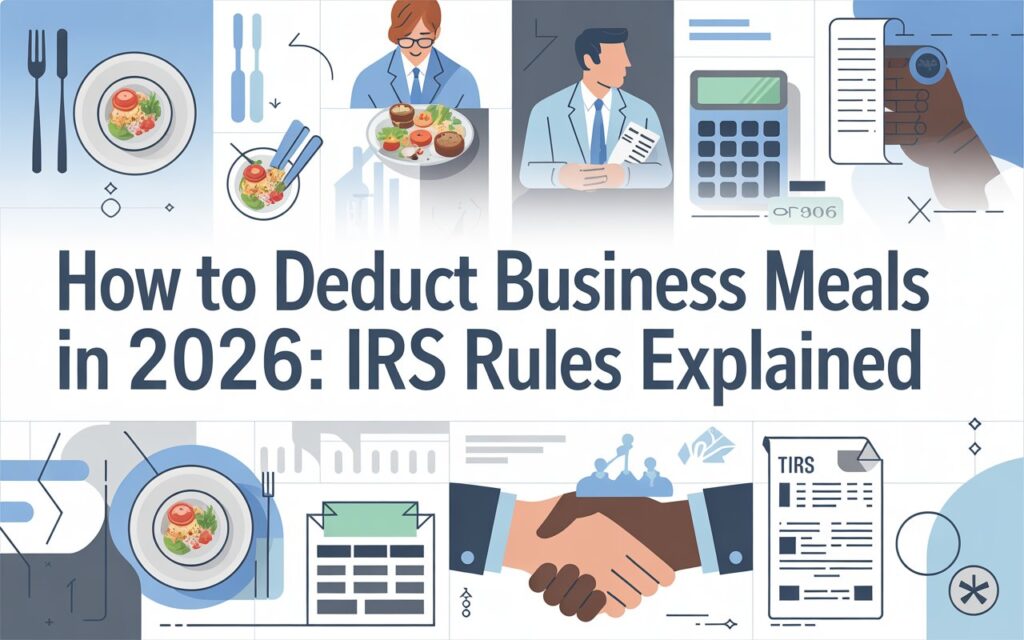
Every dollar counts when you run your own business.
Yet millions of US taxpayers leave legitimate meal deductions on the table each year — simply because the rules are confusing. Understanding how to deduct business meals under the 2026 IRS rules can meaningfully reduce your tax bill, whether you are a self-employed freelancer, a cannabis business owner, an OnlyFans creator, or a small-business entrepreneur.
The Tax Cuts and Jobs Act (TCJA) of 2017 eliminated most entertainment deductions and slashed meal deductions to 50 percent in most cases. However, meals are not deducted as a meal. The rules are strict, and documentation matters. In this guide, you will learn exactly which meals qualify, how much you can deduct, what records you must keep, and how to avoid the costly mistakes that trigger IRS audits.
What Does It Mean to Deduct Business Meals Under IRS Rules?
Deducting business meals means reducing your taxable income by the cost of qualifying meals that have a legitimate business purpose. The IRS allows this deduction under IRC Section 162, which covers ordinary and necessary business expenses. However, every qualifying meal must pass specific tests before it can be written off.
For US taxpayers, the current deduction rate for most business meals is 50 percent of the actual cost. That means if you spend $100 on a qualifying client dinner, you may deduct $50 from your taxable income. A narrow set of situations still allows a 100-percent deduction, which we will cover shortly.
Why This Matters for Self-Employed Individuals and Small Businesses
If you are self-employed, a gig worker, a content creator, or an independent consultant, you report income and expenses on Schedule C. Every valid deduction lowers your adjusted gross income, which in turn reduces both income tax and self-employment tax. At a 15.3-percent self-employment tax rate, even a few hundred dollars in additional meal deductions can save you real money.
Cannabis business owners face an additional layer of complexity. Because of IRC 280E, cannabis businesses cannot deduct most ordinary business expenses — but Cost of Goods Sold (COGS) remains deductible. Meal expenses for cannabis businesses generally fall outside COGS, making them largely non-deductible. Speak with a tax professional before claiming any meal deductions if your business operates in the cannabis sector.
The Ordinary and Necessary Standard
The IRS requires that every business meal expense be ‘ordinary and necessary.’ Ordinary means the expense is common and accepted in your industry. Necessary means it is helpful and appropriate for your trade or business. A dinner with a prospective client to discuss a new contract easily meets this standard. A lunch you grab alone at your desk typically does not.
2026 IRS Rules: What Business Meals Can You Deduct?
The IRS currently allows a 50-percent deduction for most qualifying business meal expenses. However, several categories remain fully deductible at 100 percent. Knowing which category your meal falls into is critical for accurate tax reporting.
Here is a breakdown of the key deduction rates under the 2026 IRS rules:
50% deductible: Client meals and meals with business associates where business is discussed
50% deductible: Meals while traveling overnight for business
50% deductible: Meals provided for the employer’s convenience on business premises (after the TCJA transition period)
100% deductible: Meals provided as taxable compensation to employees
100% deductible: Meals sold to customers (for example, a catering business or food truck)
100% deductible: Meals at company events open to all employees, such as a holiday party or company picnic
The Five Requirements Every Meal Must Meet
The IRS imposes five tests for a business meal to qualify as a deductible expense. All five must be satisfied simultaneously.
The expense must be ordinary and necessary for your trade or business.
The meal must not be lavish or extravagant under the circumstances.
You or one of your employees must be present at the meal.
The meal must be with a current or prospective business contact — such as a client, customer, employee, partner, or professional advisor.
Business must be discussed before, during, or after the meal — not just coincidentally.
Meeting all five criteria is non-negotiable. Failing even one can cost you the entire deduction for that meal.
What About Solo Meals?
The IRS generally does not allow a deduction for meals eaten alone, with the exception of meals consumed while traveling away from home overnight for business purposes. If you travel to a conference in another city, your dinner at the hotel restaurant qualifies at the 50-percent rate — even if you eat alone. However, a solo lunch in your home city at your usual diner does not qualify.
Common Mistakes That Get Business Meal Deductions Rejected
The IRS scrutinizes meal deductions closely because they are frequently abused. Even honest mistakes can trigger an audit or the disallowance of your entire deduction. Avoid these five pitfalls.
Mistake 1: Deducting Entertainment Along With Meals
Before the TCJA, you could bundle entertainment and meal costs into a single 50-percent deduction. That changed in 2018. Entertainment expenses — tickets to sporting events, concerts, or golf outings — are no longer deductible at all. If you take a client to a ball game and then to dinner, only the separately stated meal cost qualifies. Never combine entertainment and meal costs on a single receipt or invoice.
Mistake 2: Failing to Keep Contemporaneous Records
The IRS requires that you document meals at the time they occur — or close to it. Recreating records months later from memory is a major red flag. Your documentation must include: the amount spent, the date and location, the business purpose, and the names and business relationship of every person present. Without contemporaneous records, your deduction is vulnerable.
Mistake 3: Claiming Meals Without a Documented Business Purpose
Picking up lunch with a friend who happens to be a client is not automatically deductible. The business purpose must be real and documented. Simply writing ‘client lunch’ on a receipt is not sufficient. Your notes should describe what business topics were discussed or what specific deal, project, or proposal was on the agenda.
Mistake 4: Treating Lavish Meals as Fully Deductible
The IRS will disallow portions of a meal expense that it considers extravagant. There is no specific dollar cap in the tax code, but meals that far exceed what is reasonable for the business context attract scrutiny. A $500 dinner for two with premium wine pours may invite questions that a $90 working lunch would not.
Mistake 5: Confusing 50% and 100% Categories
Many taxpayers incorrectly deduct an employee holiday party at 50 percent when it qualifies at 100 percent, or claim office snacks at 100 percent when they are only 50-percent deductible. Misclassifying the deduction rate can result in underpayment of taxes — or, if overclaimed, a balance due plus penalties. Always verify the correct rate for each meal category.
Step-by-Step: How to Deduct Business Meals Correctly in 2026
Following a consistent process for every business meal removes guesswork at tax time and protects you in the event of an IRS audit. Here are seven steps to deduct business meals the right way.
Step 1: Confirm the Meal Qualifies
Before you even order, ask yourself: Is there a genuine business purpose? Is a current or prospective business contact present? Will I be able to document what was discussed? If the answer to any of these is no, do not plan to deduct the meal.
Step 2: Keep the Original Receipt
Always request an itemized receipt that shows individual food and beverage items. Credit card statements alone are not sufficient — the IRS wants itemized proof. Photograph or scan the receipt immediately. Thermal paper receipts fade quickly.
Step 3: Record the Business Details on the Spot
Immediately after the meal, write down — in a log, note-taking app, or on the back of the receipt — the names of all attendees, their company and title, and the specific business topic discussed. Apps like Expensify or Wave can streamline this process for the self-employed.
Step 4: Separate Meals From Entertainment
If the evening involved both a meal and entertainment — say, dinner followed by a basketball game — make sure the restaurant receipt is completely separate from the entertainment cost. Only the meal portion is deductible. Pay for each component separately whenever possible.
Step 5: Apply the Correct Deduction Rate
Determine whether the meal is 50-percent or 100-percent deductible based on the categories outlined earlier. If you are unsure, default to 50 percent and consult a tax professional before filing.
Step 6: Enter the Expense in Your Accounting Records
Record the expense promptly in your bookkeeping software — QuickBooks, FreshBooks, or a spreadsheet — categorized as ‘Meals & Entertainment (Business).’ Flag the deduction rate at the time of entry so there is no confusion at year-end.
Step 7: Deduct on the Correct Tax Form
Self-employed individuals deduct business meals on Schedule C, Line 24b. C-corporations deduct them on Form 1120. S corporations and partnerships pass them through to owners via Schedule K-1. Employees who are not reimbursed by their employer cannot deduct unreimbursed meal expenses under current law — the TCJA suspended the miscellaneous itemized deduction through 2025, with no restoration yet enacted for 2026.
📋 Need Help Tracking Business Meal Deductions?
Tranzesta’s bookkeeping and tax team can set up a meal expense tracking system tailored to your business — and make sure every qualifying dollar is captured at tax time.
Contact us at hello@tranzesta.com for a free consultation.
Deduct Business Meals 2026 IRS Rules: Expert Tips to Maximize Your Deduction
Following the baseline rules is the minimum. These expert strategies help you build a stronger, more defensible position — and capture more of the deductions you are entitled to.
Use a dedicated business
credit card for all meal expenses. This creates a clean audit trail that separates personal and business spending automatically.
Photograph receipts with
a receipt management app immediately. Never rely on paper receipts — they fade within months.
Schedule recurring client
meals as calendar events and include the business agenda in the calendar notes. This contemporaneous documentation is powerful in an audit.
For meals while traveling,
keep your boarding passes, hotel receipts, and conference agendas together with your meal receipts to establish the business travel context.
If you host a meal for all
employees — even just two people — document it as a company event to potentially qualify for the 100-percent deduction rate.
Review your deduction
categories each year. Tax law changes — what was 50 percent last year may be 100 percent this year, or eliminated.
Additionally, US taxpayers who are sole proprietors should remember that meal deductions reduce self-employment income, which lowers both federal income tax and the 15.3-percent self-employment tax. This dual benefit makes legitimate meal deductions especially valuable for the self-employed.
For content creators who regularly collaborate with brand partners, attend industry events, or entertain collaborators, meal expenses can add up to thousands of dollars annually. Tranzesta helps creators in the United States identify and document every qualifying meal so none of that potential deduction goes to waste.
Conclusion: Know the Rules, Keep the Records, Claim the Deduction
deduct business meals 2026 IRS rules
one of the most valuable — and frequently mishandled — deductions available to US taxpayers in 2026. The three most important takeaways from this guide are:
Most qualifying business meals are 50-percent deductible; a narrow set of situations qualifies for 100 percent.
Documentation is everything — record the amount, date, location, attendees, and business purpose for every meal at the time it occurs.
Entertainment expenses are no longer deductible and must be kept completely separate from meal costs.
The IRS does not make these rules simple. But with the right systems and the right advisor, you can claim every dollar you are owed without fear of audit.
Ready to get expert help with your business meal deductions?
Email us at hello@tranzesta.com or visit Tranzesta.com to schedule your free tax strategy session today.
FAQs
Business meal deductions in 2026 are generally limited to 50 percent of the qualifying cost. However, 100-percent deductions apply in specific situations: meals treated as taxable compensation to employees, meals sold to customers as part of your business, and meals at company events such as an annual holiday party that are open to all employees. Most client dinners and working lunches fall under the 50-percent rule.
The IRS requires contemporaneous records for every business meal deduction. Your documentation must include the total amount spent, the date and location of the meal, the business purpose of the meal, and the names and business relationships of all people present. Keep itemized receipts — not just credit card statements — and record the business context as close to the meal as possible. Logs maintained in apps like Expensify or a simple notes document also work.
Yes. Self-employed individuals in the United States can deduct qualifying business meals on Schedule C of their federal tax return, typically at 50 percent of the meal cost. The meal must meet all IRS requirements: a business purpose, an attendee who is a business contact, and proper documentation. Solo meals are generally not deductible unless you are traveling away from home overnight for business. These deductions reduce both income tax and self-employment tax.
Yes. Meals with employees, co-owners, or business partners are deductible at 50 percent when there is a genuine business purpose discussed during or in association with the meal. Simply socializing with a business partner does not qualify. A working dinner where you discuss a project timeline, a contract, or a business strategy does qualify — provided you document the business topics covered and keep an itemized receipt.
The Tax Cuts and Jobs Act of 2017 eliminated the deduction for entertainment expenses, effective for tax years beginning after December 31, 2017. Entertainment costs — such as tickets to sporting events, theater, or golf — are no longer deductible, even if they include business discussion. However, meal costs that are separately stated and billed apart from entertainment remain 50-percent deductible. Always separate your meal receipt from any associated entertainment costs and pay for them independently.
One Response