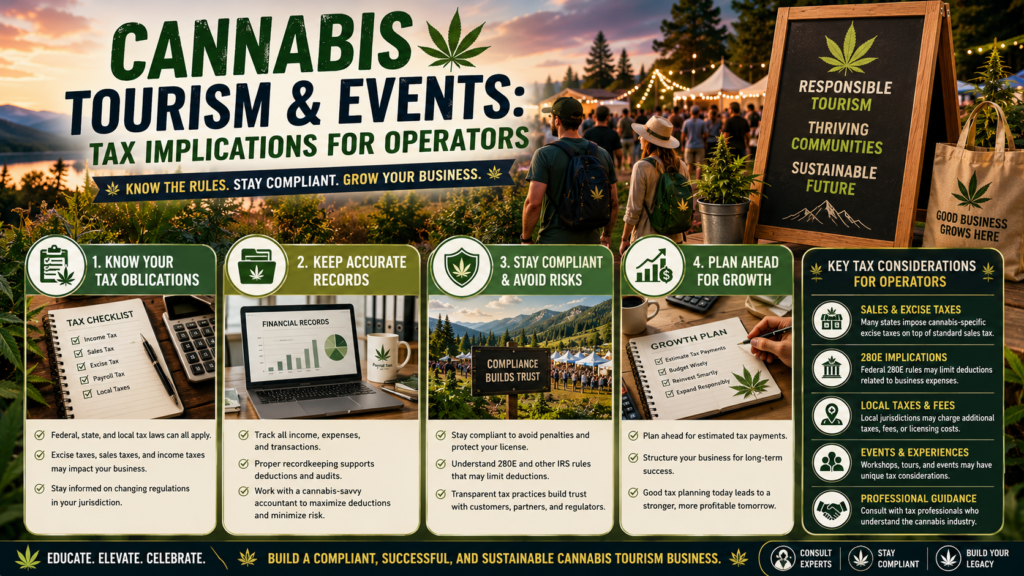
The cannabis industry is booming
and so is cannabis tourism. Festivals, cannabis-friendly hotel packages, consumption lounges, and farm tours are drawing millions of visitors across the United States every year. However, navigating the cannabis tourism events tax implications that come with running these experiences is one of the most complex challenges operators face today.
If you run a cannabis event, host a consumption lounge,
or operate a cannabis tourism business in the USA, you are subject to a layered web of federal, state, and local tax obligations that differ dramatically from any other hospitality business. From the notorious IRC Section 280E at the federal level to state-specific cannabis excise taxes, sales taxes, and special event permits, the tax burden is significant — and the mistakes are costly.
In this guide, you will learn exactly what taxes apply to cannabis tourism and event operators, the most common compliance mistakes, a step-by-step approach to tax planning, and how Tranzesta helps cannabis business owners stay compliant and profitable. Let’s dive in.
What are the Cannabis Tourism Events Tax Implications?
Cannabis tourism events tax implications refer to all of the federal, state, and local tax obligations that arise specifically when a cannabis business hosts, sponsors, or operates tourism-related activities — including festivals, consumption lounges, guided farm tours, cannabis-infused dining events, or cannabis-friendly lodging packages.
These implications go far beyond ordinary event tax rules. Cannabis operators face the dual burden of being a regulated hospitality business and a cannabis seller. That means every dollar of revenue — from ticket sales to cannabis product sales at an event — must be tracked and reported under multiple overlapping tax frameworks.
Why This Matters for Cannabis Business Owners
Unlike a concert promoter or hotel owner, a cannabis event operator cannot simply deduct ordinary business expenses on their federal return. Under Internal Revenue Code Section 280E, cannabis businesses are prohibited from deducting most operating expenses because cannabis remains a Schedule I controlled substance under federal law. This rule can raise effective federal tax rates to 70% or higher for some operators.
Additionally, a cannabis tourism event typically generates multiple revenue streams — merchandise, food and beverage, entertainment, and cannabis product sales — each of which may be taxed differently under state law. Operators who fail to track these streams separately often end up overpaying taxes or, worse, triggering audits.
Who Is Affected by These Tax Rules?
These tax rules apply to any US-based cannabis business operator involved in:
Cannabis festivals and outdoor consumption events
Cannabis-themed hotel or resort packages
Cannabis farm tours and “bud and breakfast” accommodations
Consumption lounges and social consumption spaces
Cannabis cooking classes, pairing dinners, or wellness retreats
Pop-up cannabis retail events and vendor markets
If your business falls into any of these categories, understanding your full tax exposure is critical before your next event date.
Key Federal and State Tax Rules for Cannabis Tourism Event Operators
The tax framework for cannabis tourism events is built on several distinct layers. Understanding each layer is essential for accurate filing and cost control.
IRC Section 280E: The Federal Tax Penalty
Section 280E of the Internal Revenue Code is the single most impactful federal tax rule for cannabis operators. This provision disallows any deduction or credit for expenses paid or incurred in a business that “consists of trafficking in controlled substances” — which includes cannabis under federal law.
For cannabis tourism events, this means you generally cannot deduct:
Event venue rental fees
Staff wages for non-COGS activities (marketing, sales, management)
Advertising and marketing costs
Insurance premiums for your event
Legal and accounting fees related to the event
The only expenses protected from 280E are the Cost of Goods Sold (COGS) — the direct cost of producing or acquiring the cannabis products you sell. As a result, strategic COGS allocation is one of the most powerful tools in a cannabis operator’s tax planning arsenal.
IRS Reference: IRC Section 280E was upheld in multiple Tax Court cases, including Harborside Health Center v. Commissioner (2018). Cannabis operators should consult a qualified CPA before filing. Visit IRS.gov for the full text of Section 280E.
State Cannabis Excise Taxes
Every state that has legalized adult-use or medical cannabis imposes its own excise taxes on cannabis sales. These vary dramatically:
California: 15% cannabis excise tax on retail sales, plus local taxes
Colorado: 15% retail marijuana excise tax plus 15% state sales tax on retail
Michigan: 10% excise tax on recreational cannabis
Illinois: 10%–25% cannabis excise tax depending on THC content
At a cannabis tourism event, every cannabis product transaction — even samples in some states — may trigger excise tax obligations. Tranzesta.com Operators must register with state revenue authorities and collect and remit these taxes on schedule.
Sales Tax on Event Tickets and Non-Cannabis Revenue
Non-cannabis revenue at your event — including ticket sales, food and beverage, merchandise, and entertainment — is typically subject to standard state and local sales tax. However, rules vary by state. Some states treat event tickets as exempt; others do not. Cannabis food products (edibles) may be taxed at the regular food rate or the cannabis excise rate depending on jurisdiction.
A common mistake is treating all event revenue
as cannabis revenue and applying only the cannabis tax rate. This can lead to under-collecting sales tax on non-cannabis items and potential liability.
Federal Income Tax Reporting
Despite 280E limitations, all revenue from cannabis tourism events must be reported as gross income on your federal return (Form 1120 for corporations, Schedule C for sole proprietors). Even if you cannot deduct most expenses, you must still report all income. Failing to do so constitutes tax fraud under federal law.
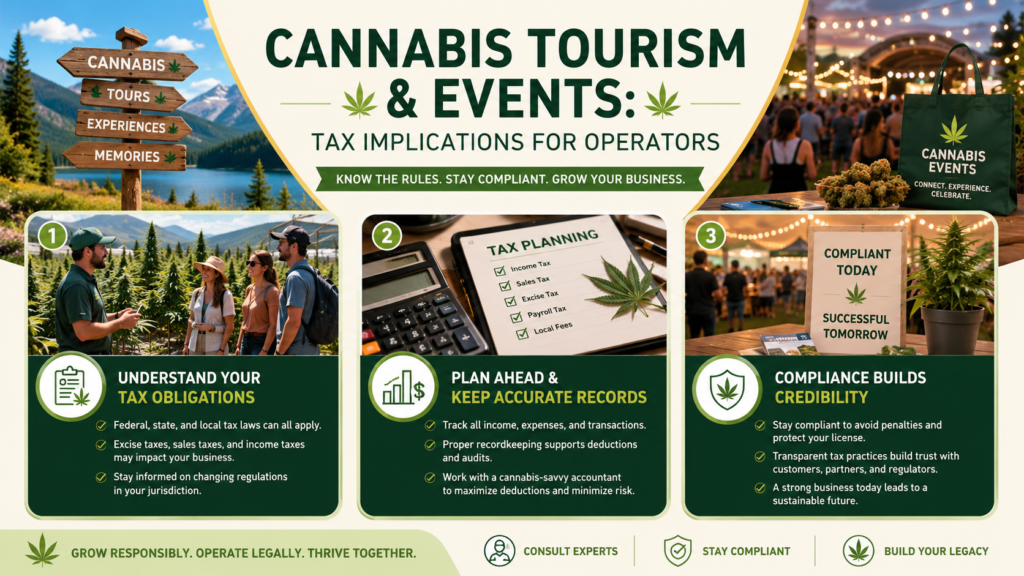
What Are the Most Common Tax Mistakes Cannabis Event Operators Make?
Cannabis tourism event operators face a steep learning curve. The most costly errors typically come from applying conventional hospitality tax rules to a cannabis context — or from missing industry-specific obligations entirely.
Mistake 1: Failing to Separate Revenue Streams
When your event generates revenue from ticket sales, cannabis product sales, food and beverage, and merchandise, each stream may carry a different tax treatment. Operators who lump all revenue together often miscalculate excise tax, sales tax, and COGS allocations. The result is either overpayment or underpayment — both of which are problematic. Use separate point-of-sale systems or cost centers for each revenue category from day one.
Mistake 2: Ignoring Local and Municipal Tax Obligations
State taxes are just the beginning. Many cities and counties that allow cannabis events impose their own cannabis taxes, business license fees, and special event permit fees. In California, for example, some local jurisdictions impose an additional cannabis business tax of up to 15% on top of the state excise tax. Operators who skip local research can face surprise back-tax bills and penalties.
Mistake 3: Misclassifying COGS Under 280E
Because COGS is the only expense that escapes 280E’s grip, many operators try to reclassify operating expenses as COGS. However, the IRS scrutinizes cannabis returns heavily. Expenses that qualify as COGS are strictly limited to the direct cost of cannabis products — growing, harvesting, processing, and acquiring inventory. Incorrectly classifying staff wages, event costs, or overhead as COGS can trigger audits and substantial penalties.
Mistake 4: Failing to Obtain Event-Specific Cannabis Licenses
Most states that allow cannabis events require operators to obtain a special temporary event license or retailer license for any on-site cannabis sales or consumption. Operating without this license is not only a regulatory violation — it can also void your insurance coverage and expose you to state tax penalties for unlicensed sales. Tranzesta.com Always verify licensing requirements with your state cannabis regulatory authority at least 60–90 days before your event.
Mistake 5: Missing Quarterly Estimated Tax Payments
Cannabis businesses often generate large gross revenues with artificially inflated federal taxable income (due to 280E). This can result in large quarterly estimated tax payments that operators — especially first-time event organizers — are not prepared for. Missing estimated tax payments results in IRS underpayment penalties on top of an already elevated tax burden. A qualified cannabis CPA can help you model your quarterly obligations well in advance
Step-by-Step Guide: How to Handle Cannabis Tourism Events Tax Implications
Follow these seven steps to build a compliant, efficient tax strategy for your next cannabis tourism event.
Step 1: Register with All Required Tax Authorities Before the Event.
Before selling a single ticket or cannabis product, confirm that your business is registered with your state’s department of revenue for cannabis excise tax, general sales tax, and any local cannabis business tax. Also verify your cannabis event license or temporary retail permit is active. These registrations can take weeks, so start early.
Step 2: Set Up Separate Revenue Tracking for Each Income Stream.
Implement separate tracking for: cannabis product sales, event ticket revenue, food and beverage revenue, merchandise sales, and any other income. This separation is essential for accurate excise tax calculation, COGS allocation, and state sales tax filings after the event.
Step 3: Calculate and Maximize Your COGS Allocation.
Work with a cannabis CPA to identify every legitimate cost that qualifies as COGS under 280E. This includes the purchase price of cannabis inventory, direct production labor, and packaging costs tied directly to the products sold at the event. Maximizing valid COGS reduces your 280E tax burden — legally.
Step 4: Collect and Remit State and Local Cannabis Excise Taxes.
During and after the event, collect the correct cannabis excise tax on all qualifying product sales. Track this separately in your POS system. File and remit to the state revenue authority on the schedule required by your state — monthly or quarterly depending on your sales volume.
Step 5: File Sales Tax Returns for Non-Cannabis Revenue.
Report ticket sales, food and beverage, and merchandise revenue on your standard state sales tax return. Consult your state’s specific exemption rules for event tickets, food, and beverages — these vary widely across the United States.
Step 6: Make Federal Quarterly Estimated Tax Payments.
Use your projected gross income (less allowable COGS) to estimate your federal income tax liability for the year. Divide this by four and make quarterly payments to the IRS using Form 1040-ES (sole proprietors) or Form 1120-W (corporations) to avoid underpayment penalties. Due dates are typically April 15, June 15, September 15, and January 15.
Step 7: Conduct a Post-Event Tax Reconciliation.
After each event, reconcile all revenue streams against your tax filings and receipts. Tranzesta.com Identify any discrepancies in excise tax collected versus remitted, and verify that all income has been captured for federal reporting. This reconciliation is the foundation of your annual tax return and audit defense.

How Tranzesta Can Help With Cannabis Tourism Events Tax Implications
At Tranzesta, we specialize in cannabis industry accounting and tax compliance for US-based operators. We understand that cannabis tourism and events create unique, layered tax obligations that standard accountants are simply not equipped to handle.
Our team works directly with cannabis event operators, consumption lounge owners, cannabis festival organizers, and cannabis hospitality businesses to deliver:
IRC 280E analysis and COGS optimization strategies
State cannabis excise tax registration and filing support
Sales tax compliance for multi-revenue-stream events
Quarterly estimated tax planning to avoid IRS penalties
Bookkeeping and accounting systems designed for cannabis businesses
Annual federal and state tax return preparation
We know that every state has different rules, and every event structure is different. That’s why we provide personalized cannabis tax strategies — not cookie-cutter advice.
Ready to get expert help with your cannabis event taxes? Contact our team at hello@tranzesta.com for a free consultation. You can also learn more about our cannabis accounting services at Tranzesta.com.
Cannabis Tourism Events Tax Implications: Expert Tips for 2026
As the cannabis tourism industry matures in the United States, here are the most important strategies and insider insights for operators heading into 2026.
Stay ahead of 280E changes:
Track federal legislative developments on cannabis rescheduling.
In 2024 and 2025, there were active discussions about rescheduling cannabis from Schedule I to Schedule III under the Controlled Substances Act. If rescheduling is finalized, it would potentially eliminate or limit the 280E disallowance — dramatically reducing federal tax liability for cannabis operators. Stay informed and model both scenarios in your financial planning.
Use event-specific financial tracking:
Treat every event as a separate reporting entity for tax purposes.
Rather than blending event revenue into your main business P&L, set up event-specific cost centers or separate LLCs where appropriate. This makes post-event reconciliation faster, reduces audit risk, and gives you cleaner data for future event planning and investor reporting.
Expand carefully across state lines:
New states are opening for cannabis events — each with unique rules.
If you plan to operate cannabis tourism events in multiple US states, be aware that each state has its own licensing, excise tax, and reporting requirements. There is no national “multi-state” cannabis license. Expand methodically, working with a cannabis-specialized CPA to map out compliance in each new jurisdiction before you sign any venue contracts.
Separate cannabis income from hospitality income:
Not all cannabis-related income at events is treated the same way.
Revenue from cannabis sales, consumption fees, guided tours, tickets, food, and merchandise may each be treated differently for state excise tax and sales tax purposes. Proper classification at the point of sale saves hours of reconciliation work and reduces the risk of over-remitting taxes.
Use cannabis-specialized accounting:
Work with a CPA who specializes in cannabis tax — not a generalist.
Given the complexity of 280E, state excise taxes, and the rapidly changing regulatory landscape, working with a cannabis industry specialist like Tranzesta is one of the highest-ROI investments an operator can make.
Conclusion: Get Ahead of Cannabis Tourism Event Taxes in 2026
Cannabis tourism and events represent one of the most exciting growth sectors in the US cannabis industry — but they also come with some of the most complex tax obligations any operator will face. Three key takeaways from this guide:
IRC Section 280E
is the most impactful federal tax rule for cannabis event operators, and proper COGS allocation is your primary legal defense.
State and local cannabis excise taxes,
sales taxes, and licensing fees layer on top of the federal burden — and vary significantly across the United States.
Proactive, event-by-event tax planning
is the only way to manage your liability, stay compliant, and protect your profit margins.
The stakes are high, but so are the rewards for operators who get their tax strategy right. Don’t navigate these complexities alone.
Ready to get expert help with your cannabis event taxes? Email us at hello@tranzesta.com or visit Tranzesta.com to schedule your free tax strategy session today.
FAQs
Yes. Cannabis event operators in the United States must report all gross revenue as federal taxable income, even though Section 280E of the Internal Revenue Code prohibits deducting most ordinary business expenses. The practical effect is an extremely high effective federal tax rate — sometimes exceeding 70%.
As of 2026, states like Colorado, California, Nevada, Michigan, and Illinois have frameworks allowing licensed cannabis events and consumption lounges. Federal law still classifies cannabis as a Schedule I substance, meaning operators face federal restrictions even in legal states, particularly regarding banking, taxes, and interstate commerce.
Cannabis excise tax calculations vary by state. Most states apply a percentage tax on the retail price of cannabis products sold — for example, California charges a 15% cannabis excise tax on retail sales, while Colorado charges 15%. Some states calculate excise taxes based on weight or THC content. At cannabis events, excise taxes apply to every qualifying product sale. Operators must register with their state revenue authority, collect the tax at the point of sale, and remit it on the schedule specified by state law.
possibly a special use permit for outdoor venues. Requirements vary significantly by state and city. In California, for instance, local approval is required before a state event license will be issued. Operators should begin the licensing process at least 60–90 days before their event to avoid delays.
Only partially. Under IRC Section 280E, cannabis businesses cannot deduct most operating expenses — including wages, rent, marketing, and insurance — from their federal taxable income. However, non-cannabis revenue streams at an event (ticket sales, food, merchandise) are not subject to 280E and can have normal business deductions applied. Proper revenue separation is essential for maximizing allowable deductions.