More than 70% of self-employed content creators
in the United States receive an unexpected IRS penalty — simply because they did not know about quarterly estimated taxes. If you earn income from OnlyFans, YouTube, TikTok, Twitch, or any other platform, the IRS does not automatically withhold taxes from your paycheck the way an employer would. Instead, you are required to calculate and pay quarterly estimated taxes content creators owe four times per year. Miss these payments, and the IRS charges interest and penalties — even if you pay everything at year-end.
In this complete 2026 guide, Tranzesta breaks down exactly what quarterly estimated taxes are, how to calculate them, when they are due, and how to avoid the most common mistakes creators make. Additionally, you will get a step-by-step payment strategy and expert tips to keep more money in your pocket legally.
What Are Quarterly Estimated Taxes for Content Creators?
Quarterly estimated taxes are prepayments of your annual income tax and self-employment tax, made four times per year directly to the IRS. As a self-employed creator, no employer withholds taxes from your earnings. Therefore, you must estimate what you will owe and pay it in installments throughout the year.
The IRS requires this system under the “pay-as-you-go” tax principle. According to IRS Publication 505, you must make estimated tax payments if you expect to owe at least $1,000 in taxes after subtracting withholding and credits. For most content creators earning over $25,000 annually, quarterly payments are mandatory.
Who Must Pay Quarterly Estimated Taxes?
You must pay quarterly estimated taxes if you are self-employed — including as a sole proprietor, LLC member, or freelancer — and expect to owe $1,000 or more in federal taxes. This applies to OnlyFans creators, YouTubers, Twitch streamers, Instagram influencers, and any US-based content creator earning income outside of traditional W-2 employment. Furthermore, if you have a day job but earn significant side income from content creation, you may still need to make quarterly payments on that side income.
What Taxes Are Included in Quarterly Payments?
Your quarterly payments cover two types of taxes. First, federal income tax — calculated based on your tax bracket. Second, self-employment tax — which is 15.3% on your net self-employment income, covering Social Security (12.4%) and Medicare (2.9%). As a result, content creators often face a combined effective tax rate of 25% to 40% or higher on net income. Planning for this is essential to avoid a large surprise bill in April.
2026 Quarterly Estimated Tax Deadlines for Content Creators
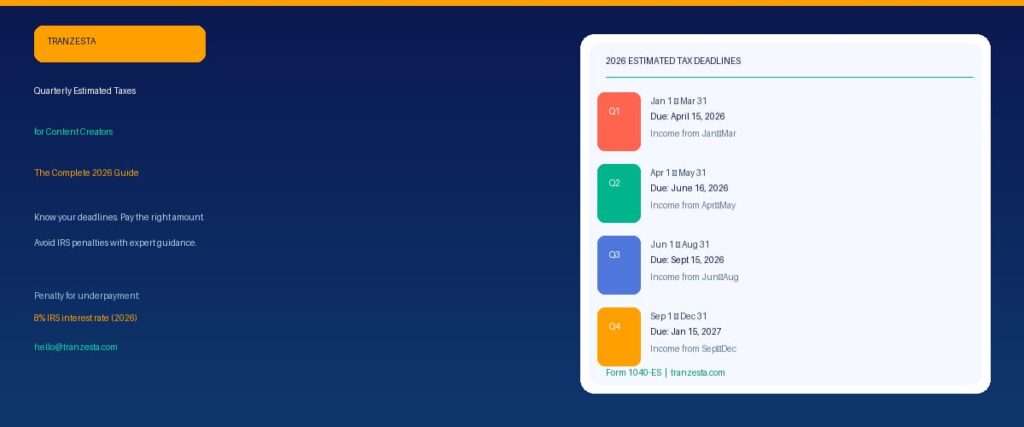
The IRS sets four specific due dates each year for estimated tax payments. Missing any of these dates triggers an automatic underpayment penalty, even if you pay the full balance later. Below are the 2026 quarterly tax deadlines every content creator in the USA must know.
Quarter
Income Period
Due Date
Form to Use
Q1
Jan 1–Mar 31
April 15, 2026
1040-ES
Q2
Apr 1–May 31
June 16, 2026
1040-ES
Q3
Jun 1–Aug 31
Sept 15, 2026
1040-ES
Q4
Sep 1–Dec 31
Jan 15, 2027
1040-ES
Note that Q2 covers only two months — April and May — while Q4 covers four months. Therefore, creators with volatile or seasonal income should plan their Q2 and Q4 payments extra carefully. Additionally, if a due date falls on a weekend or federal holiday, the deadline moves to the next business day.
For official payment instructions, visit the IRS Estimated Tax Payments page (opens in new tab).
How Do You Calculate Quarterly Estimated Taxes as a Content Creator?
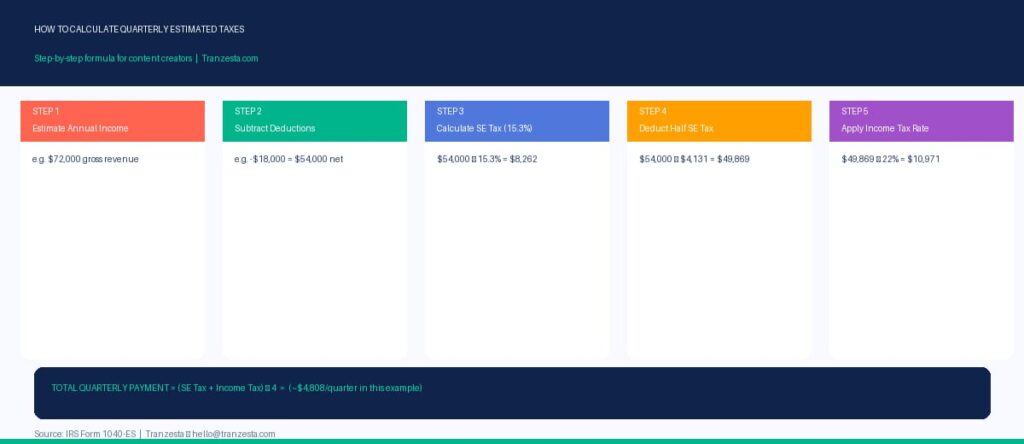
Calculating your quarterly estimated taxes requires three components: your expected gross income, your estimated deductions, and your applicable tax rates. Tranzesta recommends using the following formula for accurate results.
Step 1: Estimate Your Annual Gross Income
Start by estimating your total expected income for the year from all content platforms — OnlyFans, YouTube ad revenue, brand deals, tips, and any other sources. If your income is inconsistent, use the prior year as a baseline and adjust for known changes. Most importantly, err on the side of overestimating — paying slightly more quarterly is always better than underpaying and facing penalties.
Step 2: Subtract Your Business Deductions
Reduce your gross income by all legitimate business deductions — equipment, home office, internet, subscriptions, marketing, and professional services. For example, if you earn $72,000 but have $18,000 in deductions, your net self-employment income is $54,000. As a result, this is the figure you will use for tax calculations, not your gross revenue.
Step 3: Calculate Self-Employment Tax
Apply the 15.3% self-employment tax rate to 92.35% of your net earnings. The IRS allows you to exclude 7.65% because employers normally cover that portion. Therefore: $54,000 × 92.35% = $49,869. Then $49,869 × 15.3% = $7,630 in self-employment tax.
Step 4: Calculate Income Tax
Deduct half of your self-employment tax from your net income before applying income tax rates. This is a standard IRS deduction for self-employed individuals. In this example: $54,000 – $3,815 = $50,185. If you are in the 22% federal tax bracket, your income tax is approximately $11,041. Add both taxes together and divide by four for your quarterly payment amount.
Step 5: Use IRS Safe Harbor Rules
The IRS safe harbor rule protects you from penalties as long as you pay either 90% of your current year tax liability or 100% of your prior year tax liability — whichever is smaller. If your prior year adjusted gross income exceeded $150,000, the safe harbor threshold increases to 110% of last year’s tax. Therefore, many creators simply pay what they owed last year divided by four to stay penalty-free.
Common Mistakes Content Creators Make With Quarterly Taxes
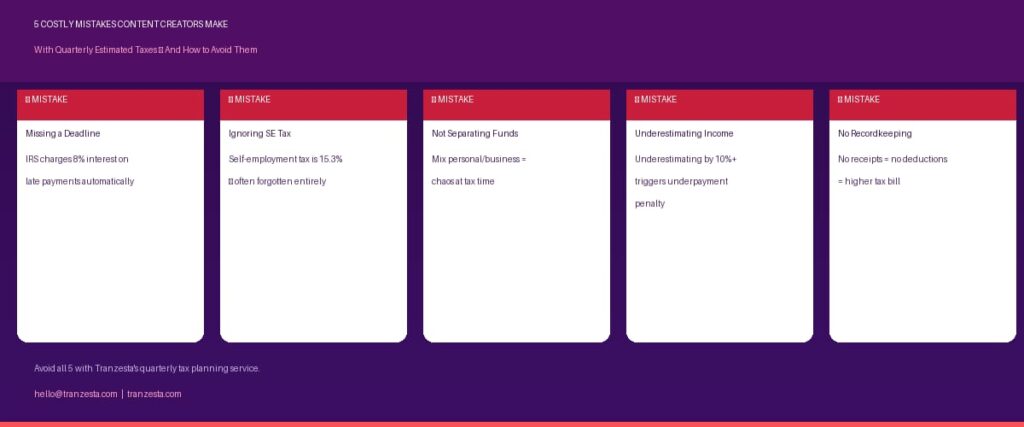
Even experienced creators make avoidable errors when managing quarterly estimated taxes. Understanding these mistakes can save you hundreds or thousands of dollars in unnecessary penalties and interest.
Mistake 1: Skipping Quarterly Payments Entirely
Many first-year creators do not realize quarterly payments are required until they file at year-end and receive an IRS penalty notice. The IRS charges interest on underpaid taxes at 8% annually (2026 rate), calculated from the original due date. Therefore, skipping all four quarters can mean paying hundreds of dollars in interest on top of your tax bill.
Mistake 2: Forgetting Self-Employment Tax
Income tax is only part of what you owe. Self-employment tax at 15.3% often doubles or triples the amount creators expect to owe. For example, a creator who budgets for a 22% income tax rate but ignores the 15.3% self-employment tax will be significantly underprepared. Always calculate both components before making quarterly payments.
Mistake 3: Using Gross Income Instead of Net Income
Your quarterly payment should be based on net profit — income after deductions — not gross revenue. Creators who pay taxes on their full revenue without accounting for deductions dramatically overpay. Conversely, creators who guess their deductions too aggressively may underpay and face penalties. Accurate bookkeeping throughout the year solves both problems.
Mistake 4: Missing State Estimated Taxes
Federal payments are just one part of the picture. Most US states with an income tax also require quarterly estimated state tax payments. California, New York, Illinois, and Texas all have different rules and deadlines. In contrast, states like Nevada, Florida, and Texas have no state income tax. Check your state’s revenue department for specific requirements.
Mistake 5: No Dedicated Tax Savings Account
Mixing your tax savings with your operating funds is a recipe for disaster. Tranzesta recommends setting aside 25–30% of every payment you receive into a dedicated savings account earmarked solely for taxes. This simple habit eliminates cash flow crunches at quarterly deadlines.
How to Pay Quarterly Estimated Taxes: Step-by-Step for Creators
Paying your quarterly estimated taxes is straightforward once you understand the process. Follow these six steps to stay compliant and avoid IRS penalties in 2026.
Determine your payment method.: The IRS offers several options: IRS Direct Pay (free bank transfer at IRS.gov), EFTPS (Electronic Federal Tax Payment System), credit or debit card (processing fee applies), or mailing a check with Form 1040-ES.
Register for EFTPS if you are a first-time payer.: Visit EFTPS.gov and create a free account using your Social Security Number or Employer Identification Number. EFTPS allows you to schedule all four quarterly payments in advance — a major time saver.
Calculate your payment using the formula above.: Use your estimated annual net profit to determine the quarterly amount. Alternatively, use the IRS Form 1040-ES worksheet to guide your calculation accurately.
Set calendar reminders for all four deadlines.: Mark April 15, June 16, September 15 (2026), and January 15 (2027) in your calendar right now. Additionally, set a reminder one week before each date to prepare your payment.
Make your payment on or before the deadline.: Log in to IRS Direct Pay or EFTPS and submit your payment. Always save the confirmation number as proof of payment. For check payments, mail at least five business days before the due date.
Reconcile at year-end with your actual tax return.: When you file your annual Form 1040, all quarterly payments are credited against your actual tax liability. If you overpaid, you receive a refund. If you underpaid slightly, you pay the balance with your return — without penalties if you met the safe harbor threshold.
Learn more about our quarterly tax planning services at Tranzesta.com to get a customized payment schedule built for your income level.
How Tranzesta Helps Content Creators With Quarterly Estimated Taxes
📅 Never Miss a Quarterly Tax Deadline Again
Get personalized quarterly tax planning from Tranzesta — built for content creators.
Contact hello@tranzesta.com or visit Tranzesta.com for a FREE consultation →
Tranzesta is a US-based tax consultation firm
that specializes in the unique financial situations of content creators. Our team understands that creator income is often irregular, multi-platform, and difficult to predict — which makes quarterly tax planning more complex than it is for traditional employees.
We offer a dedicated quarterly tax planning service that includes income forecasting, deduction optimization, safe harbor calculation, and payment scheduling. As a result, our clients never miss a deadline and never overpay by more than necessary. Furthermore, we handle all four major creator categories: OnlyFans creators, social media influencers, streamers, and multi-platform content businesses.
Visit Tranzesta.com to learn more about our creator tax services and see how we can simplify your quarterly tax obligations. You can also explore our Business Tax and Bookkeeping services for full-year financial management.
Contact our team at hello@tranzesta.com for a free consultation. Whether you are a brand-new creator or an established six-figure earner, Tranzesta has a quarterly tax solution that fits your situation.
Quarterly Estimated Taxes Content Creators: Expert Tips for 2026
Beyond the fundamentals, there are advanced strategies that experienced creators and their accountants use to reduce quarterly tax stress. Tranzesta shares these insider tips to help you stay ahead.
Open a high-yield savings account specifically for taxes. Park 25–30% of every payment received here immediately. Some creators automate this transfer using their bank’s rules-based savings feature.
Use accounting software from day one. QuickBooks Self-Employed, FreshBooks, or Wave automatically tracks income, categorizes expenses, and estimates quarterly tax payments based on real data — not guesses.
Contribute to a SEP-IRA or Solo 401(k). Retirement contributions reduce your net income and therefore your quarterly payment amounts. In 2026, SEP-IRA contributions can be up to 25% of net self-employment income.
Pay slightly over the safe harbor amount. Overpaying by a small margin eliminates all penalty risk and gives you a head start on the following year’s liability. The excess simply becomes a credit or refund at year-end.
Track state requirements separately. If you live in California, New York, or another high-tax state, your state quarterly payments can rival your federal ones. Set up separate reminders and calculations for state obligations.
For official IRS guidance on estimated tax payments, visit IRS Publication 505 (opens in new tab) — the authoritative source for all US self-employment tax rules.
FAQs
Missing a quarterly estimated tax payment triggers an IRS underpayment penalty. The penalty is calculated as interest on the unpaid amount — currently 8% annually for 2026 — from the original due date until you pay. Even if you pay your full tax bill at year-end, the IRS still charges this interest for the period the payment was late. Filing your annual return on time does not eliminate the penalty for missed quarterly payments.
Content creators in the United States should set aside 25–30% of their net income for quarterly estimated taxes. This covers both federal income tax — typically 22% for creators earning $47,000 to $100,000 — and self-employment tax at 15.3% of net earnings. However, the exact amount depends on your income level, deductions, state of residence, and filing status. Tranzesta recommends calculating your safe harbor amount precisely rather than relying solely on the 25–30% rule of thumb.
Yes — most US states that have an income tax also require quarterly estimated state tax payments if you are self-employed. States like California, New York, New Jersey, and Illinois have their own estimated tax systems with separate deadlines and forms. However, states including Florida, Nevada, Washington, Wyoming, and Texas have no state income tax, so no state quarterly payments are required. Always check your specific state revenue department for current rules.
Yes. Tax preparation fees and accounting costs are deductible for self-employed content creators in the United States under IRS Section 212. This includes fees paid to accountants, tax software subscriptions, and consulting services like those provided by Tranzesta. These costs are reported as a business expense on Schedule C of your Form 1040, reducing your net self-employment income and therefore your quarterly and annual tax liability.
The IRS safe harbor rule protects self-employed taxpayers from underpayment penalties as long as their total quarterly payments equal either 90% of the current year’s tax liability or 100% of the prior year’s tax liability — whichever is smaller. For creators whose prior year adjusted gross income exceeded $150,000, the threshold increases to 110% of the prior year’s tax. Using this rule, many content creators simply divide last year’s total tax bill by four and pay that amount each quarter to avoid all penalties.
3 Responses