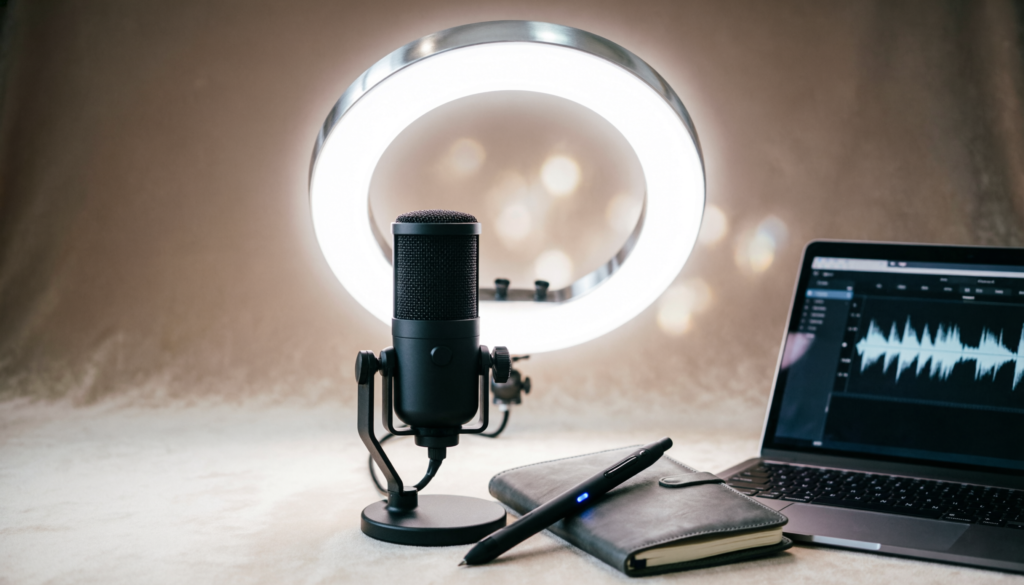
If you are a content creator in the United States
who has spent hundreds — or even thousands — of dollars on studio equipment, you may be leaving serious money on the table at tax time. The good news is that ring light studio equipment and other creator tools are tax deductible under IRS rules, as long as you meet the right requirements. This guide explains exactly what qualifies, how much you can deduct, and the steps to claim it correctly on your federal tax return.
In this article, you will learn which studio equipment
and props are deductible, the IRS rules that govern these deductions, the most common mistakes creators make, and how to maximize your equipment deductions for 2026. Whether you create content on OnlyFans, YouTube, TikTok, Instagram, or any other platform, these tax rules apply to you as a self-employed individual in the USA.
Is Ring Light and Studio Equipment Tax Deductible for Creators?
Yes — ring lights, cameras, microphones, backdrops, and other studio equipment are tax deductible for creators who operate as self-employed businesses in the United States. The IRS allows self-employed individuals to deduct ordinary and necessary business expenses under Internal Revenue Code Section 162. If you use equipment primarily to produce income-generating content, it qualifies as a deductible business expense.
The IRS ‘Ordinary and Necessary’ Standard
The IRS uses two criteria to determine whether a business expense is deductible. First, the expense must be ordinary — meaning it is common and accepted in your industry. For a content creator, a ring light and camera clearly meet this test. Second, the expense must be necessary — meaning it is helpful and appropriate for your work. You do not have to prove the expense was absolutely essential, only that it serves a legitimate business purpose.
These two standards come from IRS Publication 535, Business Expenses, which is the authoritative guide for self-employed taxpayers across the USA. Any equipment you purchase or lease primarily for content creation satisfies both criteria — and therefore qualifies for a deduction.
Why This Matters for OnlyFans and Digital Creators
As a self-employed creator, you pay income tax plus a 15.3% self-employment tax on your net profit. Every dollar of deductible equipment expense reduces your net profit, which lowers both taxes simultaneously. For example, a creator in the 22% federal income tax bracket who deducts $3,000 in studio equipment saves approximately $1,110 in income tax plus an additional $459 in self-employment tax — a combined saving of about $1,569 from a single equipment deduction.
Therefore, understanding what qualifies and how to claim it is not just a tax technicality — it is a direct financial benefit that puts real money back in your pocket every year.
What Studio Equipment and Props Are Tax Deductible for Content Creators?
A wide range of creator equipment qualifies as a tax-deductible business expense. Below is a comprehensive breakdown organized by category, all eligible for deduction under IRS rules for self-employed US taxpayers.
Lighting Equipment
Ring lights (LED ring lights in all sizes)
Softbox lighting kits and diffusers
LED video panels and light bars
Portable on-camera lights
Light stands, mounts, and clamps
Reflectors and blackout curtains for studio control
Lighting is the single most impactful investment many creators make in their studio setup. Fortunately, all of the above qualify as fully deductible business equipment when used for content creation.
Camera and Video Equipment
DSLR cameras, mirrorless cameras, and camcorders
Action cameras (GoPro, DJI, etc.) used for content
Camera lenses and lens filters
Tripods, monopods, and camera sliders
Gimbals, stabilizers, and drone equipment
Memory cards, batteries, and charging accessories
Audio Equipment
Lavalier microphones, shotgun mics, and USB microphones
Audio interfaces and mixers
Headphones and studio monitors
Boom poles andmic stands
Acoustic panels and soundproofing foam for your studio
Props deserve special attention. The IRS allows deductions for props used in content creation, but the item must be used primarily — or exclusively — for business purposes. A chair you purchased specifically for your video background qualifies. A chair you bought for your living room and occasionally appear in on video does not.
Post-Production and Editing Equipment
Desktop computers and workstations used for editing
External hard drives and NAS storage for footage
Graphics tablets for thumbnail and graphic design
Capture cards for streaming and screen recording
Video editing software (Premiere Pro, DaVinci Resolve, Final Cut Pro)
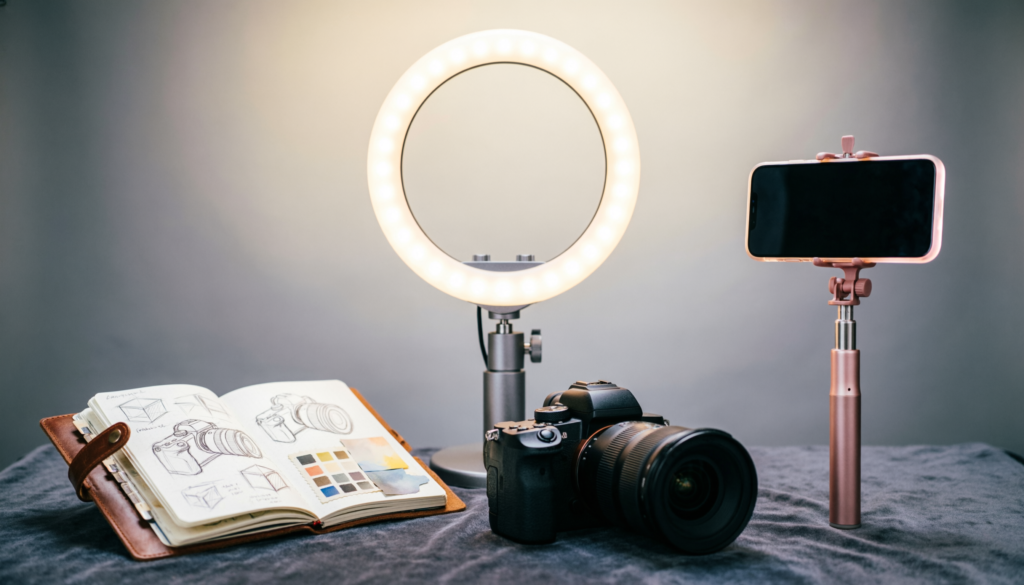
IRS Rules: How to Deduct Ring Light and Studio Equipment Correctly
The IRS offers several methods to deduct equipment purchases, each with different benefits depending on your situation. Understanding these rules helps you choose the strategy that maximizes your tax savings.
Section 179: Deduct the Full Cost in Year One
IRS Section 179 — formally called the Section 179 deduction — allows self-employed individuals and business owners to deduct the full purchase price of qualifying equipment in the year they buy it, rather than spreading the cost over several years through depreciation. For 2026, the Section 179 deduction limit is $1,220,000, which is far more than most individual creators will ever spend on equipment in a single year.
To use Section 179, you must place the equipment in service
during the tax year — meaning you must buy it and start using it for business before December 31. Additionally, the business use percentage must be greater than 50%. If you use a camera 80% for content creation and 20% for personal use, you can deduct 80% of the purchase price immediately using Section 179.
Bonus Depreciation: An Alternative to Section 179
Bonus depreciation — also known as additional first-year depreciation — is another method that allows you to deduct a large portion of a qualifying asset’s cost in the year of purchase. Through 2026, the bonus depreciation rate is being phased down from 100% (which applied through 2022). Check the current IRS guidance each year, as the rate changes annually. Bonus depreciation is available even if your equipment use is below 50% business use, making it more flexible than Section 179 in some situations.
Standard Depreciation: Spreading the Cost Over Time
If you prefer not to use Section 179 or bonus depreciation, you can use standard depreciation — also called MACRS depreciation (Modified Accelerated Cost Recovery System). Under MACRS, most photography and video equipment falls under a 5-year recovery period, meaning you deduct a percentage of the cost each year over five years. This approach is less aggressive but can be useful if you want to spread deductions across multiple tax years for planning purposes.
The 50% Business-Use Rule for Listed Property
Cameras, computers, and certain other equipment fall into a category the IRS calls listed property — assets that are commonly used for personal purposes as well as business. For listed property, you must use the item more than 50% for business to qualify for Section 179 or bonus depreciation. If your business use drops to 50% or below in a later year, the IRS requires you to recapture (pay back) a portion of the deduction you previously claimed. Therefore, keep detailed records of how you use shared equipment.
Common Mistakes Creators Make When Deducting Studio Equipment
Even creators who know their equipment is deductible often make costly errors that reduce their savings or trigger IRS scrutiny. Here are the most important mistakes to avoid.
Mistake 1: Claiming 100% Deduction on Personal-Use Equipment
This is the most common audit trigger for creator equipment deductions. If you use a laptop, camera, or phone for both personal and business purposes, you can only deduct the business-use percentage. The IRS scrutinizes mixed-use equipment closely — especially for content creators, where the line between personal and business use can blur. Claiming 100% of a mixed-use device as a business expense without documentation is a red flag that invites IRS inquiry.
Mistake 2: Not Keeping Purchase Receipts and Business-Use Records
The IRS requires you to substantiate every deduction you claim. For equipment, this means keeping purchase receipts, invoices, and records that demonstrate business use. A simple log noting when and how you used the equipment for business — for example, dates of content shoots, upload dates, or project notes — provides the documentation you need. Without this, a legitimate deduction can be disallowed during an audit.
Mistake 3: Forgetting to Deduct Accessories and Consumables
Many creators focus on the big-ticket items — cameras and ring lights — and forget that smaller accessories and consumables are also deductible. SD memory cards, batteries, lens cleaning kits, cables, gels for lighting, and similar items all qualify as ordinary and necessary business supplies. Additionally, ongoing costs like cloud storage for footage and software subscription renewals are fully deductible as business expenses each year.
Mistake 4: Missing the Section 179 Election Deadline
Section 179 requires you to place equipment in service — meaning purchase it and use it for business — before December 31 of the tax year. Many creators wait until January to make major purchases, inadvertently pushing the deduction into the following tax year. If you are planning a major studio upgrade, buy the equipment before year-end to capture the full Section 179 deduction on your current year return.
Mistake 5: Deducting Props That Are Actually Personal Items
Props must be used primarily for content creation to qualify for a deduction. A piece of furniture, decorative item, or clothing that you purchased for your home — and occasionally appears in your content — does not qualify. In contrast, items purchased specifically and exclusively for your studio or content do qualify. When in doubt, ask yourself: would I have bought this if I were not a content creator? If the answer is no, it is likely deductible.
How to Deduct Ring Light and Studio Equipment: A Step-by-Step Guide
Claiming your equipment deductions correctly requires a specific process. Follow these steps to ensure you maximize your deduction while staying fully compliant with IRS rules.
Keep all purchase receipts from the moment you buy any equipment.
Store digital copies in a dedicated folder — organized by tax year — in cloud storage. Include the date of purchase, the vendor, the amount paid, and a note about the business purpose (for example, ‘ring light purchased for studio content setup’).
Track your business-use percentage for all shared equipment.
For any item you use for both business and personal purposes, maintain a simple log. Record the dates you used it for content creation versus personal use. Apps like Toggl or a basic spreadsheet work well for this. Calculate the business-use percentage at year-end and apply it to the deductible amount.
Decide whether to use Section 179,
bonus depreciation, or standard depreciation. For most creators, Section 179 is the best option because it allows a full first-year deduction. Compare the strategies with a tax professional to determine which approach saves you the most based on your current income level and projected equipment purchases.
Report equipment deductions on Schedule C,
Part II (Expenses). List smaller equipment and supplies under the ‘Supplies’ or ‘Other expenses’ line. For larger equipment subject to Section 179 or depreciation, complete Form 4562 — the IRS Depreciation and Amortization form — and attach it to your Schedule C. Your tax software or accountant will handle this automatically.
Elect Section 179 on Form 4562 if applicable.
On Form 4562, Part I, enter the total cost of qualifying equipment and elect the Section 179 deduction. Make sure you list each asset individually, including the date placed in service and the business-use percentage. This form must be filed with your tax return for the election to be valid.
Check whether your studio qualifies as a home office.
If you have a dedicated studio space in your home used exclusively and regularly for content creation, you may be able to deduct a portion of your rent or mortgage, utilities, and internet costs in addition to your equipment deductions. This stacks on top of your equipment deductions and can significantly increase your total savings.
Work with a tax professional who specializes in creator businesses.
Equipment deduction rules — particularly around listed property, bonus depreciation phase-downs, and Section 179 elections — change frequently. A specialist at Tranzesta can review your equipment purchases, determine the optimal deduction strategy, and ensure your Form 4562 is filed correctly.
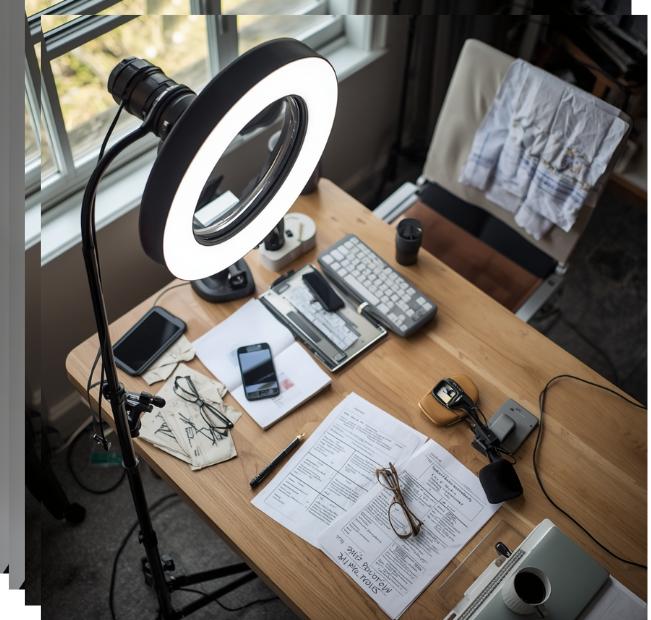
Ring Light Studio Equipment Tax Deductible Creator Tips for 2026
Beyond the basics, these advanced strategies will help you squeeze the maximum value from your equipment deductions in the 2026 tax year.
Time major purchases strategically. If you plan to buy a new camera, lighting kit, or computer in the near future, consider whether buying before December 31 versus after January 1 produces a better tax outcome for you. Buying before year-end lets you capture the deduction one year earlier — which has real value if you are in a higher tax bracket this year.
Bundle your studio upgrade into a single tax year when possible. Section 179 rewards creators who make multiple equipment purchases in the same year. Consolidating several upgrades — lights, a new camera, and editing hardware — into one tax year allows you to take a large, impactful deduction in that year rather than spreading smaller deductions across multiple years.
Consider a SEP-IRA or Solo 401(k) on top of equipment deductions. Equipment deductions reduce your taxable income, but combining them with retirement contributions can push your taxable income even lower. Self-employed individuals in the USA can contribute up to 25% of net self-employment income to a SEP-IRA. Using both strategies together is one of the most powerful tax minimization approaches available to creators.
Keep a business credit card exclusively for studio purchases. Using a dedicated business credit card for all equipment and supply purchases makes bookkeeping effortless. Your monthly statement becomes an automatic expense record, and you eliminate the risk of mixing personal and business transactions. Many business credit cards also offer rewards on purchases, adding another layer of value.
Photograph your studio setup annually. Take dated photos of your studio showing all major equipment in use for content creation. This visual documentation supports your business-use claims and provides evidence of when equipment was placed in service — two pieces of information the IRS may request in an audit.
Conclusion: Your Studio Equipment Is a Tax Asset — Treat It That Way
The three most important takeaways from this guide are as follows. First, ring lights, cameras, microphones, backdrops, and other studio equipment are fully tax deductible for content creators in the United States who operate as self-employed businesses. Second, using IRS Section 179 allows you to deduct the full cost of qualifying equipment in the year you buy it — which can translate into thousands of dollars in immediate tax savings. Third, accurate documentation of your business-use percentage and purchase receipts is the foundation of every successful equipment deduction.
Do not let another tax year pass while leaving your equipment deductions on the table. Tranzesta’s creator tax specialists are ready to help you claim every dollar you are entitled to — with the documentation, precision, and IRS knowledge to back it up.
Ready to get expert help? Email us at hello@tranzesta.com or visit Tranzesta.com to schedule your free tax strategy session today.
FAQs
Yes, content creators can deduct a ring light as a business expense when it is used primarily for income-generating content creation. Under IRS rules, ring lights qualify as ordinary and necessary business equipment for self-employed creators in the United States. You can deduct the full purchase price in the year of purchase using the IRS Section 179 deduction, or depreciate the cost over several years using standard MACRS depreciation. Keep your receipt and document how the ring light is used for business.
YouTubers and content creators can write off a broad range of equipment as tax deductions, including cameras, lenses, ring lights, softboxes, LED lighting panels, microphones, audio interfaces, tripods, gimbals, green screens, backdrop stands, computers used for editing, external hard drives, capture cards, and editing software subscriptions. Props and set decorations purchased exclusively for content creation are also deductible. All of these qualify as ordinary and necessary business expenses for self-employed creators filing a Schedule C in the United States.
Yes, you can deduct studio equipment even if content creation is a side job rather than your primary occupation, as long as you operate with a profit motive. The IRS requires that you intend to make a profit from the activity — not just pursue it as a hobby. If you report your side income on Schedule C and demonstrate a business intent, your equipment deductions apply the same way they do for full-time creators. If the IRS classifies your activity as a hobby rather than a business, the deduction rules change significantly and become far more restrictive.
To prove studio equipment is used for business, you should keep the original purchase receipt showing the date and amount paid, maintain a log or record of the dates you used the equipment for content creation, save documentation such as upload dates, video files, or shoot schedules that demonstrate business use, and photograph your studio setup with equipment in place. If you use equipment for both personal and business purposes, calculate and document the business-use percentage. These records protect your deduction in the event of an IRS audit.
A camera can be 100% tax deductible for content creators if it is used exclusively for business purposes. If you use the camera for both personal and business use, you can only deduct the business-use percentage — for example, 80% if you use it 80% for content creation. Using IRS Section 179, you can deduct the full business-use portion of the purchase price in the year you buy the camera, rather than depreciating it over five years. Always document your business-use percentage to support the deduction.
One Response