
Tens of thousands of US creators are asking the same
question right now: does it matter, from a tax standpoint, whether I work as an independent OnlyFans creator or through an agency? The answer is yes — significantly. The OnlyFans agency vs independent tax difference affects how your income is classified, what you can deduct, how much self-employment tax you owe, and what forms you must file every year.
Getting this wrong can mean overpaying taxes
by thousands of dollars — or facing unexpected IRS penalties for under-reporting. In this guide, you will learn exactly how each setup is taxed under US law, the key deductions available in each scenario, the most costly mistakes creators make when switching between models, and the step-by-step actions you need to take right now to stay compliant.
Whether you are just starting out or already generating significant monthly income, understanding your tax structure is the foundation of a sustainable creator business.
What Is the OnlyFans Agency vs Independent Tax Difference?
The OnlyFans agency vs independent tax difference comes down to one core question: are you running your own business, or are you working for someone else’s? Independent creators are self-employed. Agency-represented creators may be self-employed, employees, or something in between — and the IRS treats each situation differently.
This distinction shapes everything from your quarterly
estimated tax payments to your eligibility for certain deductions. Most US OnlyFans creators fall into one of two categories, and many do not fully understand which one applies to them.
What Does It Mean to Be an Independent OnlyFans Creator?
An independent OnlyFans creator owns and operates their account entirely on their own. They set their subscription prices, manage their content calendar, handle all customer interactions, and receive payouts directly from OnlyFans. Under US tax law, this person is self-employed — typically operating as a sole proprietor or through a single-member LLC.
As a self-employed individual, you report all OnlyFans
income on Schedule C of your federal tax return. You also owe self-employment (SE) tax — currently 15.3% on net earnings up to $168,600 (2024 threshold), covering Social Security and Medicare. Additionally, you must pay federal income tax on your net profit. However, you can deduct a wide range of business expenses to reduce both.
What Does It Mean to Work With an OnlyFans Agency?
An OnlyFans management agency — sometimes called a talent agency or content agency — typically manages a creator’s account in exchange for a commission, usually between 20% and 50% of gross revenue. The agency may handle messaging, promotions, pricing strategy, and social media growth.
However, the tax treatment depends entirely on the legal
structure of your relationship with the agency. In most cases, creators remain self-employed and simply pay the agency commission as a deductible business expense. In some arrangements, the creator may be classified as an employee of the agency — which changes the entire tax picture. Understanding your contract is therefore essential before filing your taxes.
Key Tax Rules: How the IRS Treats Independent vs Agency-Based Creators
The IRS does not have a special rule for OnlyFans — instead, it applies the same worker classification and self-employment tax rules that govern all US freelancers and independent contractors. Here is what you need to know in both scenarios.
Tax Treatment for Independent OnlyFans Creators
Independent creators receive Form 1099-K from OnlyFans if their annual earnings exceed $5,000 (the 2024 threshold, reduced from $20,000). Even if you do not receive a 1099-K, all income is taxable and must be reported under IRC Section 61, which defines gross income broadly as ‘all income from whatever source derived.’
Independent creators file Schedule C with their Form
1040 to report income and deduct business expenses. Allowable deductions under IRC Section 162 include equipment, internet service, home office, content props, subscriptions, and professional services. After deducting expenses, the resulting net profit is subject to both income tax and the 15.3% self-employment tax.
Additionally, independent creators must pay quarterly
estimated taxes using IRS Form 1040-ES to avoid underpayment penalties. The IRS expects these payments by April 15, June 15, September 15, and January 15 of the following year.
Tax Treatment for Agency-Represented Creators
If your agency relationship is structured as a standard independent contractor arrangement, your tax filing process is similar to that of an independent creator. You still report income on Schedule C and pay self-employment tax. The agency commission — typically 20%–50% of gross revenue — is fully deductible as a business expense on Line 10 (commissions and fees) of Schedule C.
However, if the agency classifies you as an employee,
the tax treatment shifts dramatically. The agency must withhold federal income tax and the employee share of FICA (7.65%) from your earnings and issue you a W-2 at year-end. You would no longer owe self-employment tax, but you also lose the ability to deduct most creator business expenses on your personal return — a significant disadvantage for active content creators.
Key rules to remember:
All OnlyFans income is taxable regardless of how it is received — platform payouts, tips, and gifts all count.
Self-employed creators owe 15.3% SE tax on net earnings up to $168,600 (2024).
Agency commissions are deductible when you remain self-employed.
Employee-classified creators lose Schedule C deductions but gain payroll tax splitting with the employer.
Always review your agency contract to confirm your legal classification before filing.
Form 1099-K thresholds are changing — consult a tax professional for the latest rules.
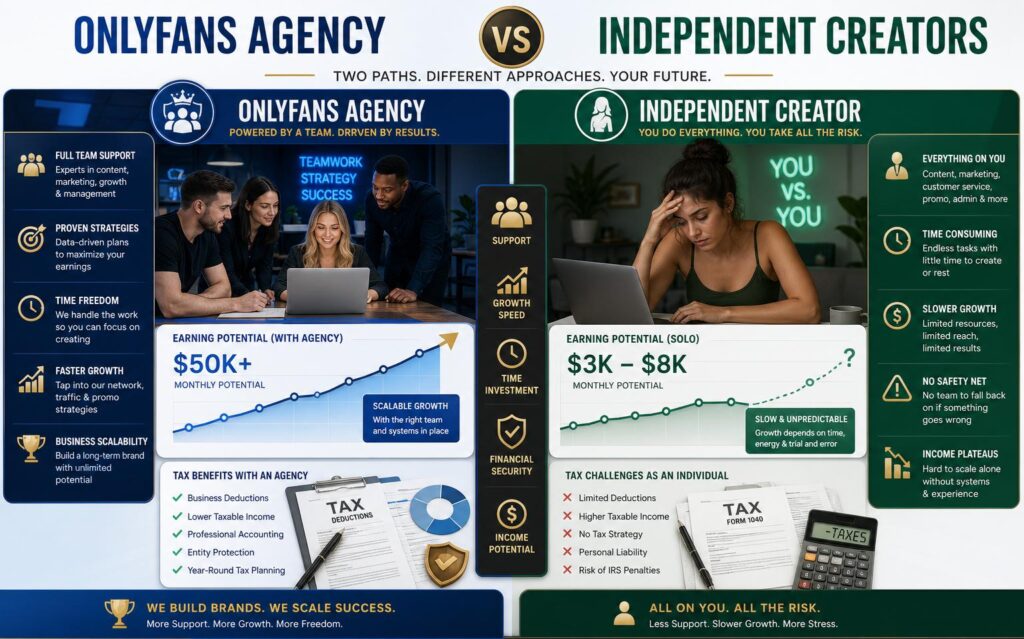
Common Tax Mistakes OnlyFans Creators Make With Agency vs Independent Status
Whether you operate independently or through an agency, there are several costly mistakes that creators across the United States make every year. Understanding these pitfalls in advance can save you thousands of dollars and significant stress.
Mistake 1: Assuming Agency Income Is Not Fully Taxable
Some creators mistakenly believe that because the agency takes a large commission, only their net payout is taxable. This is incorrect. Under US tax law, you must report your gross income — the total amount before any agency deduction — and then separately deduct the commission as a business expense. Failing to report gross income can trigger an IRS notice or audit, particularly if OnlyFans or the agency issues a 1099 reflecting the full amount.
Mistake 2: Not Tracking the Agency Commission as a Business Deduction
The opposite mistake is equally common. Many creators who do correctly report gross income forget to deduct the agency commission — effectively paying income tax and SE tax on money they never received. A 30% agency commission on $100,000 in gross revenue equals $30,000 in deductible expenses. At a combined federal and SE tax rate of approximately 40%, forgetting this deduction could cost you $12,000 or more in a single year.
Mistake 3: Misunderstanding Your Employment Status
Many agency agreements are loosely worded. Some creators receive W-2s from agencies when they expected 1099s — or vice versa. If you receive a W-2 but believe you should be a contractor, the classification may be incorrect, and you may have overpaid taxes without access to your full deductions. Similarly, receiving a 1099 when you are legally an employee means the agency failed to withhold taxes — leaving you with an unexpected self-employment tax bill.
Mistake 4: Skipping Quarterly Estimated Tax Payments
Self-employed creators — both independent and those with 1099-based agency arrangements — must pay quarterly estimated taxes. Many first-year creators skip this step entirely, then owe a large lump sum plus underpayment penalties in April. The IRS charges the federal short-term rate plus 3% on unpaid estimated taxes, compounded daily. For high-earning creators, this can easily add up to hundreds or thousands of dollars in unnecessary penalties.
Step-by-Step: How to Handle Your Taxes Based on Your OnlyFans Setup
Follow these steps to handle your taxes correctly, whether you are independent or working with an agency. This process applies to all US-based OnlyFans creators filing a federal return.
Step 1 — Confirm Your Legal Classification.
Read your agency contract carefully, or consult a tax professional. Determine whether you are classified as an independent contractor (expect a 1099) or an employee (expect a W-2). This single step determines your entire filing strategy.
Step 2 — Collect All Income Documentation.
Gather your OnlyFans earnings statements, any 1099-K forms from the platform, any 1099-NEC or W-2 from your agency, and records of tips, pay-per-view sales, and direct messages. Every dollar is taxable, and every document protects you in an audit.
Step 3 — Track All Deductible Business Expenses.
For self-employed creators, document every legitimate business expense throughout the year. This includes equipment, ring lights, cameras, costumes, subscriptions, agency commissions, advertising, home office costs, and professional services like accountants. Use dedicated bookkeeping software to record each expense with a date and business purpose.
Step 4 — Set Up and Pay Quarterly Estimated Taxes.
If you expect to owe $1,000 or more in federal taxes for the year, the IRS requires quarterly estimated payments using Form 1040-ES. Calculate your estimated liability, divide it by four, and pay by each quarterly deadline. As a general rule, setting aside 25–35% of net income covers most creators’ obligations.
Step 5 — File Schedule C With Your Form 1040.
If you are self-employed — whether independent or under a 1099-based agency deal — file Schedule C to report your business income and expenses. Also complete Schedule SE to calculate your self-employment tax. If you are an employee receiving a W-2, follow standard employee filing procedures instead.
Step 6 — Evaluate Your Business Structure Annually.
If your net OnlyFans income exceeds approximately $60,000 per year, consider whether an S-Corp election could reduce your self-employment tax burden. An S-Corp allows you to pay yourself a reasonable salary and take the remaining profit as a distribution not subject to SE tax — potentially saving thousands annually.
Step 7 — Review Your Agency Contract Before Renewal.
Tax implications can shift if your agency changes your compensation structure, moves you from 1099 to W-2, or begins withholding taxes. Review your contract every year — ideally with a tax professional — so you are never surprised by your filing obligations.
How Tranzesta Helps OnlyFans Creators Navigate Agency vs Independent Taxes
At Tranzesta, we specialize in OnlyFans and content creator taxes across the United States. We work with independent creators and agency-represented creators every day, and we understand the specific income structures, deduction opportunities, and compliance requirements that apply to this industry.
Whether you are earning $2,000 a month or $20,000 a month,
Tranzesta builds a tax strategy tailored to your exact situation. We handle worker classification reviews, Schedule C preparation, quarterly estimated tax planning, S-Corp evaluations, bookkeeping setup, and year-end filings — so you never have to guess what you owe or whether you filed correctly.
We also help creators who received incorrect tax
treatment from their agencies — whether that means filing amended returns, requesting reclassification, or proactively structuring future contracts to maximize deductions. Learn more about our creator tax services at Tranzesta.com/creator-taxes, or explore our full business tax and bookkeeping solutions at Tranzesta.com.
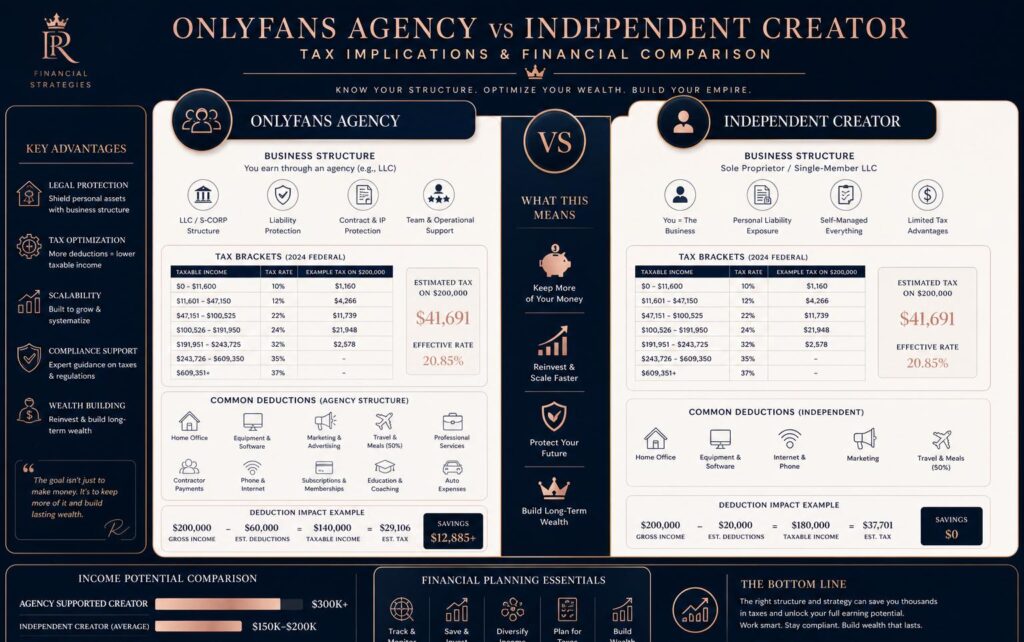
OnlyFans Agency vs Independent Tax Difference: Expert Tips for 2026
Beyond the core rules, here are the advanced strategies that experienced creator-business owners use to minimize their tax liability and avoid the IRS’s most common traps. Tranzesta incorporates these approaches into every creator tax plan we design.
Negotiate your agency contract for maximum tax benefit. If possible, have the agency pay you as a 1099 contractor rather than a W-2 employee. This preserves your ability to deduct business expenses on Schedule C, which is especially valuable for creators with significant equipment and production costs.
Deduct the full agency commission,
not just the net payout. Report gross income and separately deduct the commission. This ensures your deduction is properly documented and maximizes the reduction to your taxable income.
Open a dedicated business bank account immediately.
Mixing personal and business finances is one of the top red flags in an IRS audit. A dedicated account also makes bookkeeping dramatically easier and ensures every deduction is cleanly documented.
Consider an LLC for liability protection. While a single-member LLC is taxed identically to a sole proprietor by default, it provides important personal liability protection and adds credibility if you later elect S-Corp status.
Track the home office deduction carefully. Many creators work from home full-time. Under IRS rules, you can deduct the portion of your home used exclusively and regularly for business — either using the simplified method ($5 per square foot, up to 300 sq ft) or the regular method based on actual expenses.
If your agency represents you in multiple countries,
international tax treaties may affect your US obligations. The United States taxes its citizens on worldwide income, so foreign-sourced OnlyFans revenue is fully taxable regardless of where the agency is based. Tranzesta can guide you through international compliance when applicable.
Most importantly,
do not wait until April to think about taxes. Proactive planning throughout the year — with the right professional support — is the single most effective way to reduce what you owe and eliminate the stress of tax season entirely.
Conclusion
The OnlyFans agency vs independent tax difference is significant — and getting it right matters more than most creators realize. The three most important takeaways are these: first, confirm your legal classification with your agency before filing; second, always report gross income and separately deduct the agency commission as a business expense; and third, pay quarterly estimated taxes to avoid underpayment penalties and year-end surprises.
Your tax structure is not set in stone.
As your income grows and your creator business evolves, the right strategy may shift — from sole proprietor to LLC to S-Corp, or from independent to agency-represented. Regular tax planning keeps you ahead of those transitions.
Ready to get expert help? Email us at hello@tranzesta.com or visit Tranzesta.com to schedule your free tax strategy session today.
FAQs
OnlyFans creators working with an agency may pay taxes differently depending on their legal classification. If the agency pays you as an independent contractor, you still file Schedule C and owe self-employment tax, but you can deduct the agency commission as a business expense. If the agency classifies you as an employee and issues a W-2, you do not owe self-employment tax, but you lose most Schedule C deductions. Always confirm your status with your agency before filing.
Yes — an OnlyFans agency commission is fully tax deductible as a business expense when you are self-employed. Under IRC Section 162, ordinary and necessary business expenses are deductible, and commissions paid to an agency for managing your account clearly qualify. Report your full gross income from OnlyFans and deduct the commission separately on Schedule C, Line 10 (commissions and fees). Keep records of all commission payments and your agency agreement.
Independent OnlyFans creators in the United States typically need to file Form 1040 with Schedule C (business income and expenses), Schedule SE (self-employment tax), and make quarterly estimated payments using Form 1040-ES. If you receive a 1099-K from OnlyFans, that amount must be reported. Even without a 1099-K, all income is taxable. If you hire any contractors, you may also need to issue Form 1099-NEC for payments of $600 or more.
An independent OnlyFans creator owes federal income tax plus 15.3% self-employment tax on net earnings, but can deduct all legitimate business expenses. An agency employee pays only the employee share of FICA (7.65%), with the agency covering the other half, but loses the ability to deduct most business costs. For high-earning creators with significant expenses, the independent contractor structure often results in a lower total tax burden — especially with proper deductions and S-Corp planning.
Yes — OnlyFans creators who receive agency income as independent contractors can deduct content creation expenses on Schedule C. Deductible costs include cameras, lighting equipment, costumes and props, home office space, internet, software subscriptions, and the agency commission itself. However, creators classified as employees by the agency generally cannot deduct unreimbursed employee expenses on their personal federal return under current US tax law following the 2017 Tax Cuts and Jobs Act.
One Response