
Cannabis dispensaries across the United States
face a compliance challenge that no other industry deals with in quite the same way: they must pay competitive employee benefits to attract and retain talent, yet they cannot deduct most of those benefit costs at the federal level. Understanding cannabis employee benefits tax implications is therefore essential for every dispensary owner, HR manager, and cannabis business operator in the USA.
In this guide, you will learn which employee benefits
are affected by IRS Section 280E, how different benefit types are treated for tax purposes, what mistakes dispensary owners commonly make when structuring compensation packages, and how to set up a compliant, cost-effective benefits strategy for your cannabis workforce.
Additionally, you will find a step-by-step framework for evaluating your current benefits setup — plus expert guidance from the cannabis accounting team at Tranzesta. Let’s start with the fundamentals.
What Are Cannabis Employee Benefits Tax Implications?
Cannabis employee benefits tax implications refer to how the IRS treats the costs of employee benefit programs — health insurance, retirement plans, paid leave, and other compensation — at a business that sells cannabis. Unlike most US businesses, cannabis dispensaries cannot deduct these costs at the federal level due to Section 280E of the Internal Revenue Code. However, the tax treatment of benefits for employees themselves can still be favorable, creating a complex split between employer and employee tax exposure.
For cannabis business owners in the USA,
this split matters enormously. You may be paying for health insurance that your employees receive tax-free — but your business gets zero federal deduction for it. Understanding exactly where the tax burden falls for each benefit type is the foundation of smart cannabis workforce compensation planning.
Why Section 280E Changes Everything for Cannabis Employers
Section 280E (IRC Section 280E) is the federal tax code provision that prohibits businesses trafficking in Schedule I or Schedule II controlled substances from deducting ordinary and necessary business expenses. Since marijuana remains a Schedule I substance under federal law, every cannabis dispensary in the United States is subject to 280E. This means employee salaries, benefits, and related payroll costs — except those allocated to Cost of Goods Sold — are not deductible at the federal level.
As a result, cannabis employers effectively pay benefits
with after-tax dollars. A dispensary in California or Colorado that spends $50,000 annually on employee health insurance cannot reduce its federal taxable income by that amount, unlike a non-cannabis business that would receive a full deduction. The real cost of providing benefits is therefore significantly higher for cannabis businesses than for any other industry in the USA.
Who Is Affected by These Tax Rules?
Every cannabis business with W-2 employees is affected — including recreational dispensaries, medical marijuana retailers, cannabis delivery services, and consumption lounge operators. Additionally, multi-state operators (MSOs) that employ staff across multiple states face compounding complexity because state-level tax treatments of benefits vary widely. For example, states like Illinois and Michigan allow some cannabis business expense deductions that the federal government disallows, partially offsetting the 280E burden.
IRS Rules Governing Cannabis Employee Benefits and Compensation
The IRS governs cannabis employee benefits through a combination of Section 280E restrictions and standard employee benefit tax rules under the Internal Revenue Code. Importantly, Section 280E restricts the employer’s deductions — but it does not generally change the tax treatment of benefits from the employee’s perspective. Employees at cannabis companies can still receive many benefits on a pre-tax or tax-free basis.
Here is a summary of how the most common benefit types are treated under current IRS rules for cannabis businesses in the United States:
Health Insurance Premiums (IRC Section 106):
Employer-paid health insurance premiums are excluded from employees’ taxable income. However, the dispensary cannot deduct these premiums under 280E. The employee benefit remains intact; the employer’s tax position suffers.
Retirement Plans — 401(k) and SEP-IRA (IRC Section 401):
Cannabis businesses can sponsor qualified retirement plans. Employee elective deferrals reduce the employee’s taxable income. However, employer matching contributions are not deductible for the cannabis business under 280E.
Workers’ Compensation Insurance:
Required in most US states for cannabis employers, workers’ comp premiums are a non-deductible operating cost under 280E. State law requirements still apply regardless of federal deductibility.
Employee Discounts on Cannabis Products (IRC Section 132):
Employee discounts on cannabis products are generally taxable income to the employee because the Section 132 exclusion for qualified employee discounts does not apply to items that constitute an illegal transaction under federal law.
Transportation and Parking Benefits (IRC Section 132(f)):
Qualified transportation fringe benefits — such as transit passes and parking — are excluded from employee income up to $315 per month in 2026. However, the employer’s cost is not deductible under 280E.
Paid Time Off and Sick Leave:
Accrued PTO and sick leave costs are non-deductible under 280E for cannabis businesses. However, many states — including California, Colorado, and Illinois — mandate minimum paid sick leave for cannabis workers, making this a required non-deductible expense.
What Can Be Allocated to COGS to Preserve Some Deductibility?
The one meaningful exception to 280E’s blanket expense disallowance is the Cost of Goods Sold (COGS) deduction under IRC Section 471. Cannabis businesses can deduct the cost of acquiring cannabis inventory — and in some cases, a portion of payroll costs directly tied to COGS-producing activities. For example, a budtender who spends measurable time on inventory receiving and preparation may have a portion of their compensation allocable to COGS. This allocation must be documented carefully and consistently applied.
State-Level Tax Relief: What Some States Allow
Several US states have decoupled their tax codes from federal 280E treatment, meaning cannabis businesses in those states can deduct employee benefit costs at the state level even though they cannot do so federally. As of 2026, states including California, Colorado, Oregon, and Michigan have enacted various forms of 280E relief at the state level. Working with a cannabis-specialized CPA like those at Tranzesta is essential to capturing every available state-level deduction while staying federally compliant.

Common Cannabis Employee Benefits Tax Mistakes to Avoid
Even well-run dispensaries make costly errors when structuring employee benefits. These mistakes range from missed deduction opportunities to outright compliance violations. Therefore, understanding these pitfalls protects both your business and your employees.
Mistake 1: Assuming All Benefit Costs Are Completely Lost Under 280E
Many cannabis business owners believe that because 280E blocks their deductions, there is no point in offering structured benefit programs. This is incorrect. First, some states allow full or partial deductions at the state level. Second, benefits like health insurance and retirement plans reduce employee payroll taxes — including FICA — which creates savings even without a federal income tax deduction. Third, robust benefit packages reduce employee turnover, which lowers the hidden costs of recruiting and training new staff.
Mistake 2: Offering Cannabis Product Discounts Without Reporting Them
Employee discounts on cannabis products are a common perk at dispensaries across the USA. However, many dispensaries fail to report these discounts as taxable wages on employees’ W-2 forms. Because the Section 132 qualified employee discount exclusion does not apply to federally illegal goods, the fair market value of any cannabis product discount must generally be included in the employee’s gross income and reported accordingly. Failing to do this creates payroll tax liability and potential IRS penalties.
Mistake 3: Incorrectly Allocating Payroll to COGS
Some cannabis businesses overallocate employee compensation to COGS in an attempt to maximize their Section 471 deduction. For example, attributing 100% of a store manager’s salary to COGS — when the manager clearly performs non-COGS duties like marketing, HR, and compliance — is an allocation the IRS will disallow. Conversely, failing to allocate any payroll to COGS when legitimate COGS-related duties exist means leaving money on the table. Allocation must be reasonable, documented, and defensible.
Mistake 4: Failing to Comply with State-Mandated Benefits
Cannabis employers in states like California, Colorado, Illinois, and New York must comply with state-mandated employee benefits including paid sick leave, family and medical leave, and workers’ compensation. Because these costs are non-deductible under 280E, some cannabis businesses try to minimize them. However, violating state labor laws carries penalties far more expensive than the non-deductible benefit cost itself. Compliance with state employment law is non-negotiable regardless of federal tax treatment.
Mistake 5: Not Documenting Benefit Policies in Writing
Employee benefit plans — especially retirement plans and health insurance programs — must be documented in formal plan documents that meet IRS requirements. Cannabis businesses that offer informal benefit arrangements without proper documentation risk losing any associated tax benefits for employees and face potential IRS disqualification of their retirement plan. A qualified plan that loses its qualified status subjects all contributions to immediate taxation. Always work with an ERISA-compliant benefits administrator and a cannabis CPA.
How to Structure Cannabis Employee Benefits for Tax Efficiency: Step-by-Step
Building a tax-efficient benefits program for your cannabis workforce requires a deliberate, documented approach. Follow these six steps to create a compliant and cost-effective benefits strategy.
Step 1: Conduct a Full Payroll and Benefits Audit
Start by listing every form of compensation and benefits your cannabis business currently provides — salaries, health insurance, retirement contributions, PTO, discounts, transportation stipends, and any other perks. For each item, identify the total annual cost, the current tax treatment on your books, and whether it is being reported correctly on employee W-2 forms. This baseline audit reveals both compliance gaps and optimization opportunities.
Step 2: Identify Which Costs Can Be Allocated to COGS
Next, work with a cannabis-specialized CPA to analyze which employee roles have legitimate COGS-producing responsibilities. Document the specific activities that qualify — such as inventory receiving, cannabis product preparation, and direct sales floor duties — and establish a defensible allocation percentage for each qualifying role. This step requires both payroll records and job description documentation to withstand IRS scrutiny.
Step 3: Evaluate State-Level Deductibility for Each Benefit
Review the cannabis tax treatment in every state where you employ workers. For example, if your dispensary operates in Colorado, confirm whether your state tax return allows deductions for employee benefit costs that are disallowed federally. A state-by-state analysis can meaningfully reduce your overall effective tax rate. Tranzesta’s cannabis accounting team performs this analysis as part of every client’s annual tax planning process.
Step 4: Set Up a Qualified Retirement Plan
Offering a 401(k) or SEP-IRA is one of the most powerful compensation tools available to cannabis employers. Even though employer contributions are not federally deductible under 280E, employee elective deferrals reduce employees’ taxable income — making the retirement plan a highly valued benefit. Additionally, cannabis employees who participate in a 401(k) reduce their W-2 wages, which lowers the employer’s FICA tax obligation. Work with a qualified plan administrator and ensure the plan document meets IRS requirements under IRC Section 401.
Step 5: Properly Report Cannabis Product Discounts on W-2s
Establish a written policy for any employee cannabis product discount program. Calculate the fair market value of discounts provided each pay period and include that amount in each employee’s taxable wages. Report these amounts accurately in Box 1 of the W-2. Consult with a cannabis payroll specialist to configure your payroll software — most off-the-shelf payroll systems are not pre-configured for cannabis-specific taxable benefit reporting.
Step 6: Review and Document Your Benefits Strategy Annually
Cannabis tax law evolves quickly. Review your benefits structure at the start of each tax year with a cannabis CPA to capture new state-level relief provisions, updated IRS guidance, and any changes to your state’s employment law requirements. Store all benefit plan documents, allocation worksheets, and payroll records for a minimum of seven years. Learn more about comprehensive cannabis tax planning at Tranzesta.com, where our team helps dispensary owners across the USA build defensible, optimized compensation programs.
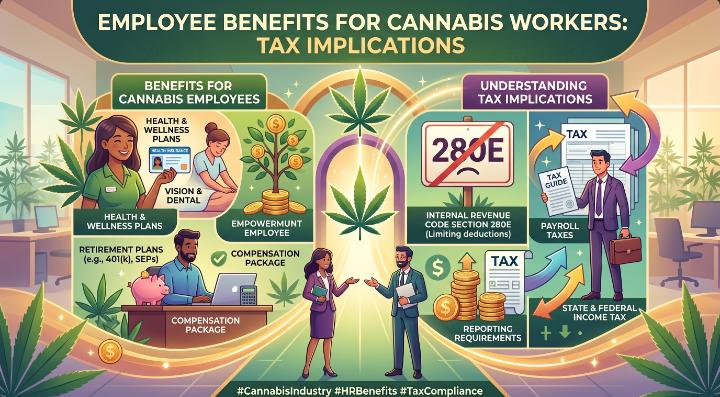
Cannabis Employee Benefits Tax Implications: Expert Tips for 2026
The most successful cannabis employers in the United States approach benefits not just as a compliance obligation but as a strategic tool for talent retention and tax efficiency. Here are Tranzesta’s top expert tips for 2026:
Prioritize benefits that reduce FICA taxes:
Even though your employer contribution to a 401(k) is not federally deductible under 280E, employees’ pre-tax contributions lower their W-2 wages — which reduces both the employee’s and your FICA tax liability. This creates real savings that offset some of the 280E pain.
Offer benefits with high employee perceived value and lower employer cost:
Voluntary benefits like dental, vision, and life insurance — where employees pay the premium through pre-tax payroll deductions — cost your business very little while providing significant value to employees. The employee’s pre-tax contribution reduces their taxable income, even though your cost as the employer is minimal.
Use a Professional Employer Organization (PEO) carefully:
Some cannabis employers use PEOs to access enterprise-level benefit programs. However, not all PEOs are cannabis-friendly — and some create co-employment complexities that affect your COGS allocation analysis. Always consult a cannabis CPA before engaging a PEO.
Document all COGS payroll allocations in a formal written policy:
Create a written Payroll Allocation Policy that describes how you determine which portion of each employee’s compensation is attributable to COGS-producing activities. Update it annually to reflect any changes in job duties or staffing.
Track state 280E decoupling legislation:
As of 2026, several US states continue to update their cannabis tax laws. New state-level relief provisions can suddenly make previously non-deductible benefit costs partially or fully deductible at the state level — potentially saving your dispensary thousands of dollars per year.
Never use cannabis product discounts as a substitute for cash compensation:
Beyond the taxable income reporting obligation, offering excessive product discounts in lieu of salary can create wage theft liability under state labor laws if the discount value does not meet minimum wage requirements.
Most importantly, work with a CPA who specializes in cannabis — not a generalist who occasionally handles dispensary clients. The intersection of 280E, ERISA, state labor law, and payroll tax is simply too complex for a generic accounting approach. Tranzesta’s team manages this complexity so you can focus on running your dispensary.
Conclusion
Cannabis employee benefits tax implications create a unique financial burden for dispensary owners across the United States — but understanding the rules clearly makes the challenge manageable. Three takeaways define what every cannabis employer needs to know. First, Section 280E prevents cannabis businesses from deducting most employee benefit costs at the federal level, but employees can still receive many benefits on a tax-free or pre-tax basis. Second, legitimate payroll allocations to COGS under IRC Section 471 offer a meaningful way to preserve some deductibility — but these allocations must be carefully documented and consistently applied. Third, state-level cannabis tax relief provisions can significantly offset the federal 280E burden, making a state-by-state analysis an essential part of every cannabis employer’s annual tax strategy.
For cannabis business owners throughout the USA,
getting your benefits structure right is both a compliance imperative and a competitive advantage. Furthermore, as cannabis employment law and tax treatment continue to evolve in 2026, expert guidance is your most valuable asset.
Ready to get expert help? Email us at hello@tranzesta.com or visit Tranzesta.com to schedule your free tax strategy session today.
FAQs
Cannabis businesses in the United States generally cannot deduct employee benefit costs at the federal level due to IRS Section 280E, which prohibits deductions for businesses trafficking in Schedule I controlled substances. However, a portion of payroll costs directly tied to Cost of Goods Sold activities may be deductible under IRC Section 471. Additionally, some US states have decoupled from federal 280E treatment and allow cannabis businesses to deduct employee benefit costs at the state level, providing partial tax relief.
Employee discounts on cannabis products are generally considered taxable income for cannabis dispensary employees in the United States. The IRS Section 132 qualified employee discount exclusion does not apply to cannabis products because they are federally illegal goods. Therefore, the fair market value of any cannabis Dispensaries that fail to report these discounts correctly risk payroll tax liability and IRS penalties.
Cannabis dispensaries can offer 401(k) and other qualified retirement plans to their employees under IRS rules. The 401(k) remains a highly valued benefit for cannabis workers and also reduces the employer’s FICA payroll tax obligation. Cannabis businesses must ensure their retirement plan documents meet IRS qualification requirements under IRC Section 401.
Section 280E affects cannabis businesses by disallowing federal income tax deductions for most payroll and employee benefit costs. However, 280E does not eliminate payroll tax obligations — cannabis employers still must pay and withhold FICA taxes (Social Security and Medicare), federal unemployment tax (FUTA), and state payroll taxes on all employee wages. The result is that cannabis employers pay payroll taxes on compensation they cannot deduct from their federal income tax — effectively increasing their overall tax burden compared to non-cannabis businesses.
Cannabis dispensary employees can receive several benefits on a tax-free or pre-tax basis despite their employer’s Section 280E restrictions. These include employer-paid health insurance premiums, which are excluded from employee income under IRC Section 106; pre-tax 401(k) elective deferrals; qualified transportation fringe benefits up to $315 per month in 2026 under IRC Section 132(f); and pre-tax health savings account (HSA) contributions if paired with a high-deductible health plan. The employer loses the federal deduction, but the employee’s favorable tax treatment remains intact under current IRS rules.