Cannabis businesses in the United States face
one major tax challenge: they often pay taxes on income they never truly keep. This happens because most deductions are disallowed under IRS rules. That’s why cannabis cost accounting COGS tracking is critical for survival and profitability.
If you get COGS wrong, you could overpay
thousands—or even hundreds of thousands—in taxes. However, if you get it right, you can significantly reduce taxable income legally.
In this guide, you’ll learn exactly how cannabis cost
accounting works in the USA, how to track COGS accurately, and how to avoid costly IRS mistakes. You’ll also discover expert strategies used by successful cannabis operators and how Tranzesta helps businesses stay compliant.
Let’s start with the basics.
What Is Cannabis Cost Accounting COGS Tracking?
Cannabis cost accounting COGS tracking is the process of identifying, calculating, and documenting the direct costs associated with producing or purchasing cannabis products for sale.
In simple terms, it determines what portion of your revenue is tax-deductible under strict IRS rules.
Why Is Cannabis Cost Accounting So Important in the USA?
Cannabis businesses in the United States operate under Internal Revenue Code Section 280E. This rule prevents businesses involved in controlled substances from deducting most operating expenses.
However, they can deduct Cost of Goods Sold (COGS).
For example, a dispensary in California generating $1.5 million in revenue may only deduct COGS—not rent, marketing, or admin salaries. Therefore, proper cannabis cost accounting COGS tracking becomes the primary way to reduce taxable income.
What Costs Are Included in COGS?
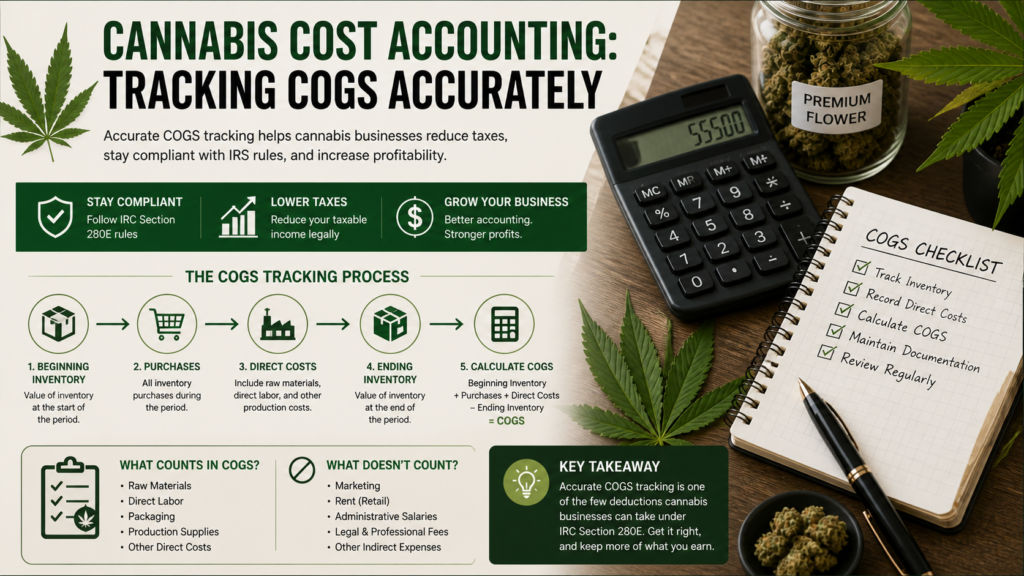
COGS includes only direct costs tied to inventory. These typically include:
Raw materials for growers
Wholesale inventory purchases for dispensaries
Direct labor involved in production
Certain production-related overhead
In contrast, expenses like advertising, executive salaries, and retail rent do not qualify.
How Does Cannabis Cost Accounting COGS Tracking Work Under IRS Rules?
Cannabis cost accounting COGS tracking follows strict IRS inventory accounting principles, primarily under Sections 471 and 280E.
In short, you must track inventory accurately and include only allowable costs in COGS.
Key IRS Rules You Must Follow
To comply in the United States, cannabis businesses must follow these rules:
Use inventory accounting (IRC Section 471)
This defines how inventory and COGS are calculated.
Apply Section 280E limitations
Most indirect expenses cannot be deducted.
Use a consistent accounting method
FIFO (First-In, First-Out) is commonly used.
Track beginning and ending inventory
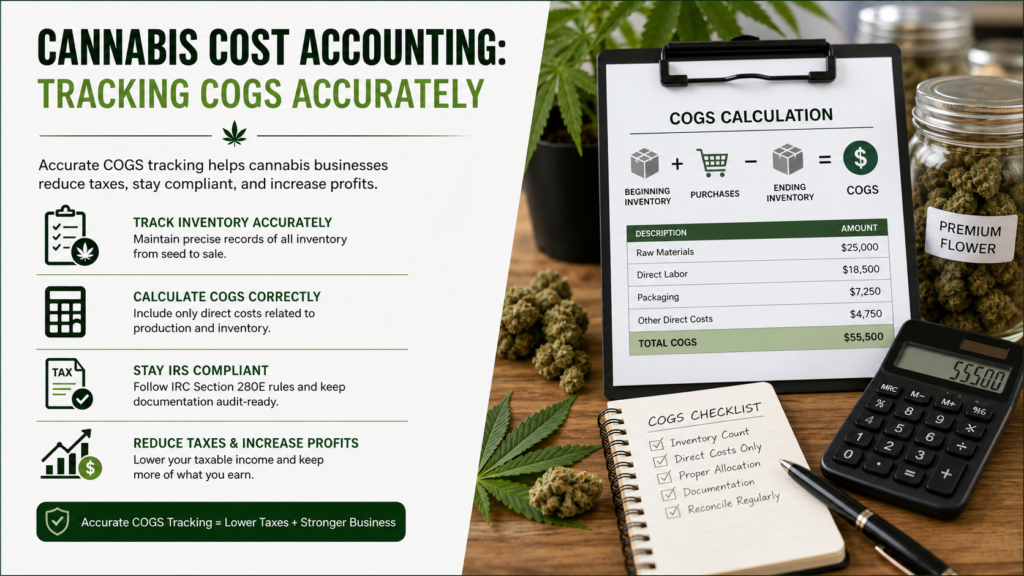
COGS = Beginning Inventory + Purchases − Ending Inventory
Maintain detailed documentation
The IRS requires proof for every cost included.
Avoid aggressive allocations
Overstating COGS can trigger audits.
You can review IRS inventory rules here (opens in a new tab):
https://www.irs.gov/publications/p538
Direct vs Indirect Costs Explained
Direct costs are expenses directly tied to production or inventory. These are included in COGS.
Indirect costs, such as marketing or general admin, are not deductible under Section 280E.
Additionally, cannabis businesses cannot use full Section 263A capitalization like other industries. This limitation increases the importance of precise cannabis cost accounting and COGS tracking.
Common Mistakes in Cannabis Cost Accounting COGS Tracking
Cannabis businesses in the USA often overpay taxes due to avoidable accounting mistakes. Here are the most common issues.
Misclassifying Expenses
Many operators incorrectly include non-allowable expenses in COGS.
For example, including marketing or retail salaries can lead to IRS penalties.
Poor Inventory Tracking
Without accurate inventory counts, your COGS calculation becomes unreliable.
As a result, your tax filings may not reflect actual costs.
Ignoring Section 280E
Some businesses apply standard accounting rules without adjusting for 280E.
However, cannabis businesses must follow stricter guidelines.
Lack of Documentation
Even correct calculations can fail without supporting records.
The IRS requires invoices, payroll records, and inventory logs.
Inconsistent Accounting Methods
Switching between methods like FIFO and LIFO without proper documentation raises red flags.
Consistency is essential in cannabis cost accounting and COGS tracking.
Step-by-Step Guide: How to Track COGS Accurately
Cannabis cost accounting COGS tracking becomes manageable when you follow a structured system.
Step 1: Identify Your Business Model
Determine whether you are a cultivator, manufacturer, distributor, or dispensary.
Each model has different allowable COGS components.
Step 2: Choose an Accounting Method
Select a consistent inventory method, such as FIFO.
This ensures compliance with IRS expectations.
Step 3: Track Beginning Inventory
Start with the inventory value at the beginning of the tax year.
This number must match your previous year’s ending inventory.
Step 4: Record All Direct Costs
Track every cost tied to production or inventory.
This includes materials, labor, and purchase costs.
Step 5: Calculate Ending Inventory
Conduct physical inventory counts regularly.
Accurate counts prevent misstatements in your financials.
Step 6: Apply the COGS Formula
COGS = Beginning Inventory + Purchases − Ending Inventory
This formula determines your deductible amount.
Step 7: Maintain Audit-Ready Records
Store all documentation securely.
This protects your business during IRS audits.
How Tranzesta Can Help With Cannabis Cost Accounting COGS Tracking
Cannabis tax compliance in the United States is complex. That’s why businesses rely on Tranzesta for expert guidance.
Tranzesta is a US-based tax consultation firm specializing in cannabis accounting, Streamlined Filing, creator taxes, and business bookkeeping for US taxpayers.
Here’s how Tranzesta supports cannabis businesses:
Accurate COGS calculation aligned with IRS rules
Inventory tracking system setup
Section 280E compliance strategies
Monthly bookkeeping tailored to cannabis operators
Audit preparation and documentation support
Most importantly, Tranzesta helps reduce your tax liability while keeping your business compliant.
Contact our team at hello@tranzesta.com for a free consultation.
Visit Tranzesta.com to learn more about our cannabis accounting services.
Learn more about business tax and bookkeeping at Tranzesta.com.
Explore IRS compliance strategies at Tranzesta.com.
Cannabis Cost Accounting COGS Tracking: Expert Tips for 2026
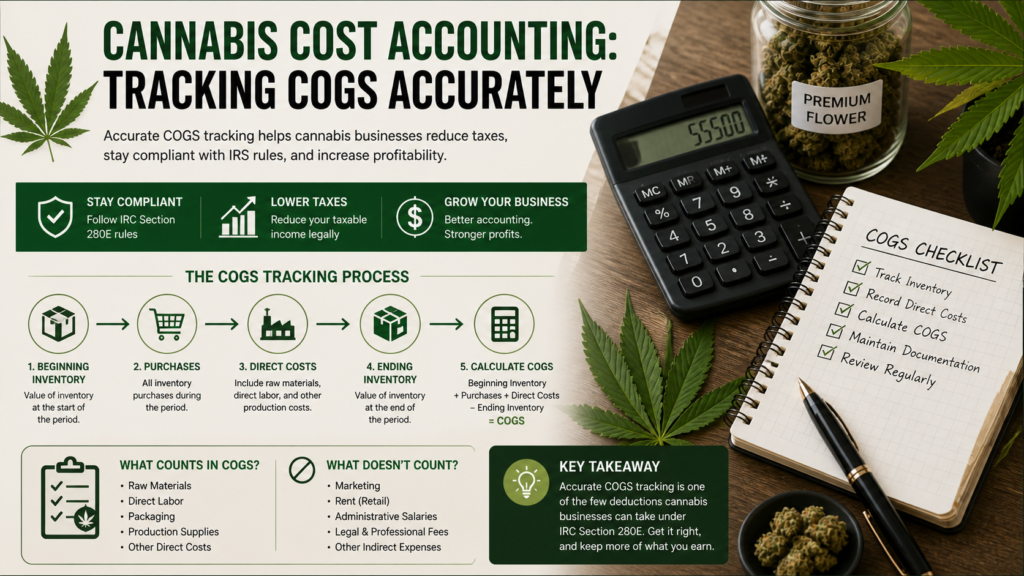
Cannabis cost accounting COGS tracking can significantly improve your tax position when handled strategically.
Here are expert insights used by top-performing cannabis businesses in the USA:
Use automated inventory systems
This reduces human error and improves reporting accuracy.
Segment cannabis vs non-cannabis revenue
This allows additional deductions where legally permitted.
Review COGS allocations quarterly
Early corrections prevent year-end surprises.
Work with cannabis-specific tax professionals
General accountants may not fully understand Section 280E.
Prepare for IRS audits proactively
Maintain organized, digital records at all times.
According to industry data, proper COGS tracking can reduce taxable income by 20% to 40% for cannabis businesses.
Tranzesta implements these strategies to help clients maximize compliance and profitability.
Conclusion
Cannabis cost accounting COGS tracking is essential for every cannabis business operating in the United States.
Here are the three key takeaways:
COGS is often your only major deduction under Section 280E
Accurate inventory tracking ensures compliance and tax savings
Mistakes can lead to audits, penalties, and lost profits
Therefore, investing in expert accounting support is a smart business decision.
Ready to get expert help? Email us at hello@tranzesta.com or visit Tranzesta.com to schedule your free tax strategy session today.
FAQs
Cannabis cost accounting COGS tracking defines COGS as the direct costs of producing or purchasing cannabis products. This includes raw materials, inventory purchases, and direct labor. In the United States, cannabis businesses can deduct COGS under IRS Section 280E, even though most other expenses are disallowed.
Cannabis cost accounting COGS tracking highlights that most operating expenses are not deductible due to Section 280E. However, businesses can deduct COGS. Proper separation of cannabis and non-cannabis activities may allow additional deductions in certain cases.
Cannabis cost accounting COGS tracking uses the formula: Beginning Inventory + Purchases − Ending Inventory = COGS. Dispensaries must track inventory accurately and maintain consistent accounting methods to comply with IRS rules.
Cannabis cost accounting COGS tracking commonly uses FIFO (First-In, First-Out). This method aligns with IRS inventory guidelines. Consistency and documentation are more important than the method itself.
Cannabis cost accounting COGS tracking emphasizes that Section 280E limits deductions for cannabis businesses in the USA. Since most expenses are disallowed, accurate COGS tracking becomes the primary way to reduce taxable income legally.
Talk to a real, signing professional
AI precision, human accountability — across the US, UK & UAE.
Book a free consultation