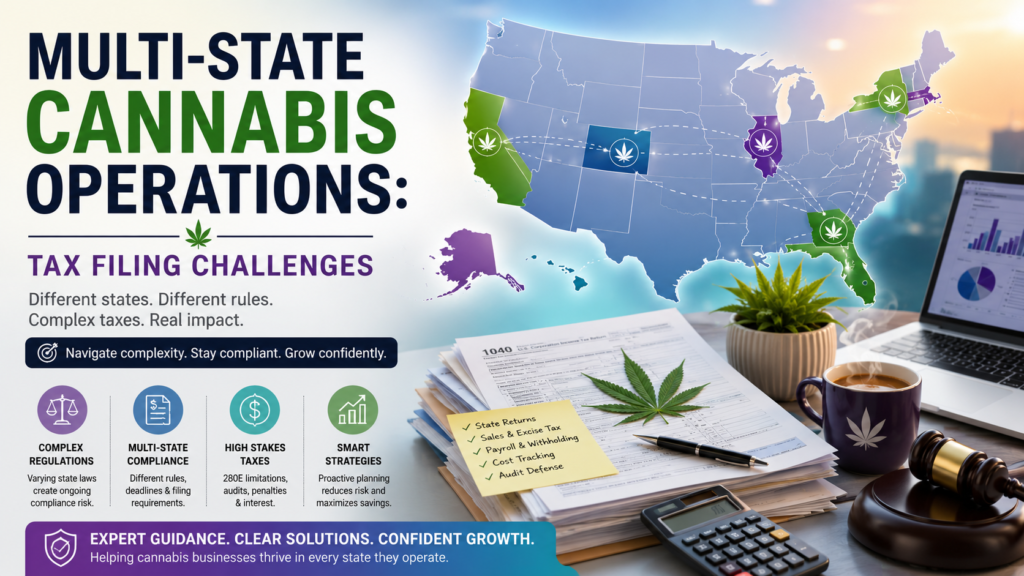
Running a cannabis business in multiple states sounds
like a growth success story — and it is. However, multi-state cannabis operations tax filing is one of the most punishing compliance challenges in all of American business. The tax code does not treat cannabis kindly, and operating across state lines multiplies every risk, every deadline, and every potential penalty.
In this guide, you will learn exactly why multi-state cannabis operations tax filing is so complex, which federal and state rules apply to your business, the most common mistakes operators make, and a step-by-step process to get and stay compliant in 2026. Whether you run dispensaries, cultivation sites, or distribution arms across California, Colorado, Illinois, or any other legal state, this resource is built for you.
What Is Multi-State Cannabis Operations Tax Filing?
Multi-state cannabis operations tax filing refers to the full set of federal, state, and local tax obligations that apply when a cannabis business has a presence — through sales, payroll, inventory, or physical locations — in more than one US state. It is far more complex than standard multi-state business filing because cannabis is still a Schedule I controlled substance under federal law.
Why Federal Law Makes Everything Harder
Under the Controlled Substances Act, cannabis remains federally illegal. As a result, cannabis businesses cannot use standard federal business deductions. Instead, they are governed by Internal Revenue Code Section 280E, which prohibits any business “trafficking” in a Schedule I or II substance from deducting ordinary business expenses. Only the Cost of Goods Sold (COGS) is deductible.
For a single-state operator, 280E is painful.
For a multi-state operator, 280E is painful in every jurisdiction simultaneously. Each state has its own income tax treatment of cannabis, and most do not perfectly mirror federal rules.
⚠ Key Stat: According to the IRS, cannabis businesses are audited at higher rates than most industries due to 280E compliance issues. A single misclassified expense can trigger a six-figure tax liability.
Who Needs to File in Multiple States?
Cannabis operators typically trigger multi-state filing requirements when they have a physical dispensary, cultivation facility, or processing center in more than one state. However, nexus — the legal threshold that obligates you to file in a state — can also be triggered by employees working remotely across state lines, inventory stored in another state, or delivery operations crossing state borders.
Understanding nexus is the first step. After that,
every state has its own cannabis-specific excise taxes, income taxes, sales taxes, and reporting deadlines that must be tracked separately.
How Does IRS Code 280E Affect Multi-State Cannabis Operations Tax Filing?
IRS Section 280E is the single biggest tax challenge for any cannabis business in the United States. It states that no deduction or credit shall be allowed for any amount paid or incurred in carrying on a trade or business that consists of trafficking in a controlled substance.
What 280E Actually Means for Your Bottom Line
In practical terms, a cannabis business cannot deduct rent, salaries, marketing costs, banking fees, or most other ordinary operating expenses on a federal return. Only the direct cost of producing or acquiring the product — COGS — is deductible. For multi-state operators, this rule applies to every entity and every location.
For example, if your multi-state operation earns $5 million in gross revenue and has $3.5 million in operating costs, a regular business would be taxed on $1.5 million. Under 280E, you could end up taxed on $3 million or more, depending on how COGS is calculated.
State-Level Deviations From 280E
Several US states have decoupled from federal 280E treatment. States such as California, Colorado, and Massachusetts allow cannabis businesses to deduct standard business expenses at the state level — even though the same deductions are denied federally. However, other states conform fully to federal treatment.
Multi-state operators must therefore track every expense, categorize it correctly, and apply a different tax treatment in each jurisdiction. This is not a spreadsheet job — it requires dedicated cannabis accounting expertise, like the services Tranzesta provides.
📌 IRS Reference: IRS Publication 334 (Tax Guide for Small Business) and the IRS’s own guidance at IRS.gov acknowledge that cannabis businesses are subject to 280E. Learn more at https://www.irs.gov/businesses/small-businesses-self-employed/marijuana-industry
Key Tax Filing Requirements for Multi-State Cannabis Operations
Multi-state cannabis operations face a layered web of obligations. Here is a breakdown of the core requirements every operator needs to understand.
Federal Tax Obligations
All cannabis businesses must file a federal income tax return, typically on Form 1120 (C-Corporation), Form 1120-S (S-Corporation), or Schedule C (sole proprietor). Payroll taxes — Form 941 — are required quarterly. Because banks often refuse cannabis accounts, the IRS also allows cannabis businesses to pay taxes in cash, though they must pre-notify the IRS using Form 8300.
File federal income tax return annually (Form 1120, 1120-S, or Schedule C)
Pay estimated taxes quarterly (Form 1040-ES or Form 1120-W)
Report and remit payroll taxes quarterly via Form 941
File Form 8300 for cash payments over $10,000
Maintain detailed COGS records to maximize allowable deductions under 280E
State-Level Tax Obligations
Each state where you have nexus requires a separate state income tax return and, typically, a cannabis-specific excise tax return. States like Illinois impose a tiered cannabis excise tax based on THC potency. California charges a 15% cannabis excise tax plus local sales taxes that can exceed 10%. Colorado has its own retail marijuana sales tax. These are separate from income tax filings.
Additionally, multi-state operators must maintain a separate payroll tax account in each state where employees work. Sales tax registration is mandatory wherever taxable cannabis sales occur.
Local Tax and Licensing Compliance
Beyond state requirements, many counties and cities impose additional cannabis taxes and license fees. Los Angeles, San Francisco, Chicago, and Denver each have local cannabis business taxes that operate independently of state-level requirements. These must be tracked and filed on separate local schedules — often quarterly or monthly.
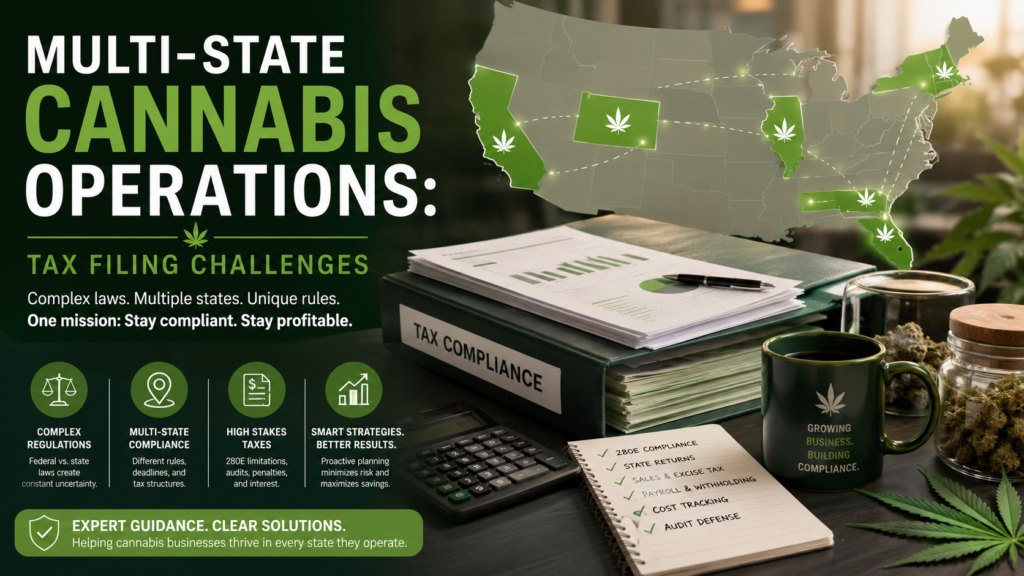
Common Mistakes in Multi-State Cannabis Operations Tax Filing
Even experienced business owners get tripped up by the complexity of multi-state cannabis taxes. Here are the most costly mistakes Tranzesta sees regularly.
Mistake 1: Misclassifying Expenses Under 280E
The most expensive mistake multi-state cannabis operators make is incorrectly categorizing operating expenses as COGS to artificially inflate deductions. The IRS scrutinizes cannabis returns closely, and any reclassification caught in audit results in back taxes, interest, and steep penalties. Every expense must be accurately categorized from day one.
Mistake 2: Failing to Establish Nexus in Every Active State
Many cannabis operators focus on their primary state and neglect to register and file in states where they have secondary operations. Delivering products to a neighboring state, paying remote employees in a different state, or storing inventory across state lines can all create tax nexus. Ignoring these obligations does not make them disappear — it creates compounding back-tax liability.
Mistake 3: Treating State and Federal Returns as Identical
Since some states decouple from 280E, the taxable income on your federal return and your California or Colorado return can be dramatically different. Filing both returns with the same figures is a common and costly error. Each return must be prepared independently using the correct state-specific rules.
Mistake 4: Poor Record-Keeping Across Locations
Multi-state cannabis operations generate enormous volumes of financial records — inventory logs, COGS calculations, sales receipts, payroll records, and excise tax payments — across every location. Without a centralized, organized recordkeeping system, annual tax filing becomes a crisis exercise. The IRS recommends retaining all business records for at least three years, and cannabis businesses should keep them longer given audit risk.
Mistake 5: Missing State-Specific Deadlines
Every state has its own tax calendar. California’s cannabis excise tax is due quarterly. Illinois has its own monthly excise tax reporting requirements. Colorado’s marijuana sales tax deadlines differ from income tax deadlines. Multi-state operators who only track the federal April 15 deadline routinely miss state-level filings and incur unnecessary penalties.
Step-by-Step Guide to Multi-State Cannabis Operations Tax Filing
Here is a practical, actionable process for managing your multi-state cannabis tax obligations in 2026.
Step 1: Determine your nexus in every state.
Before you file anything, map out every state where your cannabis business has economic or physical presence. This includes dispensary locations, cultivation and processing facilities, warehouse or distribution operations, and remote employees. Consult a cannabis tax professional to confirm which activities create filing obligations in each jurisdiction.
Step 2: Register with state tax authorities in every nexus state.
Once you’ve identified your nexus states, register with each state’s department of revenue. This typically includes sales tax registration, income tax account setup, and cannabis-specific excise tax registration. Many states require this before your first sale — not after.
Step 3: Set up a COGS tracking system that separates allowable federal deductions.
Your accounting system must clearly separate COGS from non-COGS operating expenses at the entity level and at each location. This is the foundation of 280E compliance. Use cannabis-specific accounting software and have a professional review your chart of accounts.
Step 4: Build a multi-state tax calendar.
List every tax filing deadline for every jurisdiction: federal estimated tax dates (April 15, June 15, September 15, January 15), state income tax due dates, and cannabis excise tax filing schedules for each active state. Assign ownership of each deadline to a specific team member or your accountant.
Step 5: Prepare state returns using state-specific rules, not federal treatment.
Work with a cannabis-specialized CPA to prepare each state return independently. Identify which states decouple from 280E, which allow additional deductions, and how each state defines taxable income for cannabis entities. Never copy your federal return figures directly into state returns.
Step 6: File and remit all cannabis excise taxes on the correct schedule.
Cannabis excise taxes are separate from income taxes and have their own filing schedules. These must be filed and paid on time — penalties for late cannabis excise tax payments are aggressive in most states. Set automated reminders at least two weeks before each excise tax due date.
Step 7: Conduct an annual compliance review before your federal return is due.
Each year, review your entire multi-state filing picture before April 15. Verify that all state returns are filed, all excise taxes are current, all payroll tax accounts are reconciled, and all COGS documentation is complete and accurate. This review prevents costly surprises during an IRS audit.
Ready to Get Help? Contact our team at hello@tranzesta.com for a free consultation. Visit Tranzesta.com to learn more about our
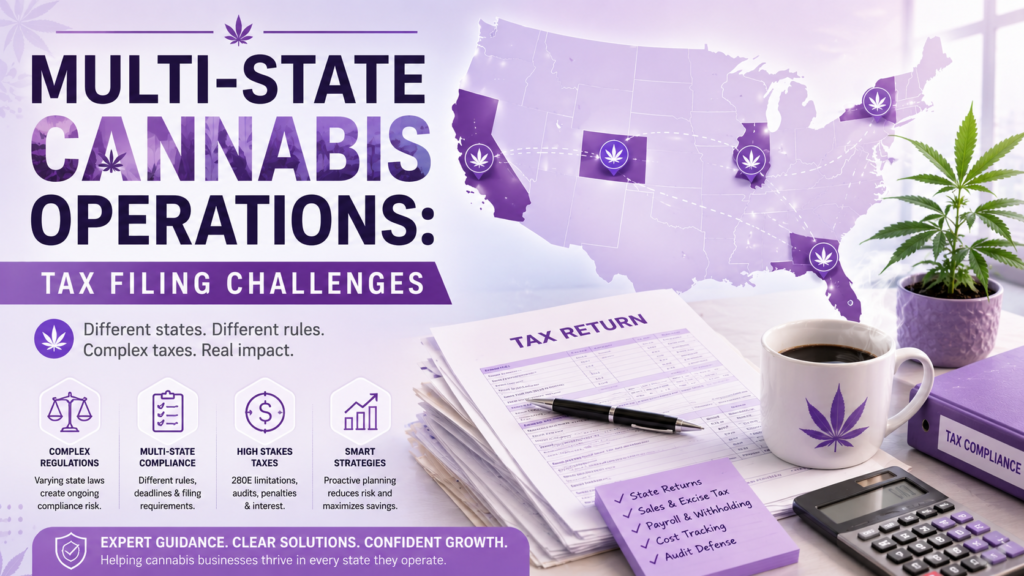
Multi-State Cannabis Operations Tax Filing: Expert Tips for 2026
Based on years of working with cannabis operators across the United States, here are Tranzesta’s top expert tips for multi-state cannabis tax compliance in 2026.
Maintain a separate legal entity (LLC or corporation) for each state’s operations where possible. This simplifies 280E calculations, limits liability, and makes multi-state tax filings cleaner.
Never commingle funds across state entities.
Each entity should have its own bank account, its own payroll account, and its own accounting records.
Get a cannabis-specific CPA, not a generalist.
The 280E landscape changes frequently — including ongoing Congressional debate about rescheduling cannabis — and only specialists track these developments in real time.
Budget for a higher effective tax rate.
Multi-state cannabis operators routinely pay effective federal tax rates of 50–70% due to 280E. Model this into your financial projections so it does not become a cash flow crisis at tax time.
Document everything.
In a cannabis IRS audit, the burden of proof is on the business. Every COGS dollar must be traceable to an invoice, a purchase order, or a payroll record.
Stay current on rescheduling news.
If cannabis is rescheduled from Schedule I to Schedule III, 280E would no longer apply — dramatically changing your tax picture. However, rescheduling is not guaranteed, and you must file under current law until any rescheduling is finalized.
💡 Pro Insight: Tranzesta tracks all legislative developments affecting cannabis taxation in the USA. Our clients receive proactive updates whenever tax law changes could affect their multi-state filing strategy.
Conclusion
Multi-state cannabis operations tax filing is one of the most complex challenges in American business tax law. Three key takeaways from this guide: first, IRS Section 280E severely limits federal deductions for cannabis businesses, making expert COGS management essential. Second, every state has unique cannabis tax rules and deadlines that must be managed independently. Third, the consequences of non-compliance — including aggressive IRS audits and state penalties — make professional guidance not optional but necessary.
The good news is that with the right systems, the right accountant, and a clear multi-state compliance calendar, cannabis operators can minimize their tax burden and stay ahead of every deadline.
🚀 Ready to Get Expert Help? Email us at hello@tranzesta.com or visit Tranzesta.com to schedule your free tax strategy session today. Tranzesta’s cannabis tax specialists are ready to help you navigate every state, every deadline, and every dollar.
FAQs
Yes. IRS Section 280E is a federal law that applies to all cannabis businesses operating in the United States, regardless of which state they are in. It prohibits cannabis businesses from deducting ordinary business expenses because cannabis remains a Schedule I controlled substance federally.
Multi-state cannabis operators typically owe several types of taxes in each active state: state income tax on business profits, cannabis-specific excise taxes (often a percentage of the retail price or based on THC content), sales tax on retail cannabis transactions, and payroll taxes for employees in that state. Additionally, many cities and counties impose local cannabis business taxes. Each state has its own rates, forms, and filing deadlines, requiring a separate compliance calendar for every jurisdiction.
COGS typically includes the direct cost of purchasing or producing the cannabis product: raw material costs, direct labor, and certain overhead costs directly tied to production. Operating expenses such as rent, marketing, and general administrative costs cannot be included in COGS. Accurate COGS calculation is the primary lever for reducing federal tax liability under 280E.
Failing to file taxes in a state where your cannabis business has nexus can result in significant back taxes, interest, and civil penalties. Most states impose failure-to-file penalties ranging from 5% to 25% of the tax owed. Cannabis businesses are already at elevated audit risk, so unregistered nexus creates compounding legal and financial exposure.
such as administrative staff, marketing employees, or front-of-house dispensary personnel — are not deductible as operating expenses on a federal return. However, wages paid to employees whose work is directly tied to production and COGS — such as growers, processors, and certain logistics staff — may be included in COGS calculations. Correct classification of employee roles is critical and should be reviewed by a cannabis tax specialist.
2 Responses