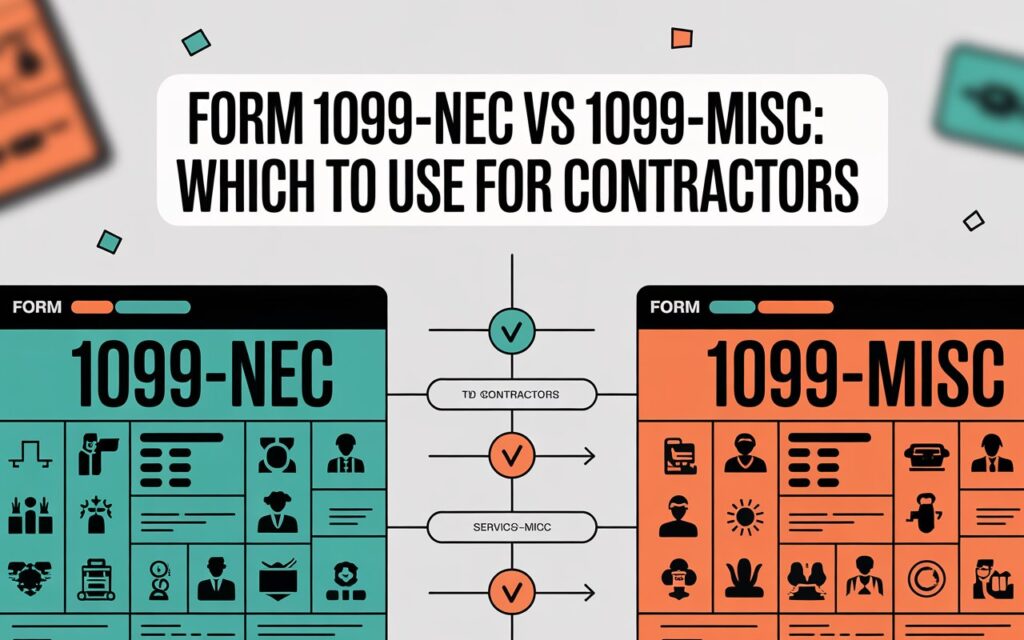
Every year, thousands of US businesses send
the wrong 1099 form to their contractors — and face IRS penalties they could have easily avoided. The confusion between Form 1099-NEC vs 1099-MISC for contractors is one of the most common tax filing mistakes in America today. In this complete 2026 guide, you will learn exactly which form to use, when each applies, what the filing deadlines are, and how to stay fully compliant with IRS rules.
Whether you run a cannabis dispensary that pays freelance trimmers, an OnlyFans agency that compensates independent managers, or a traditional US business that hires contractors, this guide covers everything you need to know. Additionally, if you want a tax professional to handle your 1099 filings from start to finish, Tranzesta is here to help. Let’s begin with the fundamentals.
What Are Form 1099-NEC and Form 1099-MISC — and Why Does the Difference Matter?
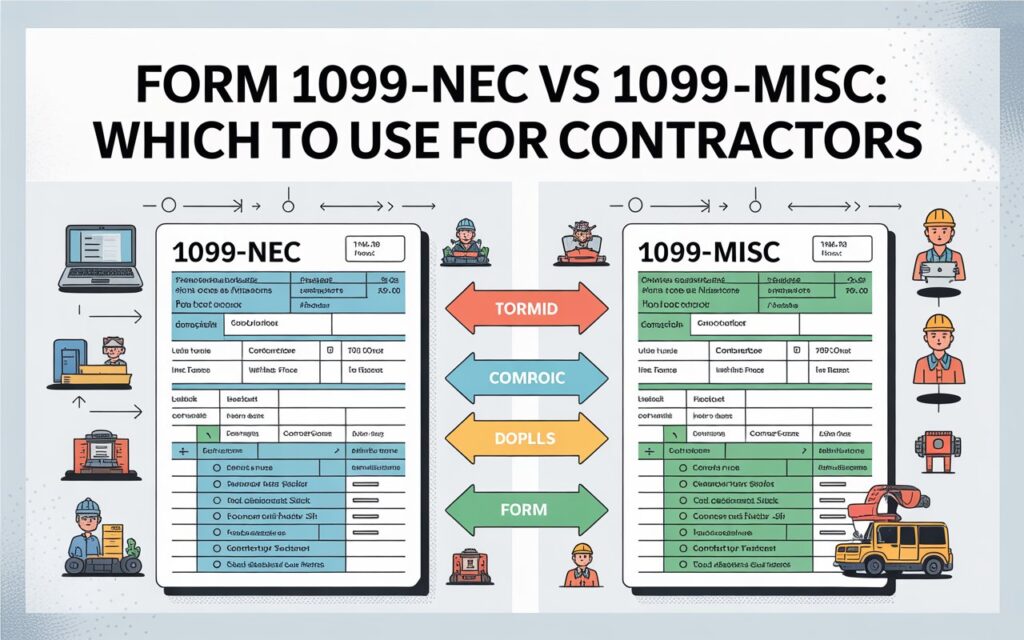
Form 1099-NEC (Nonemployee Compensation) and Form 1099-MISC (Miscellaneous Information) are both IRS information returns used to report payments made to non-employees. However, they cover different types of payments, carry different deadlines, and trigger different tax treatment for recipients.
Getting the right form to the right person by the right deadline is not optional. The IRS requires businesses to report contractor payments accurately. Sending the wrong form — or no form at all — can result in penalties of $60 to $630 per form, depending on how late or incorrect the filing is.
What Is Form 1099-NEC?
Form 1099-NEC was reintroduced by the IRS in 2020 to specifically report nonemployee compensation — that is, payments made to independent contractors, freelancers, and self-employed individuals for services performed in a trade or business. Before 2020, this type of income was reported in Box 7 of Form 1099-MISC.
The IRS requires a 1099-NEC for any individual,
sole proprietor, or single-member LLC that you paid $600 or more during the tax year for services rendered. For example, if you paid a freelance web developer $800 to build your website, you must send that developer a Form 1099-NEC by January 31 of the following year.
Nonemployee compensation
(the technical term for payments reported on 1099-NEC) is subject to self-employment tax at the federal level. Therefore, recipients use this form to calculate their own income tax and self-employment tax obligations on Schedule SE.
What Is Form 1099-MISC?
Form 1099-MISC still exists, but its role changed significantly in 2020 when nonemployee compensation was moved to the new Form 1099-NEC. Today, Form 1099-MISC reports a specific set of miscellaneous income types that are not contractor service payments. These include rents, royalties, prizes and awards, medical and health care payments, and attorney fees (in certain circumstances).
Additionally, Form 1099-MISC reports direct sales of consumer products worth $5,000 or more. In contrast to 1099-NEC, the 1099-MISC filing deadline is February 28 (paper) or March 31 (electronic) — not January 31. This distinction catches many US business owners off guard.
Key IRS Rules: When to Use Form 1099-NEC vs 1099-MISC for Contractors
Understanding which form applies to which payment requires knowing the IRS rules for each. Here is a clear breakdown of when each form applies, along with the thresholds and deadlines that govern them.
When to Use Form 1099-NEC
Use Form 1099-NEC when all four of the following conditions are met:
You made the payment to someone who is not your employee (an independent contractor, freelancer, or self-employed individual)
You made the payment for services in the course of your trade or business — not for personal reasons
You paid the individual, partnership, or estate $600 or more during the tax year
The payment was made to an individual, sole proprietorship, partnership, or LLC that is not taxed as a corporation
Corporations — both C-corporations and S-corporations — are generally exempt from receiving a 1099-NEC for services. However, there are exceptions. Payments to attorneys (even those structured as corporations) and payments for medical or health care services must still be reported. Always collect a Form W-9 from every contractor before making payment so you know their entity type and taxpayer identification number.
The deadline to file Form 1099-NEC with the IRS
and send copies to recipients is January 31, 2026, for the 2025 tax year. This is one of the earliest information return deadlines in the US tax calendar, and missing it carries penalties starting at $60 per form. You can access the official 1099-NEC instructions at IRS.gov/Form1099NEC (opens in new tab). https://www.irs.gov/forms-pubs/about-form-1099-nec]
When to Use Form 1099-MISC
Use Form 1099-MISC when you pay $600 or more in any of the following categories to a non-corporate recipient:
Rents — for example, office or equipment rental payments to an individual landlord
Royalties — $10 or more (lower threshold than other categories)
Prizes and awards not for services (including winnings from business promotions)
Medical and health care payments to physicians, hospitals, or other health care providers
Crop insurance proceeds
Payments to an attorney for legal services (even if the attorney is a corporation)
The 1099-MISC deadline is February 28, 2026, for paper filers and March 31, 2026, for electronic filers. However, if you report payments in Box 8 (substitute payments) or Box 10 (gross proceeds to attorneys), the recipient copy deadline moves to February 15.
What About OnlyFans and Content Creators?
Content creators who receive payments from platforms like OnlyFans typically receive a 1099-NEC or 1099-MISC from the platform, depending on the payment type. However, content creators who also run their own business and pay freelance editors, social media managers, or photographers must issue 1099-NEC forms to those contractors if they meet the $600 threshold. This is one area where Tranzesta’s creator tax expertise makes a real difference — many creators do not realize they have their own 1099 filing obligations as payers.
Common Form 1099-NEC vs 1099-MISC Contractor Mistakes That Trigger IRS Penalties
Even financially savvy business owners make 1099 filing errors. Below are the five most costly mistakes US businesses make when navigating Form 1099-NEC vs 1099-MISC for contractors.
Mistake 1: Still Using 1099-MISC to Report Contractor Payments
Before 2020, all contractor payments went on Form 1099-MISC Box 7. Many business owners — and even some accountants — still mistakenly use 1099-MISC for contractor service payments. As a result, the IRS may not properly credit the contractor’s income, and you may face penalties for filing the wrong form. If you pay an independent contractor for services, use Form 1099-NEC. Full stop.
Mistake 2: Missing the January 31 Deadline for 1099-NEC
The 1099-NEC deadline of January 31 is earlier than most other information return deadlines. Many businesses confuse it with the 1099-MISC deadline (late February or March) and miss the January cutoff entirely. The IRS penalty for filing 1–30 days late is $60 per form. Filing 31 days late through August 1 costs $130 per form. Filing after August 1 or not at all costs $330 per form. These amounts double for intentional disregard, reaching up to $660 per form.
Mistake 3: Failing to Collect Form W-9 Before Payment
Form W-9 is the IRS document that contractors use to provide their legal name, address, and taxpayer identification number (TIN). Without a W-9, you cannot accurately complete a 1099-NEC or 1099-MISC. Moreover, if the contractor provides incorrect information and the IRS notifies you, you are required to begin backup withholding at 24% on future payments. Collect a signed W-9 before issuing any payment — not after the year ends.
Mistake 4: Ignoring the Royalties Threshold on 1099-MISC
Most 1099 forms require a $600 minimum payment before reporting is required. However, Form 1099-MISC requires reporting royalties of $10 or more. Many cannabis businesses that pay licensing or brand royalties to individuals miss this lower threshold entirely. Similarly, bloggers and content platforms that pay royalties to individual creators must report amounts as low as $10. Therefore, review every payment category carefully against the applicable threshold before assuming no form is required.
Mistake 5: Not Filing State 1099 Reports
Federal 1099 filing is only half the obligation. Most US states require businesses to submit 1099 copies to the state tax agency as well, either directly or through the IRS Combined Federal/State Filing (CF/SF) program. However, not all states participate in CF/SF, and some require separate state submissions with different deadlines. For example, California requires direct state filing. Always verify your state’s requirements in addition to the federal IRS obligation.
How to File Form 1099-NEC vs 1099-MISC for Contractors: A Step-by-Step Guide
Follow these six steps to determine which form to use, gather the required information, and file accurately and on time. Working with a specialist like Tranzesta ensures every step is handled correctly.
Step 1: Collect Form W-9 From Every Contractor Before Payment
Before you pay any contractor a single dollar, request a completed and signed Form W-9. The W-9 collects the contractor’s legal name, business name (if different), address, entity type, and taxpayer identification number — either a Social Security Number (SSN) or Employer Identification Number (EIN). Without this information, you cannot complete a 1099 accurately. Store W-9s securely throughout the year, as they are the foundation of all your information return filings.
Step 2: Track and Categorize All Payments by Type
At year-end, review all payments made to non-employees. Categorize each payment as a service payment (goes on 1099-NEC), a rent or royalty payment (goes on 1099-MISC), or another miscellaneous income type. Your accounting software should already tag payments by vendor and category — if it does not, this is the time to reconcile your books. Additionally, flag all payments to attorneys, regardless of their entity type, as these have special rules under both forms.
Step 3: Apply the Correct Threshold and Choose the Right Form
For service payments, apply the $600 threshold. If you paid a contractor $600 or more during the calendar year for services, issue Form 1099-NEC. For royalties, apply the $10 threshold and use Form 1099-MISC Box 2. For rents, prizes, health care payments, and other miscellaneous income, apply the $600 threshold and use the appropriate box on Form 1099-MISC. Do not combine service and non-service payments on the same form.
Step 4: Complete the Form With Accurate Information
Using the W-9 on file, enter the recipient’s name, address, and TIN exactly as it appears on their W-9. Enter your business name and EIN in the payer fields. On Form 1099-NEC, enter the total service compensation in Box 1. On Form 1099-MISC, enter amounts in the appropriate numbered boxes for each income type. Double-check every TIN against the W-9 — a TIN mismatch generates an IRS B-Notice and triggers backup withholding requirements.
Step 5: Deliver Recipient Copies by the Required Deadline
Mail or electronically deliver Copy B of Form 1099-NEC to the contractor by January 31, 2026. For Form 1099-MISC, the recipient copy deadline is also January 31 for most boxes — but February 15 for Boxes 8 and 10. Delivering early is always better. Contractors need their 1099 forms to file their own tax returns, and delays create frustration and potential disputes about the reported amount.
Step 6: File Copy A With the IRS by the Applicable Deadline
File Copy A of Form 1099-NEC with the IRS by January 31, 2026 — both paper and electronic filers share this deadline. For Form 1099-MISC, the IRS deadline is February 28, 2026, for paper filers and March 31, 2026, for electronic filers. If you file 250 or more information returns of any type, the IRS requires electronic filing. Use IRS FIRE (Filing Information Returns Electronically) or an IRS-approved third-partyfiling service to submit electronically.
Form 1099-NEC vs 1099-MISC for Contractors: Expert Tips for 2026
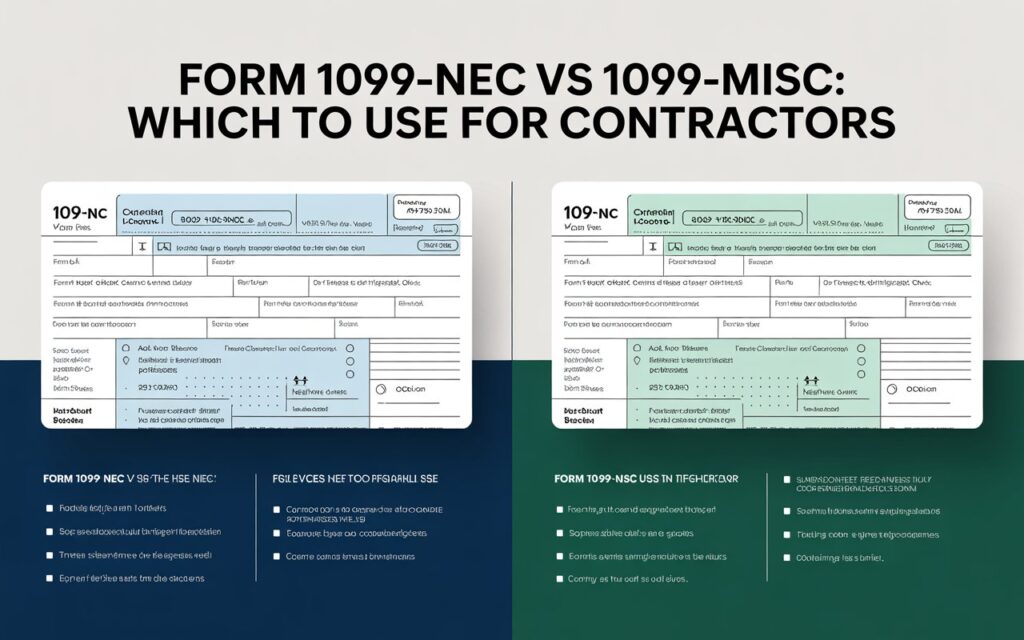
Beyond the basics, here are five professional strategies from Tranzesta that separate compliant businesses from those that get caught in avoidable IRS problems every January.
Set up a W-9 collection workflow at the point of onboarding, not at year-end.
Make it a condition of your contractor agreement that a W-9 must be received before the first payment is released. This eliminates the frantic December chase for missing TINs that plagues most small businesses every year.
Use accounting software that automatically flags contractor payments approaching the $600 threshold. QuickBooks, Xero, and most modern accounting platforms can generate 1099 reports automatically at year-end. However, always verify the output against your actual records — software only knows what you entered correctly throughout the year.
Understand the LLC filing exception carefully.
Single-member LLCs (SMILLCs) that are disregarded entities for tax purposes receive 1099-NEC forms just like sole proprietors. However, multi-member LLCs taxed as partnerships do NOT receive 1099-NEC forms for services. The W-9 each contractor submits will identify their entity type — use it to make this determination with confidence.
Consider the backup withholding rule as a compliance tool,
not a punishment. If a contractor refuses to provide a W-9 or provides an incorrect TIN, IRS rules require you to withhold 24% of each payment and remit it to the IRS as backup withholding. This rule protects you from liability if the contractor later underreports income. Therefore, treat backup withholding as a legitimate reason to insist on accurate W-9 information.
Keep copies of all issued 1099 forms and W-9s for at least
four years after the due date of the return. The IRS statute of limitations for information return audits is generally three years, but keeping records for four years provides an additional buffer. Store these securely — W-9s contain sensitive TIN information.
Anchor text: “OnlyFans and content creator tax services” → Tranzesta.com/creator-taxes]
Conclusion: Know the Difference Between 1099-NEC and 1099
Three things matter most when navigating Form 1099-NEC vs 1099-MISC for contractors: use Form 1099-NEC for all service payments to independent contractors, use Form 1099-MISC for rents, royalties, and other miscellaneous income, and meet the January 31 deadline for 1099-NEC without exception. Get these three things right and you will avoid the IRS penalties that trip up thousands of US businesses every year.
For businesses in complex spaces — cannabis, content creation, multi-contractor operations, or multi-state filings — getting professional help is not a luxury. It is the smartest financial decision you can make before the January deadline arrives. Tranzesta handles the entire process so nothing falls through the cracks.
Ready to get expert help? Email us at hello@tranzesta.com or visit Tranzesta.com to schedule your free tax strategy session today.
FAQs
Form 1099-NEC (Nonemployee Compensation) reports payments made to independent contractors and freelancers for services performed for a business. Form 1099-MISC (Miscellaneous Information) reports other types of income including rents, royalties, prizes, and health care payments. Before 2020, all contractor payments were reported on Form 1099-MISC Box 7. The IRS separated them in 2020 to give contractor compensation its own dedicated form with an earlier January 31 filing deadline, which is distinct from the February/March deadline for Form 1099-MISC.
Whether you send a Form 1099-NEC to an LLC depends on how that LLC is taxed. A single-member LLC treated as a disregarded entity and a multi-member LLC taxed as a partnership both receive Form 1099-NEC for service payments of $600 or more. However, an LLC that has elected to be taxed as a C-corporation or S-corporation is generally exempt from receiving a 1099-NEC for services. Always collect a Form W-9 from every contractor before payment to determine their entity type and filing requirement.
The deadline for filing Form 1099-NEC in 2026 for the 2025 tax year is January 31, 2026. This deadline applies to both sending the recipient copy to the contractor and filing Copy A with the IRS. This is the same deadline for both paper and electronic filers — unlike Form 1099-MISC, which has different paper and electronic deadlines. Missing the January 31 deadline results in IRS penalties starting at $60 per form for filings up to 30 days late.
Using the wrong 1099 form — for example, reporting nonemployee compensation on a Form 1099-MISC instead of a Form 1099-NEC — may cause the IRS to flag the return as incorrect. The IRS could treat it as a failure to file the correct form, resulting in penalties of $60 to $630 per incorrect form depending on how quickly the error is corrected. Additionally, the contractor may have difficulty properly reporting their income without the correct form. You can correct the error by filing a corrected Form 1099-NEC and voiding the incorrect 1099-MISC.
You do not need to file a 1099 for every contractor you pay. Form 1099-NEC is required only when you pay an individual, sole proprietor, or unincorporated entity $600 or more during the tax year for services in your trade or business. Payments to corporations are generally exempt, as are payments made through credit cards or third-party payment networks like PayPal or Venmo — those are reported by the payment processor on Form 1099-K instead. Always collect a W-9 to confirm whether a 1099 filing obligation applies.