Nearly 16 million Americans file Schedule C with their tax
returns each year — yet a surprising number do not fully understand how it connects to Form 1040. If you are self-employed, a freelancer, a content creator, or a sole proprietor, understanding the Form 1040 vs Schedule C self-employed relationship is not optional. It is the foundation of your entire tax filing.
Filing one without the other — or completing them incorrectly — can result in penalties, missed deductions, and IRS scrutiny. In this guide, you will learn exactly what each form does, why both are required for self-employed individuals, the most common mistakes to avoid, and a step-by-step process for getting it right in 2026.
Whether you earn income through a side hustle, an OnlyFans account, a consulting practice, or a full-time freelance business, this guide is built for you.
What Is the Difference Between Form 1040 and Schedule C?
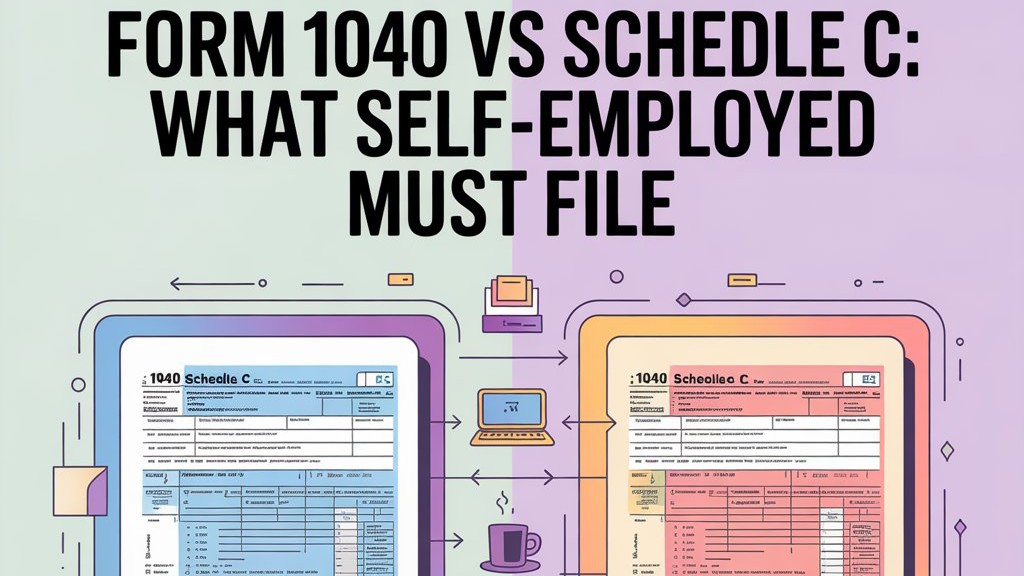
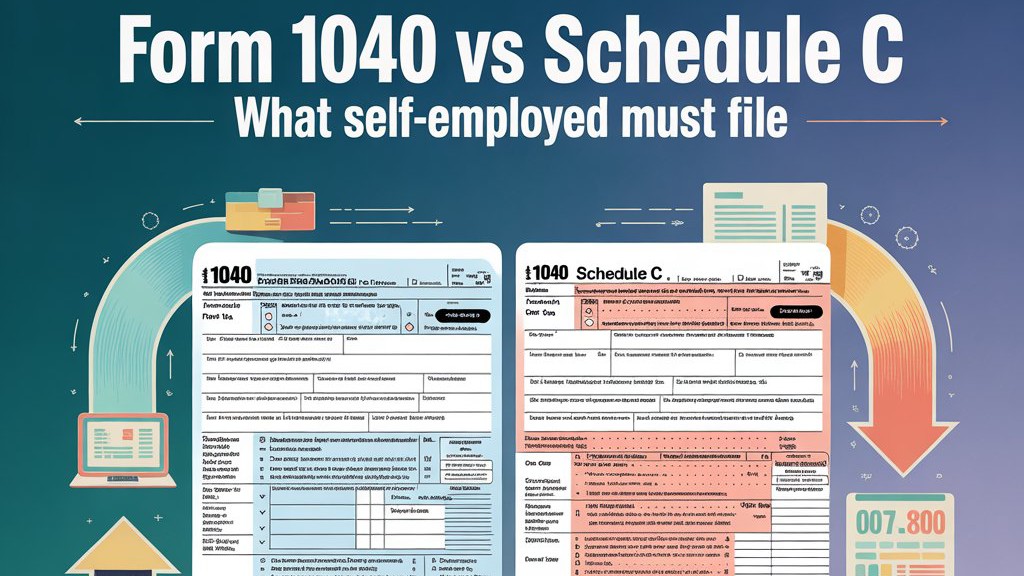
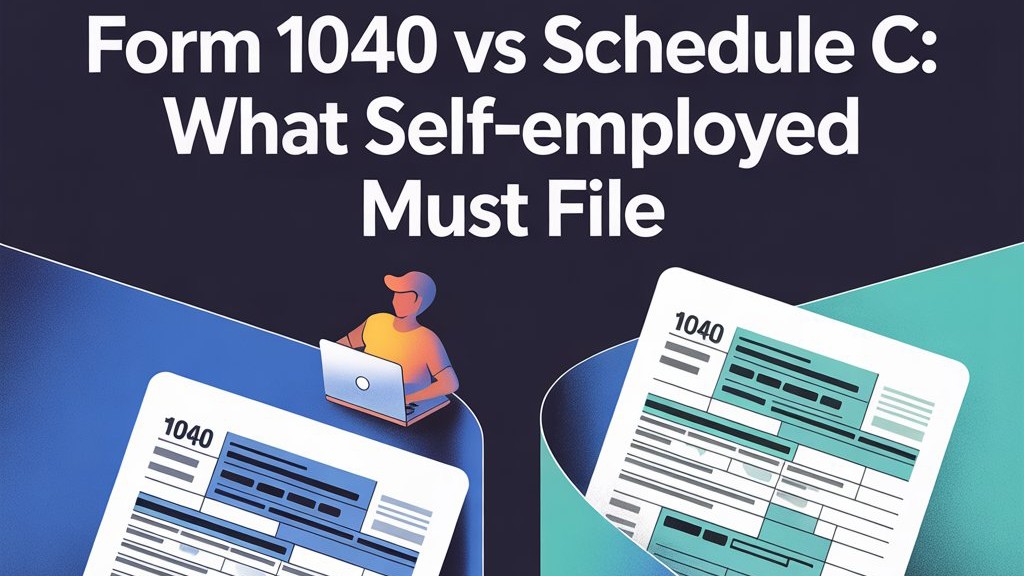
Form 1040 is the master federal income tax return that every individual taxpayer in the United States files with the IRS. Schedule C is a supplemental form attached to Form 1040 that reports profit or loss from a sole proprietorship or single-member business. Together, they form the complete picture of a self-employed person’s tax filing.
Think of it this way: Form 1040 is the container, and Schedule C is one of the pieces that fills it. You cannot file Schedule C without Form 1040, and if you are self-employed with more than $400 in net earnings, you cannot file Form 1040 correctly without Schedule C.
What Is Form 1040?
Form 1040 — formally called the U.S. Individual Income Tax Return — is the standard federal tax return for all individual taxpayers. It reports total income from all sources: wages, self-employment income, investments, rental income, and more. Form 1040 also calculates deductions, credits, and your final tax liability. The IRS redesigned Form 1040 in 2018, making it shorter on its face but relying more heavily on schedules for detail.
For the 2025 tax year, the standard deduction on Form 1040 is $14,600 for single filers and $29,200 for married filing jointly, according to IRS Rev. Proc. 2024-40.
What Is Schedule C?
Schedule C — officially titled Profit or Loss from Business (Sole Proprietorship) — is an IRS schedule that sole proprietors and single-member LLCs use to report business revenue and deductible business expenses. The resulting net profit or net loss flows directly to Form 1040, where it adds to or reduces your total taxable income. Additionally, your Schedule C net profit is the figure used to calculate self-employment tax on Schedule SE.
In short: Schedule C is where your business taxes are calculated. Form 1040 is where your personal taxes are finalized. Both work together as an integrated system.
Form 1040 vs Schedule C — Quick Comparison
How Do Form 1040 and Schedule C Work Together for Self-Employed Filers?
Self-employed individuals in the United States do not have taxes withheld from their income automatically. Therefore, they must calculate and report everything themselves. The Form 1040 and Schedule C work as a sequence — completing Schedule C first and then transferring the result to Form 1040.
The Income Flow: Schedule C to Form 1040
Here is how the numbers flow: First, you complete Schedule C by listing all business income received and subtracting all allowable business deductions. The result — your net profit or net loss — transfers to Schedule 1, Line 3, which then feeds into Form 1040, Line 8. This is the mechanism by which your business results affect your personal tax return.
If Schedule C shows a net profit of $60,000, that $60,000 becomes part of your total income on Form 1040. In contrast, if Schedule C shows a net loss, that loss reduces your overall taxable income — potentially lowering your tax bill significantly.
Self-Employment Tax: Where Schedule SE Fits In
Once Schedule C is complete, self-employed individuals must also complete Schedule SE — Self-Employment Tax. Schedule SE uses your Schedule C net profit to calculate Social Security and Medicare taxes. The combined self-employment tax rate is 15.3% on the first $168,600 of net earnings (2024 threshold). Fortunately, you can deduct half of the self-employment tax amount on Form 1040 as an above-the-line deduction, which lowers your adjusted gross income (AGI).
Who Must File Both Forms?
You must file Schedule C alongside Form 1040 if you are a sole proprietor, freelancer, independent contractor, or single-member LLC with business activity during the tax year. Even if your business operated at a loss, you should still file Schedule C to report those losses and offset other income. According to IRS Publication 334, you must file if your net self-employment earnings are $400 or more.
Common Mistakes Self-Employed Filers Make With Form 1040 and Schedule C
Even experienced self-employed taxpayers make avoidable errors. Here are the five most costly mistakes — and how to prevent each one.
Mistake 1: Forgetting to File Schedule C at All
Some first-time freelancers file Form 1040 and include their business income as ‘other income’ on Line 8 without attaching Schedule C. This is incorrect. Without Schedule C, you cannot deduct any business expenses, and you will overpay your taxes significantly. Additionally, the IRS may flag the return for inconsistency between reported income and the lack of a Schedule C when 1099-NECs have been issued.
Mistake 2: Underreporting Income
The IRS receives copies of every 1099-NEC and 1099-K issued. If a client or platform reports income you do not include on Schedule C, the IRS computer matching system will detect the discrepancy. However, the obligation goes further: all business income must be reported on Schedule C, even if no 1099 was issued. Cash payments, barter income, and small transactions below $600 are all taxable.
Mistake 3: Overclaiming Personal Expenses as Business Deductions
Schedule C only allows deductions for ordinary and necessary business expenses — as defined under IRS Section 162. Personal expenses, even those loosely connected to your work, are not deductible. Common mistakes include deducting 100% of a vehicle used partly for personal travel, claiming non-business meals, or writing off personal phone and internet bills without calculating the business-use percentage.
Mistake 4: Missing the Home Office Deduction
Many self-employed individuals skip the home office deduction out of fear of an audit. In reality, the IRS allows the deduction for any space used regularly and exclusively for business. You can use the simplified method ($5 per square foot, up to 300 square feet) or the regular method based on actual expenses. This deduction can reduce your taxable income by hundreds or even thousands of dollars annually.
Mistake 5: Ignoring Quarterly Estimated Tax Payments
When you are self-employed, no employer withholds taxes from your income. Therefore, the IRS requires quarterly estimated tax payments if you expect to owe $1,000 or more for the year. Missing these payments results in an underpayment penalty, even if you pay in full by April 15. The four quarterly deadlines for 2026 are April 15, June 16, September 15, and January 15, 2027.
How to File Form 1040 vs Schedule C Self-Employed: Step-by-Step
Follow these seven steps to file accurately and maximize your deductions for the 2025 tax year.
Collect all business income records.
Gather every 1099-NEC, 1099-K, and payment record for the year. Also include income that did not generate a 1099. Total all gross receipts on Schedule C, Part I.
List and categorize all business expenses.
Sort deductible expenses into Schedule C categories: advertising, car and truck expenses, office expenses, supplies, professional fees, home office, and utilities. Use IRS Schedule C instructions (available at IRS.gov) as your reference.
Calculate net profit or loss on Schedule C.
Subtract total expenses from total income. Enter this figure on Schedule C, Line 31. A net profit increases your taxable income; a net loss can reduce it.
Transfer net profit to Form 1040 via Schedule 1.
Your Schedule C net profit (or loss) goes to Schedule 1, Line 3. Schedule 1 totals then feed into Form 1040, Line 8.
Complete Schedule SE for self-employment tax.
Use your Schedule C net profit to calculate self-employment tax at 15.3% (up to the Social Security wage base). Deduct half of this amount on Schedule 1, Line 15 — an above-the-line deduction that lowers your AGI.
Claim all eligible deductions and credits on Form 1040.
Apply the standard deduction or itemized deductions. Also check for the Qualified Business Income (QBI) deduction under Section 199A, which allows eligible self-employed individuals to deduct up to 20% of qualified business income.
Review, sign, and file by April 15.
Double-check all figures before submitting. File Form 4868 for a six-month extension if needed — but remember, any taxes owed are still due by April 15 to avoid interest and penalties.
How Tranzesta Helps Self-Employed Filers Navigate Form 1040 and Schedule C
At Tranzesta, we specialize in tax preparation and strategy for self-employed individuals, content creators, cannabis business owners, and US expats. We understand that your taxes are not just a form — they are a reflection of your business, your income, and your financial future.
Our team prepares both Form 1040 and Schedule C together, ensuring that every eligible deduction is captured — from home office and equipment to professional subscriptions and vehicle use. We also calculate your quarterly estimated tax payments so you never face underpayment penalties.
For content creators earning through platforms like OnlyFans, Fansly, YouTube, or affiliate programs, Tranzesta handles 1099-K reconciliation and income categorization. For cannabis businesses, we apply IRC Section 280E COGS strategies alongside Schedule C to ensure compliant and optimized filings.
Most importantly, we give you peace of mind — knowing your return is accurate, complete, and audit-ready.
Let Tranzesta handle your Schedule C and Form 1040 — accurately, every year.
Contact our team at hello@tranzesta.com for a free consultation.
Visit Tranzesta.com to learn more about our self-employed tax services.
Form 1040 vs Schedule C Self-Employed: Expert Tips for 2026
Here are the most valuable strategies Tranzesta’s tax team recommends for self-employed filers heading into the 2026 filing season.
Open a dedicated business bank account.
Mixing personal and business finances is the single biggest cause of Schedule C errors. A separate account makes income and expense tracking dramatically easier.
Use accounting software year-round.
Tools like QuickBooks, FreshBooks, or Wave automatically categorize transactions and generate the reports you need for Schedule C. Starting in January — not April — makes a huge difference.
Track every business mile.
Vehicle expenses are one of the most valuable Schedule C deductions. The 2025 IRS standard mileage rate is 67 cents per mile. Use a mileage tracking app to log every business trip throughout the year.
Maximize the QBI deduction.
Under IRC Section 199A, many self-employed individuals can deduct up to 20% of qualified business income from their taxable income. This is one of the most powerful tax breaks available, but eligibility rules apply. Tranzesta can assess whether you qualify.
Review your Schedule C before and after filing.
Mistakes on Schedule C cascade through your entire return — affecting self-employment tax, AGI, deductions, and even eligibility for certain credits. A second review by a qualified tax professional can catch errors that cost thousands.
For US expats who are self-employed: you must still file Schedule C with your Form 1040 and pay self-employment tax, even when using the Foreign Earned Income Exclusion (Form 2555). Learn more about expat self-employment tax rules at Tranzesta.com.
Conclusion
The Form 1040 vs Schedule C self-employed relationship is one of the most important tax concepts any independent worker in the United States needs to understand. The three most important takeaways: Schedule C calculates your business profit or loss and attaches directly to Form 1040; every dollar of self-employment income must be reported, regardless of whether a 1099 was issued; and claiming every eligible Schedule C deduction — from home office to vehicle to equipment — can dramatically reduce what you owe.
Filing these forms correctly requires both accuracy and strategy. Tranzesta’s expert team handles the full picture — Schedule C, Form 1040, Schedule SE, estimated taxes, and beyond — so you can focus on running your business.
Ready to get expert help with your self-employed taxes?
Email us at hello@tranzesta.com or visit Tranzesta.com to schedule your free tax strategy session today.
FAQs
Yes. Self-employed individuals must file both Form 1040 and Schedule C. Schedule C attaches to Form 1040 and reports your business income and expenses. Without Schedule C, you cannot deduct any business costs, and the IRS has no record of
For a freelancer, Form 1040 is the overall individual tax return that reports all sources of income and calculates your total tax liability. Schedule C is the specific schedule where you report your freelance business income, subtract allowable business expenses, and calculate your net profit or loss. The net profit from Schedule C transfers to Form 1040, increasing your taxable income.
No. Schedule C cannot be filed as a standalone form. It is a supplemental schedule that must be attached to Form 1040 when you file your federal tax return. Schedule C reports your business results, but Form 1040 is the official return that the IRS processes.
Schedule C allows deductions for all ordinary and necessary business expenses under IRS Section 162. Common deductions include home office costs, business vehicle use (at 67 cents per mile for 2025), equipment and software, advertising and marketing, professional fees, business travel, and supplies. There is no fixed dollar cap on Schedule C deductions, but each expense must be directly related to your business and supported by documentation. Tranzesta can help identify every deduction available to your specific business.
If you fail to file Schedule C when required, Additionally, without Schedule C, all of your self-employment income appears as ordinary income with no business deductions applied — significantly overstating your tax liability. The IRS may also initiate an audit if it detects 1099-NEC or 1099-K income on your account that does not appear on a filed Schedule C. Filing correctly with Tranzesta’s help prevents all of these outcomes.
Related expertise
Talk to a real, signing professional
AI precision, human accountability — across the US, UK & UAE.
Book a free consultation