The IRS audited more than 600,000 individual tax returns
in a recent year — and miscategorized business expenses are one of the most common triggers. If you do not know how to correctly categorize business transactions for tax time, you are either overpaying your taxes or exposing yourself to penalties. Neither outcome is acceptable.
This guide gives every self-employed individual,
startup founder, content creator, and small business owner in the United States a complete, plain-English system for categorizing business transactions correctly before tax time arrives. You will learn what transaction categories mean, which IRS schedules they map to, the most expensive mistakes taxpayers make, and how to build a categorization system that works year-round.
By the end of this article, you will have everything you need to organize your books with confidence — and know exactly when to call in a professional team like Tranzesta.
What Does It Mean to Categorize Business Transactions for Tax Time?
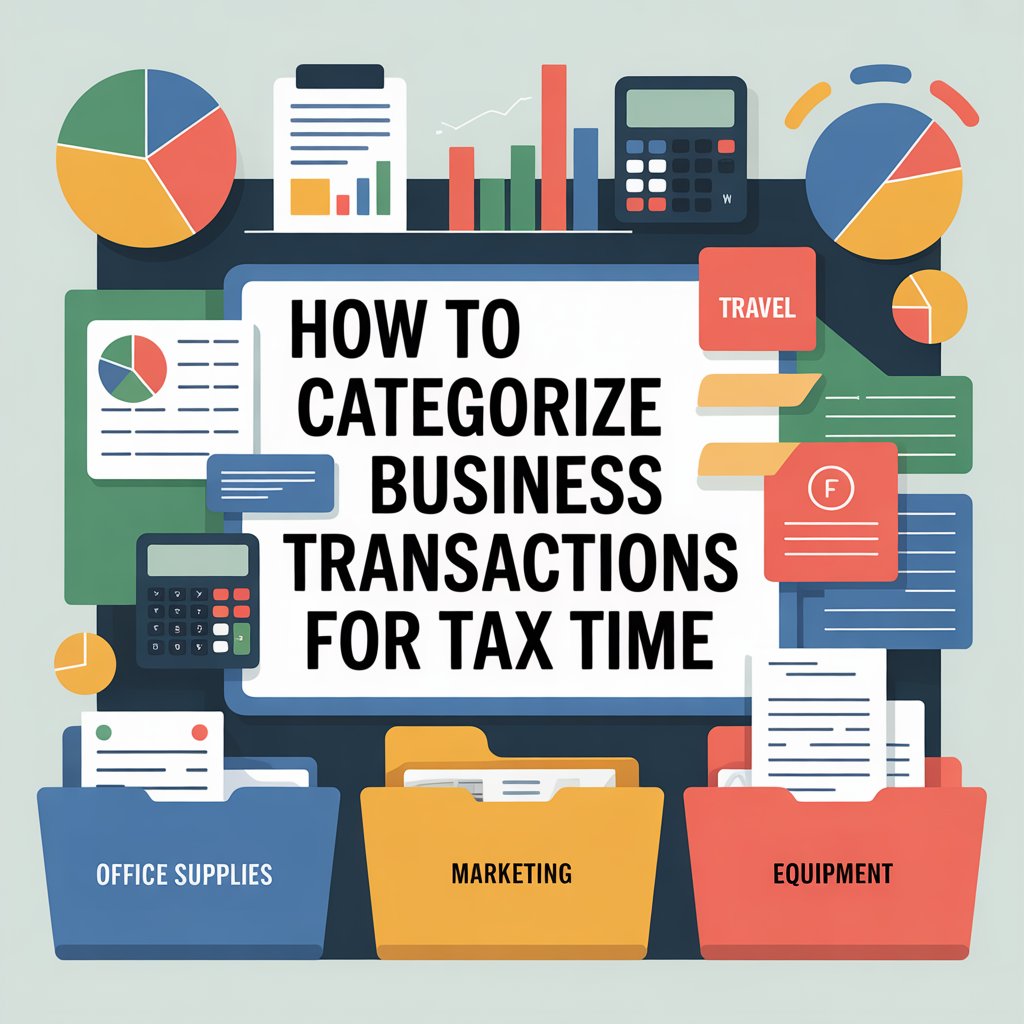
To categorize business transactions for tax time means assigning every dollar of income and every business expense to a specific account or label in your bookkeeping system so the IRS can clearly see how you earned money and what you spent it on. Think of it as sorting your financial life into clearly labeled filing folders — one for advertising, one for equipment, one for meals, and so on.
The IRS does not accept a pile of unorganized receipts.
Instead, your federal tax return — whether it is a Schedule C for sole proprietors, a Form 1120-S for S-Corps, or a Form 1065 for partnerships — requires you to report income and expenses in specific, predefined categories. If your books do not match these categories, your accountant cannot file an accurate return.
Why Proper Transaction Categorization Matters So Much
Correct categorization directly determines how much tax you owe. Every legitimate business expense you correctly categorize reduces your taxable income dollar for dollar. For a self-employed individual in the United States paying both income tax and the 15.3% self-employment tax, a single unclaimed $5,000 deduction could cost more than $2,000 in unnecessary taxes.
Additionally, the IRS uses your reported categories to flag anomalies. For example, if you report $80,000 in advertising expenses on a $120,000 gross income, that ratio may trigger scrutiny. Therefore, accurate categorization protects you from audits as much as it saves you money.
Who Needs to Categorize Business Transactions?
Every US taxpayer who earns income outside of a traditional W-2 job must categorize business transactions. This includes sole proprietors, single-member LLCs, S-corp shareholders, content creators on platforms like OnlyFans or YouTube, cannabis business operators, freelancers, independent contractors, and any startup generating its first revenue. If the IRS considers you self-employed, proper categorization is not optional — it is a legal requirement.
The Core Business Transaction Categories Every US Taxpayer Must Know
The IRS organizes business expenses into standard categories that map directly to lines on your tax forms. Here is a reference table of the most common categories and their corresponding Schedule C line items for sole proprietors and single-member LLCs in the United States.
Income Categories: What Counts as Business Revenue?
Before categorizing expenses, you must correctly categorize your income. Gross receipts — the total revenue your business receives before any deductions — must be reported in full, regardless of how it was paid. This includes cash, checks, credit card payments, PayPal, Venmo, Stripe, crypto, and any other payment method.
As of 2022, the IRS lowered the threshold for third-party payment processors to issue Form 1099-K to $600 from the previous $20,000 threshold. As a result, many freelancers and content creators received 1099-K forms for the first time. However, even if you did not receive a 1099-K, all income must be reported. The IRS matches income reports from platforms against your return.
The Difference Between a Deductible and Non-Deductible Expense
A deductible business expense — as defined by IRS Section 162 — must be both ordinary (common and accepted in your trade or industry) and necessary (helpful and appropriate for your business). For example, a camera purchased for YouTube content creation is both ordinary and necessary for a content creator. In contrast, the same camera purchased by an accountant who never films content is neither ordinary nor necessary for their trade.
Non-deductible expenses include personal living costs, fines and penalties, political contributions, and the personal-use portion of any mixed-use asset. Therefore, always separate personal and business use before categorizing an item as a business expense.
Common Mistakes When You Categorize Business Transactions for Tax Time
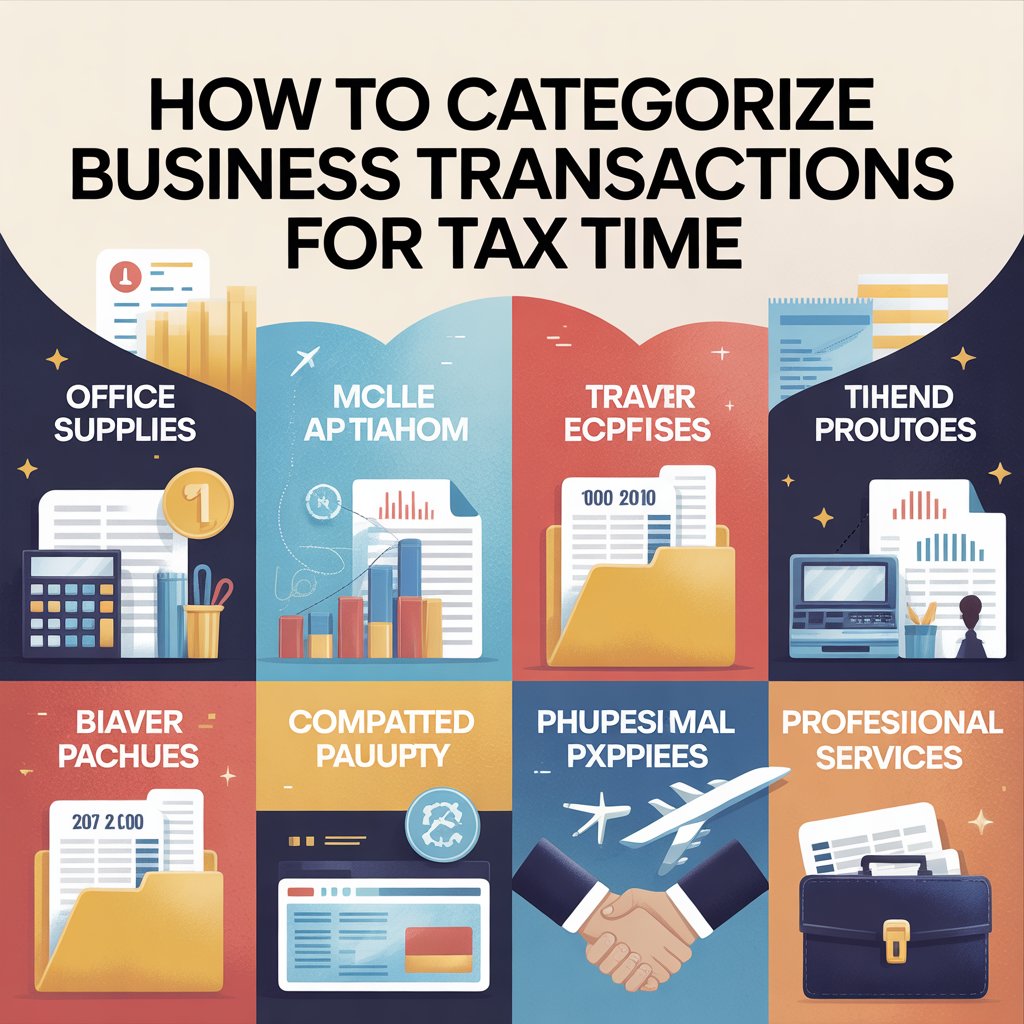
Even experienced business owners make categorization errors that cost them money or trigger IRS scrutiny. Here are the five most common mistakes — and how to avoid each one.
Mistake 1: Lumping Everything Into ‘Miscellaneous’
The miscellaneous expense category is the most abused line on Schedule C. Many business owners dump unclear expenses here rather than taking the time to identify the correct category. However, a return with an unusually large miscellaneous expense line raises immediate red flags for IRS examiners. Instead, take ten minutes to identify every transaction’s true nature — advertising, office, travel, or equipment — before defaulting to miscellaneous.
Mistake 2: Deducting 100% of Mixed-Use Expenses
A mixed-use expense serves both personal and business purposes. Your cell phone bill is a classic example. If you use your phone 60% for business and 40% personally, you may only deduct 60% as a business expense. The same rule applies to your vehicle, internet service, and home office. Claiming 100% of a mixed-use expense is one of the fastest ways to lose an audit.
Mistake 3: Categorizing Meals at 100% Instead of 50%
Under current IRS rules, business meals are generally only 50% deductible — not 100%. Furthermore, entertainment expenses such as sporting event tickets or concert tickets are no longer deductible at all under the Tax Cuts and Jobs Act of 2017. Many business owners still incorrectly categorize entertainment as a fully deductible meal. This distinction matters on Schedule C and will be caught in an examination.
Mistake 4: Expensing Capital Assets Instead of Depreciating Them
A capital asset — any business item with a useful life of more than one year, such as a computer, vehicle, or piece of equipment — generally cannot be fully expensed in the year of purchase using standard accounting rules. Instead, it must be depreciated over its useful life using IRS-approved schedules. However, Section 179 of the IRS tax code allows eligible US businesses to immediately deduct up to $1,160,000 of qualified equipment in 2023. Consult a tax professional to determine which method applies to your assets.
Mistake 5: Not Keeping Documentation
Correct categorization without documentation is worthless in an audit. The IRS requires written records to support every deduction you claim. For meals, you need the date, amount, location, business purpose, and names of people present. For travel, you need receipts, itinerary, and business purpose documentation. Digitize every receipt immediately using apps like Dext or Hubdoc — never rely on memory or bank statements alone.
How to Categorize Business Transactions Step by Step
Follow this six-step process every time a transaction hits your business account. Consistency is the key — doing this weekly takes minutes, while doing it annually takes days.
Step 1: Open Your Accounting Software and Import Transactions
Connect your business bank account and credit card to your accounting software — QuickBooks, Xero, or Wave — so transactions import automatically. Review the imported transactions at least once per week. Never let more than seven days pass without reviewing your bank feed.
Step 2: Ask the Business-or-Personal Question First
Before categorizing any transaction, ask: ‘Was this expense incurred primarily for business purposes?’ If the answer is no, do not enter it in your business books at all. If it is mixed-use, note the business-use percentage before you categorize it. This single question eliminates the most common categorization errors.
Step 3: Match the Transaction to the Correct Category
Use your chart of accounts — the master list of all income and expense categories in your bookkeeping system — to assign the correct label. Refer to the category table above for common examples. If a transaction does not fit neatly into any standard category, consult your accountant before guessing.
Step 4: Attach the Supporting Receipt or Invoice
Every categorized transaction needs documentation. Attach a digital copy of the receipt or invoice directly to the transaction inside your accounting software. Most platforms allow you to photograph receipts from your phone and attach them in seconds. This creates an audit-ready record without any extra effort at year-end.
Step 5: Reconcile Monthly
At the end of every month, reconcile your bank and credit card statements against your bookkeeping records. Reconciliation — the process of matching your internal records to your bank’s records — catches duplicate entries, missed transactions, and categorization errors before they compound. It typically takes thirty to sixty minutes per month.
Step 6: Run a Monthly Expense Report by Category
After reconciling, run a Profit & Loss report sorted by category. Review every line. If any category looks unusually high or low compared to your expectations, investigate it immediately. This monthly review is the single most powerful habit you can build for tax-time readiness.
How Tranzesta Helps You Categorize Business Transactions for Tax Time
Tranzesta is a US-based tax and accounting firm that specializes in exactly the situations where transaction categorization gets complicated. Our clients include OnlyFans and content creators who receive income from multiple platforms, cannabis business operators navigating IRS Section 280E’s complex deduction restrictions, self-employed professionals juggling mixed-use assets, and startups setting up their books for the very first time.
Our team reviews your transactions, corrects miscategorizations, flags missing documentation, and ensures your books map correctly to IRS forms before your return is prepared. We do not just record what happened — we make sure your categorization strategy actively minimizes your tax liability within legal bounds.
Tranzesta Bookkeeping and Tax Services Include:
Monthly bookkeeping with correct expense categorization
Chart of accounts setup tailored to your industry and entity type
Mixed-use asset tracking and depreciation scheduling
Section 179 and bonus depreciation analysis
Year-end tax categorization review and cleanup
Schedule C, 1120-S, and 1065 preparation with categorized financials
Contact our team at hello@tranzesta.com for a free consultation. Learn more about our business bookkeeping and tax services at Tranzesta.com — including our specialized services for content creators and cannabis businesses.
Categorize Business Transactions for Tax Time: Expert Tips for 2026
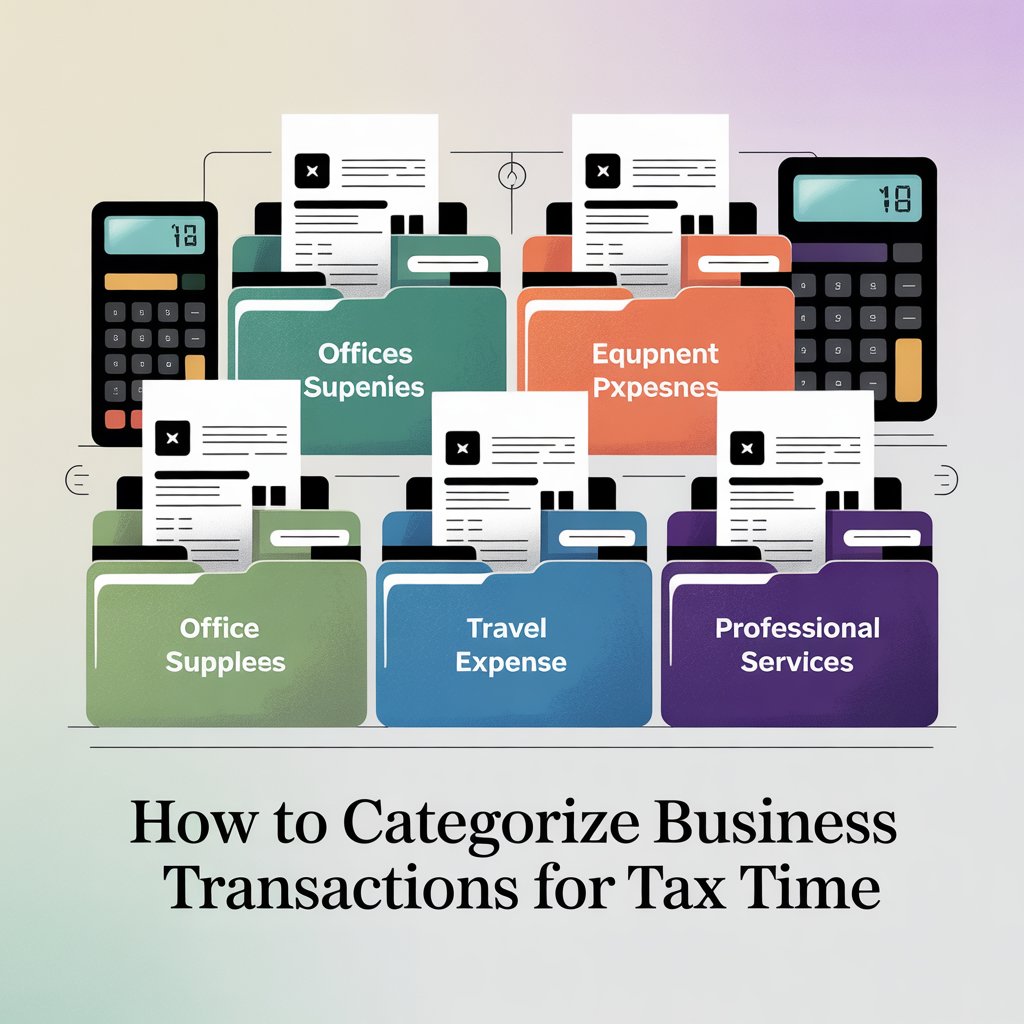
Beyond the fundamentals, there are several advanced strategies that professional bookkeepers and tax preparers use to make categorization faster, cleaner, and more defensible in an audit. Here is what the team at Tranzesta recommends for 2026.
Pro Tips From Tranzesta’s Accounting Team
Create a custom rule in your accounting software: Most platforms let you create automatic categorization rules. For example, any transaction from ‘Adobe’ can automatically be categorized as ‘Software Subscriptions.’ This eliminates repetitive manual work and reduces human error dramatically.
Use sub-categories for content creators: If you are a content creator with income from multiple platforms — OnlyFans, YouTube, Patreon, and TikTok, for example — set up sub-categories for each income source. This makes it easy to report income by platform and identify which revenue streams are most profitable.
Flag cannabis expenses with extra precision: Cannabis operators in the United States cannot deduct most standard business expenses under IRS Section 280E, which disallows deductions for businesses trafficking Schedule I or II controlled substances. However, the cost of goods sold (COGS) is still deductible. Tranzesta recommends an extremely detailed COGS categorization for every cannabis client.
Separate owner’s draws from business expenses: If you take money from your business for personal use as an LLC owner, record it as an owner’s draw — a balance sheet transaction — not a business expense. Categorizing owner’s draws as expenses overstates your deductions and understates your profit.
Keep a categorization decision log: When you make a judgment call on an unusual expense, write a one-sentence note explaining your reasoning. If the IRS ever questions that deduction, you will have a clear, contemporaneous record of your thought process — which is far more persuasive than trying to reconstruct it years later.
Review your prior-year return before year-end: Pull last year’s Schedule C or business return and compare category totals. Significant changes in any category year-over-year are worth investigating before filing — both to confirm accuracy and to be prepared to explain the change if asked.
Conclusion
Correctly categorizing business transactions is one of the highest-leverage habits you can build as a US business owner. Here are the three most important takeaways from this guide.
First, every business expense must map to a specific IRS category — miscellaneous is not a strategy, it is a red flag. Second, mixed-use expenses require careful percentage tracking, and capital assets must be depreciated correctly rather than fully expensed unless Section 179 applies. Third, documentation is as important as the categorization itself — the right category with no receipt is just as vulnerable in an audit as the wrong category.
The good news is that correct categorization becomes fast
and nearly automatic once you build the right system. And when the complexity outgrows what you want to manage alone, Tranzesta is here to take it off your plate entirely.
Ready to get expert help? Email us at hello@tranzesta.com or visit Tranzesta.com to schedule your free tax strategy session today.
FAQs
The main business expense categories on a US tax return for sole proprietors include advertising, car and truck expenses, commissions and fees, contract labor, depreciation, insurance, interest, legal and professional services, office expenses, rent or lease, repairs and maintenance, supplies, taxes and licenses, travel, meals (50% deductible), utilities, and wages. These categories appear on Schedule C of Form 1040 for self-employed individuals. Each category has a corresponding line number that maps directly to your IRS filing.
For example, if you use your vehicle 70% for business and 30% personally, you may only deduct 70% of qualifying vehicle costs. Keep a mileage log or usage log as supporting documentation. The IRS requires contemporaneous records, meaning you must track usage as it happens rather than estimating it at year-end.
To qualify, the meal must have a clear business purpose — such as discussing a project with a client or potential business partner. You must keep a receipt and document the date, location, amount, business purpose, and the names of people present. Entertainment expenses such as concert tickets or sporting events are no longer deductible at all under the Tax Cuts and Jobs Act of 2017.
A. A capital asset is a purchase with a useful life of more than one year — such as a computer, camera, vehicle, or piece of machinery — that must be depreciated over time under IRS rules rather than fully deducted in the year of purchase. However, IRS Section 179 allows eligible US businesses to immediately expense up to $1,160,000 of qualifying equipment in 2023 rather than depreciating it over multiple years.
The IRS generally requires US taxpayers to keep records supporting items on their tax return for at least three years from the date the return was filed. However, if you underreport income by more than 25%, the IRS has six years to audit your return. If the IRS suspects fraud, there is no statute of limitations at all. the Tranzesta recommends keeping all business records for a minimum of seven years to be safe.
Talk to a real, signing professional
AI precision, human accountability — across the US, UK & UAE.
Book a free consultation