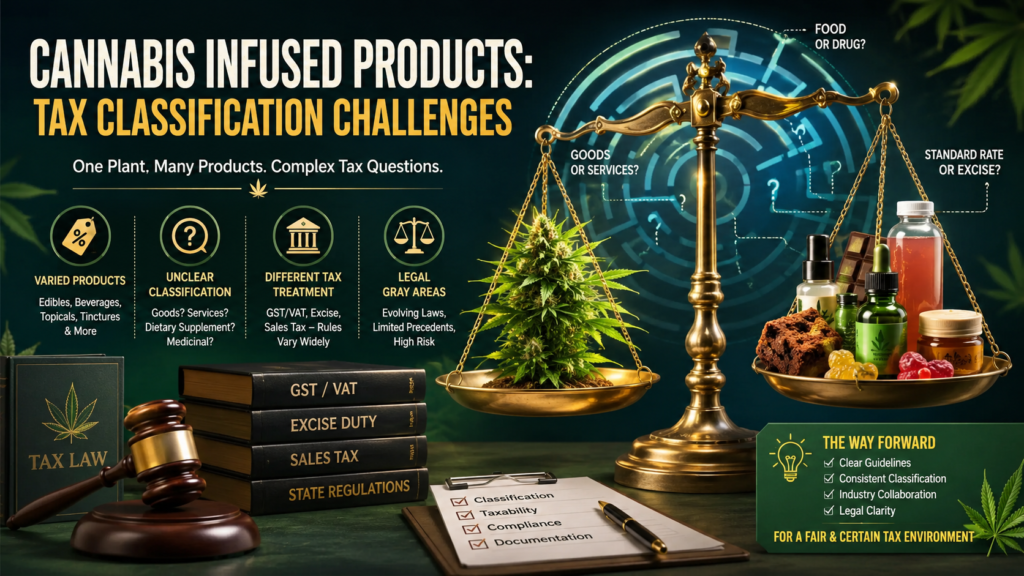
Cannabis-infused edibles, beverages, tinctures, and topicals
are among the fastest-growing product categories in the US cannabis market — but their some of the most complex compliance challenges in the industry. A single misclassification can trigger unexpected sales tax liability, denied COGS deductions, or costly IRS audit findings. The rules differ dramatically between federal and state levels, cannabis infused products tax classification
between product types, and across the more than 30 US states where cannabis is now legal in some form.
In this guide, you will learn exactly how cannabis-infused products are classified for federal income tax, sales tax, and excise tax purposes, why certain classifications create higher tax exposure, the most common mistakes manufacturers and retailers make, and how to build a defensible tax position for your infused product line. You will also discover how Tranzesta’s cannabis accounting specialists help operators across the United States navigate these classification challenges with confidence.
What Is Cannabis Infused Products Tax Classification?
The tax classification of cannabis-infused products is the process of determining how a cannabis-infused item — such as an edible, beverage, concentrate, or topical — is categorized under federal and state tax codes for income tax, sales tax, and excise tax. The classification assigned to a product determines which taxes apply, at what rate, and which deductions or exemptions are available to the producer and seller.
For businesses in the United States, this classification is uniquely complicated because cannabis remains a Schedule I controlled substance under federal law, even as individual states have legalized its sale. As a result, cannabis-infused products sit at the intersection of food and beverage law, pharmaceutical regulation, and controlled substance taxation — all of which apply different rules simultaneously.
Why Does Product Classification Matter for Cannabis Businesses?
The tax classification of your infused products has a direct impact on your bottom line in multiple ways. At the federal level, IRC Section 280E (Internal Revenue Code Section 280E) disallows standard business deductions for cannabis trafficking businesses, but allows deductions for Cost of Goods Sold (COGS) — the direct cost of producing or acquiring inventory. How you classify your production costs determines how much of your manufacturing expense qualifies as COGS versus a non-deductible operating expense.
At the state level, sales tax exemptions for food and medicine frequently apply to certain cannabis-infused products in some jurisdictions but not others. Additionally, state excise taxes on cannabis — which can range from 6% in Missouri to over 37% in Washington state — are calculated differently depending on whether a product is classified as flower, concentrate, edible, or another category. Therefore, misclassification at the state level can mean either overpaying tax or underreporting tax liability.
Which Products Fall Into the Cannabis Infused Category?
For tax purposes, cannabis-infused products typically include: edibles (gummies, chocolates, baked goods, and capsules), cannabis beverages (infused waters, teas, and sodas), tinctures and sublingual products, topicals (creams, lotions, and patches that are absorbed through the skin), and cannabis-infused health and wellness products. Notably, hemp-derived CBD products sold in non-cannabis retail channels have their own distinct classification rules under federal law, separate from state-licensed cannabis products. These distinctions matter enormously for both sales tax treatment and federal income tax purposes.
How Are Cannabis Infused Products Classified Under Federal and State Tax Rules?
Cannabis infused products face a layered tax classification framework at both the federal and state levels. Understanding each layer is essential to building an accurate and defensible tax position.
Federal Income Tax: Section 280E and COGS Allocation
At the federal level, all cannabis-infused products produced or sold by a licensed cannabis business are subject to IRC Section 280E, regardless of their specific product type. This means the producer cannot deduct manufacturing overhead, marketing, distribution, or administrative costs. However, direct production costs — including raw cannabis inputs, infusion ingredients, packaging materials, and directly attributable manufacturing labor — may qualify as COGS under the inventory cost rules of IRC Section 471 (the tax code section governing inventory costing methods).
For infused product manufacturers, COGS calculations are more complex than for simple cannabis flower sales because the production process involves multiple input materials (cannabis extract plus food or beverage ingredients), processing steps, and packaging. Each component must be evaluated separately to determine whether it meets the standard for inclusion in COGS. Producers who maximize defensible COGS allocations minimize their federal tax burden under 280E. Tranzesta specializes in this analysis for cannabis manufacturers across the USA.
State Sales Tax: Food Exemptions and Cannabis Carve-Outs
Most US states exempt food and food ingredients from sales tax. However, states almost universally exclude cannabis-infused food products from this exemption. In California, for example, cannabis edibles are subject to the standard 7.25% state sales tax plus local taxes, even though conventional food items are exempt. In Colorado, cannabis-infused edibles are taxed at the special 15% cannabis retail tax plus the standard 2.9% state sales tax. Therefore, sellers who assume that food-based packaging or labeling will trigger a food tax exemption for cannabis edibles are almost always wrong.
State Cannabis Excise Tax: Rate Structures by Product Type
Most cannabis-legalizing states impose a specific excise tax on cannabis products, and many structure rates differently based on product category. For example, California imposes its cannabis excise tax as a percentage of the average market price, while Illinois uses a potency-based system: products with THC content at or below 35% are taxed at 10% of retail price, while products above 35% THC face a 25% tax rate. Edibles in Illinois are taxed at 20% regardless of potency. These rate distinctions make accurate product classification a direct cost driver for manufacturers and retailers.
California: 15% excise tax on all cannabis products (retail price basis)
Illinois: 10%–25% excise tax based on THC potency; 20% for infused products
Colorado: 15% retail marijuana sales tax, plus standard state and local sales tax
Michigan: 10% excise tax on adult-use cannabis sales
Washington: 37% cannabis excise tax, one of the highest in the USA
Common Cannabis Infused Products Tax Classification Mistakes
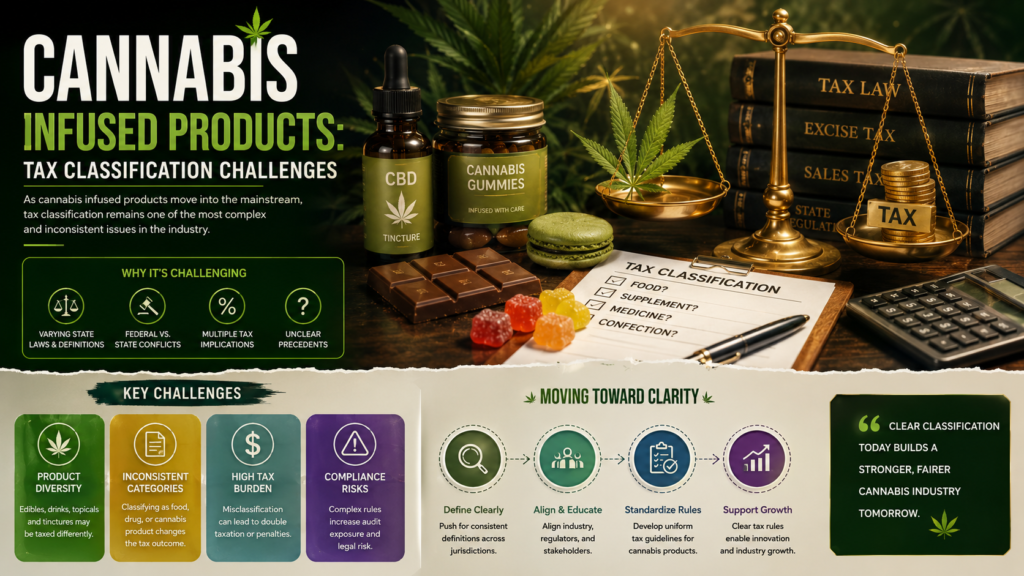
Most cannabis infused products tax classification errors are preventable. These are the mistakes that most frequently result in back taxes, penalties, and IRS audit findings.
Mistake 1: Applying Food or Beverage Tax Exemptions to Cannabis Edibles
This is the most widespread error among new cannabis-infused product manufacturers and retailers. Many operators assume that because their product is an edible food item — a gummy, a chocolate bar, a beverage — it qualifies for the same sales tax food exemption that applies to conventional groceries. In practice, every US state that has legalized cannabis explicitly carves out cannabis-infused food items from its food exemption. Applying the exemption anyway results in collected-but-not-remitted tax liability, which is treated as theft of public funds in some jurisdictions and carries significant penalties.
Mistake 2: Misallocating Manufacturing Costs Between COGS and Operating Expenses
Under Section 280E, only COGS is deductible for federal income tax purposes. However, many infused product manufacturers improperly include non-COGS items — such as quality assurance testing fees, regulatory compliance costs, sales staff compensation, and facility overhead not directly attributable to production — in their COGS calculation. This overstates the COGS deduction and creates audit exposure. Conversely, some operators under-allocate legitimate production costs to COGS, overpaying federal income tax unnecessarily. Both errors are costly and both are preventable with proper accounting systems.
Mistake 3: Classifying Hemp-Derived CBD Products as Cannabis for State Tax Purposes
Hemp-derived CBD products — those derived from hemp plants containing less than 0.3% THC on a dry-weight basis — are not subject to state cannabis excise taxes in most US states. However, some cannabis manufacturers produce both hemp-CBD and THC-infused products and incorrectly apply cannabis excise tax rates to their hemp products. This results in overpayment of excise tax and creates pricing disadvantages. Conversely, some operators attempt to classify THC-infused products as hemp to avoid excise tax, which constitutes tax fraud.
Mistake 4: Ignoring the Impact of Potency on Tax Rate Selection
In states with potency-based tax structures — including Illinois and Connecticut — failing to accurately classify products by THC potency results in applying the wrong excise tax rate. A manufacturer that classifies a high-potency concentrate as a standard-potency product to benefit from the lower rate is underreporting tax liability. State revenue agencies increasingly use laboratory testing data and state seed-to-sale tracking systems like METRC to verify potency classifications, making this type of error easy to detect during an audit.
How to Classify Cannabis Infused Products for Tax: Step-by-Step
Building a correct cannabis infused products tax classification system requires a structured approach. Follow these steps to establish an accurate and defensible tax position for your infused product line.
Step 1: Categorize Every Product by Type and Delivery Method.
Create a master product list that identifies each SKU by its product category (edible, beverage, tincture, topical, concentrate) and primary cannabinoid content (THC, CBD, or combination). Note whether each product is derived from licensed cannabis or from federally legal hemp. This categorization drives every downstream tax decision.
Step 2: Determine Federal COGS Eligibility for Each Production Cost.
Review every cost associated with manufacturing your infused products. Separate direct production costs — cannabis extract inputs, infusion ingredients, packaging, and direct manufacturing labor — from indirect costs such as facility rent, quality assurance, marketing, and administrative overhead. Only the direct costs qualify for COGS treatment under Section 471 and Section 280E. Document your allocation methodology in writing.
Step 3: Identify State Excise Tax Classification in Every Operating State.
For each state where you produce or sell infused products, determine the applicable excise tax category and rate for each product type. Pay particular attention to states with potency-based rate structures. Review the state cannabis regulatory agency’s product classification rules, not just the tax code, because regulatory classifications often drive tax rates.
Step 4: Confirm Sales Tax Treatment in Each Jurisdiction.
Research whether your state and local jurisdictions exempt any food or medicine products from sales tax, and verify that your cannabis-infused products are excluded from that exemption. Confirm whether your topical products — which are not ingested — are classified differently from ingestible products for sales tax purposes. In some states, topicals qualify for different treatment than edibles.
Step 5: Set Up Product-Level Tax Codes in Your Point-of-Sale System.
Program your POS system to apply the correct tax rates and classifications to each product SKU. Most cannabis POS platforms (such as Dutchie, Flowhub, or Treez) support product-level tax configuration. Verify that your configuration matches your research by running test transactions before going live.
Step 6: Implement Monthly Reconciliation Between Sales Data and Tax Remittances.
Each month, reconcile your POS sales data by product category against the excise and sales tax amounts remitted to each taxing authority. cannabis infused products tax classification
Discrepancies between reported sales and tax remittances are a primary audit trigger in cannabis enforcement examinations. Monthly reconciliation catches errors before they accumulate into large deficiencies.
Step 7: Review Classifications Annually or When Products Change.
State tax laws and regulatory classifications change frequently. Additionally, when you change a product’s formula, potency, or packaging, its tax classification may change as well. An annual review with a cannabis tax specialist — and a mid-year check whenever you launch new products — ensures your classifications remain current and accurate.
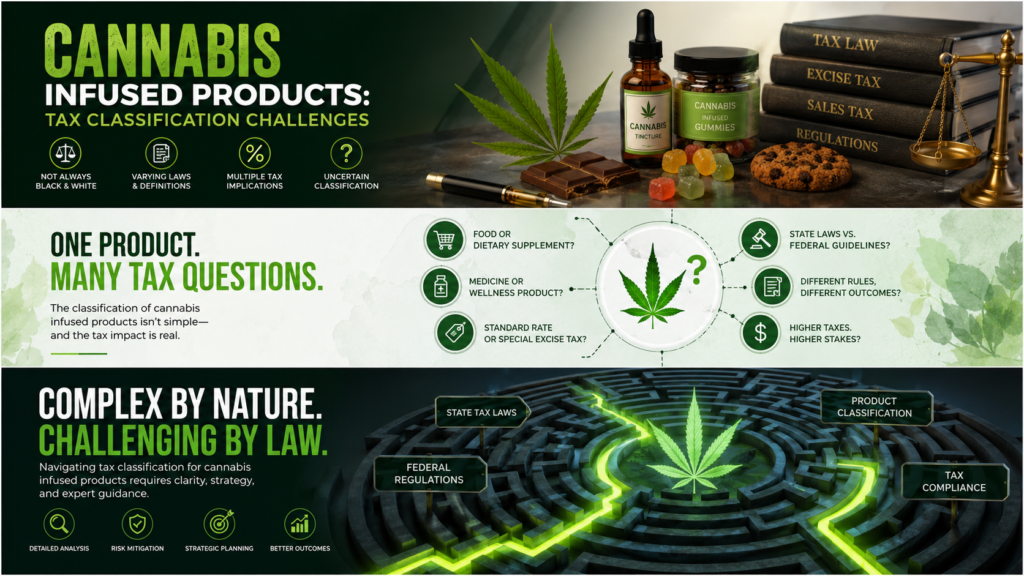
How Tranzesta Helps Cannabis Businesses Navigate Infused Product Tax Classification
Tranzesta is a US-based tax consultation firm with deep expertise in cannabis industry accounting, including cannabis infused products tax classification, COGS optimization, state excise tax compliance, and multi-state tax planning. Our cannabis accounting team works with infused product manufacturers, dispensaries, and multi-state operators across the United States to build accurate, defensible tax positions for every product line.
When you work with Tranzesta.com, we begin by reviewing your current product catalog and existing tax classifications. We then build a product-by-product classification matrix that accounts for federal 280E treatment, state excise tax rates, and sales tax exemption status in every jurisdiction where you operate. We also help you configure your accounting and POS systems to capture the correct data for monthly tax reconciliation and annual reporting.
Tranzesta’s cannabis accounting services include:
COGS allocation analysis for infused product manufacturers, state excise tax classification reviews, sales tax nexus and compliance for multi-state cannabis operators, 280E compliance reviews, and full-service bookkeeping for licensed cannabis businesses in the USA. Learn more about cannabis tax compliance services at Tranzesta.com.
Need help classifying your cannabis infused products for tax?
Contact our cannabis accounting team at hello@tranzesta.com for a free consultation.
Visit Tranzesta.com to learn more about our cannabis tax services.
Cannabis Infused Products Tax Classification: Expert Tips for 2026
Beyond the foundational rules, experienced cannabis tax professionals apply advanced strategies to minimize tax exposure and avoid classification errors. Here are key insights from Tranzesta’s cannabis accounting team for 2026.
Separate Your Hemp and Cannabis Product Lines Clearly.
If you produce both hemp-derived CBD products and THC-infused cannabis products, maintain completely separate product lines, SKUs, manufacturing records, and accounting books for each. Combining these product lines creates confusion about which excise and sales tax rules apply and can lead to over- or under-payment of tax in multiple jurisdictions.
Use a Cannabis Chart of Accounts Designed for COGS Maximization.
A standard accounting chart of accounts is not designed for 280E compliance. Using a cannabis-specific chart of accounts — with production costs properly mapped to COGS accounts — ensures that every legitimate direct production cost is captured and deducted. Tranzesta builds custom charts of accounts for cannabis manufacturers as part of our bookkeeping setup service.
Request Letter Rulings from State Revenue Agencies for Novel Products.
If you produce a product type that does not fit neatly into existing state tax classifications — for example, a cannabis-infused beverage concentrate or a transdermal patch — consider requesting a private letter ruling (an official written determination from the tax authority) before going to market. A letter ruling provides legal certainty that your classification is correct.
Track Regulatory Rescheduling Developments Closely.
The US Drug Enforcement Administration’s review of cannabis scheduling — and potential reclassification from Schedule I to Schedule III — could significantly alter the applicability of Section 280E to cannabis businesses. A Schedule III classification might remove the 280E barrier entirely, fundamentally changing the economics of infused product manufacturing. Work with a cannabis tax specialist to monitor these developments and plan proactively.
Document Your Classification Rationale in Writing.
determine how a product should be classified for tax purposes, document your reasoning, the sources you relied on, and the date of the determination. Written contemporaneous documentation is your strongest defense in a state or IRS audit of your classification decisions.
Conclusion: Get Cannabis Infused Product Tax Classification Right From Day One
Cannabis infused products tax classification sits at the intersection of federal controlled substance law, state excise tax regulation, and food and beverage sales tax rules — making it one of the most complex compliance areas in the US cannabis business. The three most important takeaways from this guide are: first, food and beverage sales tax exemptions rarely apply to cannabis-infused products in US states, regardless of product form; second, COGS allocation for infused product manufacturers requires a structured, documented methodology that separates direct production costs from operating expenses; and third, state excise tax rates vary dramatically by product type, potency, and jurisdiction, making accurate product classification a direct cost driver.
Cannabis tax law continues to evolve rapidly in the United States, especially as federal rescheduling discussions progress and more states refine their cannabis tax structures. Staying current requires ongoing attention from a qualified cannabis tax specialist — not a one-time review at business launch.
Ready to get expert help with cannabis infused product tax classification?
Email us at hello@tranzesta.com or visit Tranzesta.com
to schedule your free tax strategy session today.
FAQs
Additionally, most cannabis-legalizing states impose a separate cannabis excise tax on top of the standard sales tax rate. In California, for example, cannabis edibles are subject to both the 15% cannabis excise tax and the standard state sales tax, resulting in a combined tax rate that significantly exceeds what applies to conventional food.
because federal law still classifies marijuana as a Schedule I controlled substance. Under 280E, manufacturers cannot deduct ordinary business expenses such as rent, marketing, administrative salaries, or distribution costs. However, they may deduct the Cost of Goods Sold, which includes direct cannabis inputs, infusion ingredients, packaging materials, and directly attributable production labor. Maximizing defensible COGS allocations is the primary tax reduction strategy available to infused product manufacturers under 280E.
However, most state cannabis excise taxes apply to all cannabis products regardless of delivery method. You should check the specific rules in each state where you operate, as topical classifications vary significantly across US jurisdictions.
based on potency), 15% in Colorado, 10% in Michigan, and 37% in Washington state. Some states use flat percentage rates while others use potency-based tiered structures. Additionally, local jurisdictions in many states add their own cannabis taxes on top of the state rate, making the total effective tax rate on infused products vary widely across the USA.
Hemp-derived CBD products are generally not classified the same as cannabis-infused products for state tax purposes in the United States. Hemp products — derived from plants with less than 0.3% THC on a dry-weight basis — are federally legal under the 2018 Farm Bill and are typically not subject to state cannabis excise taxes. However, they remain subject to standard sales tax, and some states have created separate regulatory and tax frameworks for hemp-derived CBD. Additionally, hemp CBD products are not subject to Section 280E at the federal level, unlike state-licensed cannabis products.
Lorem ipsum dolor sit amet, consectetur adipiscing elit. Ut elit tellus, luctus nec ullamcorper mattis, pulvinar dapibus leo.
Lorem ipsum dolor sit amet, consectetur adipiscing elit. Ut elit tellus, luctus nec ullamcorper mattis, pulvinar dapibus leo.