
Every dollar you pay in capital gains tax is a dollar
that never compounds in your portfolio. For US investors, self-employed individuals, and business owners, learning how to reduce capital gains tax on stock sales in 2026 is one of the highest-leverage financial moves you can make this year. The IRS collected more than $270 billion in capital gains taxes in recent years — and most taxpayers overpay simply because they don’t know the rules.
In this guide, you will learn exactly how capital gains taxes work, which legal strategies actually reduce your bill, the most costly mistakes to avoid, and a step-by-step action plan you can apply before December 31, 2026. Whether you are a content creator with a growing investment account, a small-business owner reinvesting profits, or a self-employed professional building long-term wealth in the United States, these strategies apply directly to your situation.
Let’s get into it.
What Is Capital Gains Tax and Why Does It Matter for Stock Sales?
Capital gains tax is the federal tax the IRS imposes on the profit you earn when you sell an asset — including stocks — for more than you paid for it. Understanding how this tax works is the foundation of every strategy to reduce it.
Short-Term vs. Long-Term Capital Gains
The IRS divides capital gains into two categories based on how long you held the asset before selling it. Short-term capital gains apply when you sell a stock you held for one year or less. The IRS taxes these gains at your ordinary income tax rate, which can reach as high as 37% for high earners in 2026.
Long-term capital gains apply when you hold a stock for more than one year before selling. The IRS taxes these at significantly lower rates: 0%, 15%, or 20%, depending on your taxable income and filing status. For most US taxpayers, holding a position just one day longer than 365 days can cut the tax rate by more than half.
2026 Long-Term Capital Gains Tax Rate Thresholds
For the 2026 tax year, the IRS applies the following long-term capital gains rates (approximate figures based on current projections):
0% rate: Single filers with taxable income up to approximately $47,025; married filing jointly up to approximately $94,050
15% rate: Single filers up to approximately $518,900; married filing jointly up to approximately $583,750
20% rate: Taxable income above those thresholds
3.8% Net Investment Income Tax (NIIT): An additional surcharge applies to investment income for high earners above $200,000 single / $250,000 married
These thresholds matter enormously. A single filer with $46,000 in taxable income could owe zero federal capital gains tax on long-term stock sales. That same person, after a raise, could owe 15%. Planning around these brackets is one of the most powerful ways to reduce capital gains tax on stock sales in 2026.
For the official 2026 rate schedules, refer to the IRS capital gains and dividends worksheet at IRS.gov (irs.gov/taxtopics/tc409, opens in new ta
Key IRS Rules That Govern Capital Gains on Stock Sales
Before applying any strategy, you need to understand the specific IRS rules that determine how your gains are calculated, reported, and taxed. Several rules trip up even experienced investors.
The Wash-Sale Rule (IRC Section 1091)
The wash-sale rule is one of the most misunderstood provisions in the US tax code. Under IRC Section 1091, you cannot claim a capital loss if you repurchase the same or a “substantially identical” security within 30 days before or after the sale. The IRS will disallow the loss and add it to your cost basis in the new shares instead.
This 61-day window (30 days before the sale, the sale date itself, and 30 days after) catches many investors off guard, especially those trying to harvest tax losses in December. Planning your repurchase carefully is essential to making tax-loss harvesting work.
Cost Basis Methods and Their Tax Impact
Your cost basis — what you originally paid for the shares — directly determines your taxable gain. The IRS allows several methods for calculating cost basis:
FIFO (First In, First Out): The default method; the IRS assumes you sell your oldest shares first
Specific Identification: You choose which exact shares to sell, which can minimize gains by selling the highest-cost lots first
Average Cost: Allowed only for mutual funds and some ETFs
Specific identification is typically the most tax-efficient method for stock portfolios. You must notify your broker of the specific lots before the trade settles, so this requires proactive planning.
Qualified Opportunity Zones and IRC Section 1400Z
Under IRC Section 1400Z, US taxpayers can defer — and potentially reduce — capital gains by reinvesting them into a Qualified Opportunity Fund within 180 days of the sale. Tranzesta.com If you hold the Opportunity Zone investment for at least 10 years, any appreciation on the new investment is excluded from federal tax entirely. This is one of the most powerful deferral tools available for large stock-sale gains.
Learn more about advanced deferral strategies at Tranzesta.com — our team works with investors across the United States on capital gains planning every tax season.
Common Mistakes That Cost US Investors the Most in Capital Gains Tax
Most overpayment happens not from ignorance of the rules but from poor timing and planning. Here are the most expensive mistakes to avoid in 2026.
Mistake 1: Selling Long-Term Holdings Early and Triggering Short-Term Rates
Impatience is one of the most expensive tax habits. Selling a stock at 364 days rather than waiting one more day can push your entire gain into ordinary income tax rates — potentially 37% rather than 20% or 0%. For a $100,000 gain, that difference can exceed $17,000 in additional federal tax. Always confirm your holding period before executing a sale.
Mistake 2: Ignoring State Capital Gains Taxes
Federal rates get all the attention, but many US states impose their own capital gains taxes with no preferential rate. California, for example, taxes capital gains as ordinary income — at rates up to 13.3%. New York applies rates up to 10.9% combined state and city. Investors in high-tax states need a strategy that accounts for both layers. Moving states before a large liquidity event is a legitimate — though complex — planning approach that deserves careful professional guidance.
Mistake 3: Skipping Tax-Loss Harvesting Before Year-End
Many investors sit on unrealized losses without using them strategically. Tax-loss harvesting involves selling positions that are currently below your cost basis to generate a capital loss. You can use that loss to offset capital gains dollar-for-dollar. If your losses exceed your gains, you can deduct up to $3,000 of the excess against ordinary income per year, with the remainder carried forward indefinitely. December is the last window to harvest losses for the current tax year.
Mistake 4: Misunderstanding Inherited Stock Basis Rules
Inherited stock receives a “stepped-up” basis under current IRS rules, meaning the cost basis is reset to the fair market value on the date of the decedent’s death. Many heirs don’t realize this and either pay unnecessary capital gains tax by using the original purchase price or miss out on selling appreciated shares tax-free. If you inherit stocks, confirm the stepped-up basis with your brokerage before selling.
How to Reduce Capital Gains Tax on Stock Sales in 2026: Step-by-Step
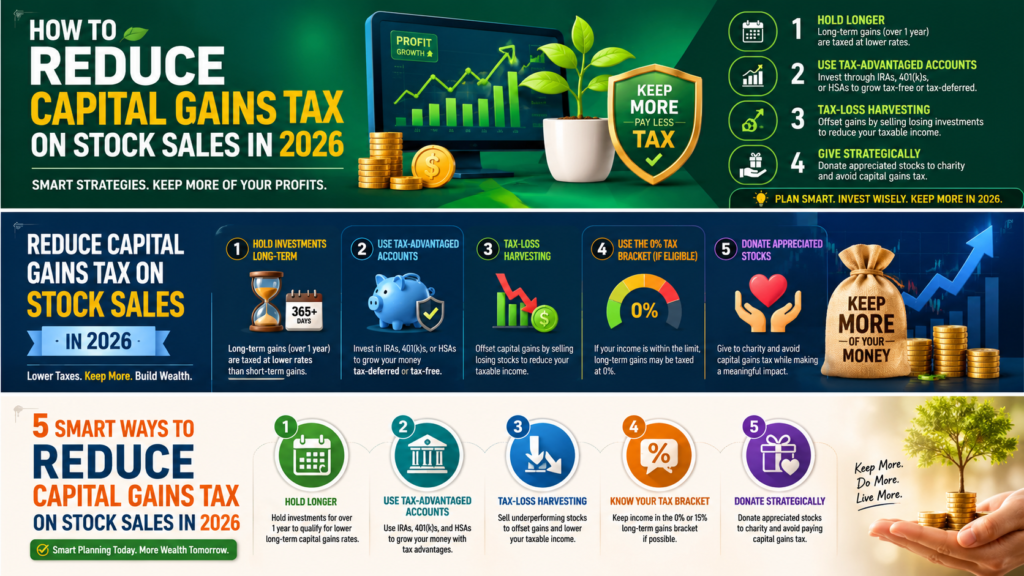
These seven steps form a complete action plan you can apply right now. Each step is legal, IRS-compliant, and proven effective for US taxpayers across income levels.
Step 1 — Review Your Holding Periods Before Any SaleLog
into your brokerage and confirm the acquisition date for every lot you plan to sell. Sort your positions by holding period. Prioritize selling lots held for more than 12 months to qualify for long-term rates. Flag any lot approaching the one-year mark and consider waiting.
Step 2 — Harvest Tax Losses to Offset Your GainsIdentify
positions in your portfolio currently trading below your cost basis. Sell those positions to realize a capital loss. Apply the loss against capital gains from your profitable sales. Remember the wash-sale rule: wait at least 31 days before repurchasing the same security, or buy a similar but not identical security immediately.
Step 3 — Project Your Taxable Income and Target a Lower
BracketWork with a tax professional to estimate your 2026 taxable income before your stock sales. If you are near the threshold between the 0% and 15% long-term rates, consider accelerating deductions (retirement contributions, business expenses) to drop into the lower bracket. Even a modest shift can eliminate federal capital gains tax entirely.
Step 4 — Maximize Tax-Advantaged AccountsMove
future stock investments into Roth IRAs, Traditional IRAs, Health Savings Accounts (HSAs), or 401(k) plans whenever possible. Gains inside these accounts are either tax-deferred or tax-free. While this doesn’t help gains already realized in taxable accounts, it prevents future gains from ever becoming taxable.
Step 5 — Consider Donating Appreciated Stock to CharityIf
you are charitably inclined, donating long-term appreciated stock directly to a qualified charity allows you to avoid the capital gains tax entirely while also claiming a charitable deduction for the stock’s full fair market value. This dual benefit makes donating appreciated stock significantly more tax-efficient than selling the stock and donating cash.
Step 6 — Use Specific Identification to Sell High-Basis
Lots FirstContact your broker and specify the exact shares you want to sell before the trade settles. Choose the lots with the highest cost basis first. This reduces your taxable gain on each sale. Over many trades, this single technique can save thousands of dollars annually without changing your investment strategy at all.
Step 7 — Explore Qualified Opportunity Zone
ReinvestmentIf you have a large realized gain — typically $50,000 or more — consider reinvesting into a Qualified Opportunity Fund within 180 days. This defers the original gain and can eliminate tax on future appreciation if you hold for 10+ years. This strategy works especially well after a major liquidity event, such as selling concentrated stock positions.
How Tranzesta Can Help You Reduce Capital Gains Tax on Stock Sales
Capital gains planning is not a one-size-fits-all exercise. The right strategy depends on your income, filing status, state of residence, investment mix, and broader financial picture. That is exactly where Tranzesta.com comes in.
Tranzesta.com is a US-based tax consultation firm specializing in business tax, bookkeeping, content creator taxes, and complex financial planning for self-employed individuals and investors across the United States. Our team reviews your full portfolio before year-end, identifies tax-loss harvesting opportunities, models bracket-shifting strategies, and helps you time stock sales for maximum after-tax return.
We also work with cannabis business owners and US expats who face unique capital gains reporting requirements — including FBAR and FATCA implications for overseas investment accounts. No matter how complex your situation, Tranzesta.com has the expertise to build a legal, audit-proof tax reduction plan tailored to your 2026 tax year.
Visit Tranzesta.com to learn more about our business tax and investment tax planning services, or explore our full range of tax consultation services for small businesses and self-employed professionals.
Ready to keep more of your investment profits?
Contact our team at hello@tranzesta.com for a free consultation.
Tranzesta.com — Expert Tax Strategy for US Investors.

Reduce Capital Gains Tax Stock Sales 2026: Expert Tips From Tranzesta
These are the advanced strategies that experienced investors and our tax professionals at Tranzesta.com use to go beyond the basics.
Pro Tips to Maximize Your After-Tax Returns in 2026
• Asset location matters: Hold high-growth, high-turnover assets in tax-advantaged accounts; hold buy-and-hold investments in taxable accounts to benefit from long-term rates and stepped-up basis at death.
• Gift appreciated stock to lower-income family members: If a family member is in the 0% capital gains bracket, transferring appreciated stock to them (within annual gift tax exclusion limits of $18,000 per recipient in 2026) allows them to sell at 0% federal capital gains tax.
• Time your retirement account conversions: A Roth IRA conversion increases your taxable income. If you plan a large conversion, avoid selling appreciated stocks in the same year — it could push your capital gains into a higher bracket.
• Keep records of every lot: Sloppy cost-basis records are one of the most common audit triggers for investors. Use your brokerage’s lot-tracking tools and back them up with your own records.
• Consider installment sales for private stock: If you are selling shares in a private company, an installment sale under IRC Section 453 spreads the gain over multiple tax years, which can keep you in a lower bracket each year.
These strategies require careful coordination with your overall tax plan. The team at Tranzesta.com can model each scenario and show you the projected after-tax impact before you commit to any sale.
Conclusion: Start Your Capital Gains Tax Plan Today
Capital gains taxes are one of the most controllable costs in any investment strategy — but only if you plan ahead. The three most important takeaways from this guide are: hold stocks for at least one year to access lower long-term rates, harvest losses strategically to offset gains, and work with a qualified tax professional to model your bracket and time your sales correctly.
Every year-end deadline that passes without a plan is money left on the table for the IRS. Additionally, the rules change frequently — and 2026 may bring additional legislative changes that affect capital gains rates and thresholds.
Ready to get expert help? Email us at hello@tranzesta.com or visit Tranzesta.com to schedule your free tax strategy session today. The sooner you plan, the more you save.
FAQs
The capital gains tax rate on stock sales in 2026 depends on your holding period and taxable income.. High earners may also owe the 3.8% Net Investment Income Tax on top of those rates.
You can legally reduce or avoid capital gains tax on stock sales through several IRS-compliant strategies. Tax-loss harvesting offsets gains with losses. Donating appreciated stock directly to charity avoids the gain entirely. Reinvesting gains into a Qualified Opportunity Fund defers taxation. Each strategy has specific eligibility rules, so consulting a tax professional is strongly recommended.
The wash-sale rule under IRC Section 1091 prevents US taxpayers from claiming a capital loss if they repurchase the same or substantially identical security within 30 days before or after the sale.cement shares instead. To preserve your harvested loss, wait at least 31 days before repurchasing, or immediately buy a similar but not identical security — such as a different ETF tracking a similar index.
Moving to a state with no income tax — such as Florida, Texas, Nevada, or Wyoming — can eliminate state-level capital gains taxes, since most states tax capital gains as ordinary income. voter registration, and other legal documents. Federal capital gains tax still applies regardless of state.
You cannot transfer existing taxable account stocks into a retirement account to avoid capital gains on past appreciation — that sale would still be a taxable event. However, directing future stock investments into a Roth IRA, Traditional IRA, or 401(k) allows any future gains to grow tax-free or tax-deferred.