bookkeeping setup in your new business
leads to missed deductions, cash flow problems, IRS penalties, and chaos at tax time. The good news is that a proper bookkeeping setup for a new business in the USA is straightforward when you know the steps.
In this guide, you’ll learn exactly how to build a bookkeeping system from scratch, which tools and methods to use, what the IRS requires, and how to avoid the most common mistakes new business owners make. Whether you’re a freelancer, an OnlyFans creator, a cannabis business operator, or launching a traditional LLC, this guide covers you completely.
What Is Bookkeeping and Why Does Every New US Business Need It?
Bookkeeping is the process of systematically recording, organizing, and tracking every financial transaction your business makes. It is the foundation of your entire financial and tax reporting system.
The Difference Between Bookkeeping and Accounting
Bookkeeping and accounting are related but distinct. Bookkeeping focuses on the day-to-day recording of transactions — income, expenses, invoices, and payments. Accounting, on the other hand, involves analyzing that data, preparing financial statements, and strategic tax planning. Most new business owners need both, but bookkeeping comes first.
Why Getting Bookkeeping Right From Day One Matters
The IRS requires all businesses to maintain accurate financial records. According to IRS Publication 583, every US taxpayer in business must keep records that support the income, deductions, and credits they report on their tax return. Failing to do so can result in disallowed deductions, penalties, and interest.
Additionally, proper bookkeeping helps you understand your actual profit margins, manage cash flow, secure business loans, and make informed decisions. Therefore, setting up bookkeeping correctly at the start of your business is one of the highest-ROI activities you can do as a new entrepreneur in the USA.
For specialized businesses — such as content creators tracking platform payouts, or cannabis businesses navigating IRC §280E restrictions — accurate bookkeeping is even more critical. Tranzesta works with businesses in exactly these situations across the United States.
Key Requirements for Bookkeeping Setup in a New US Business
The IRS does not mandate a specific bookkeeping method for most small businesses. However, certain rules and requirements apply to all US business owners, regardless of industry or business structure.
Cash vs. Accrual Accounting: Which Should You Choose?
Most new small businesses in the USA use cash-basis accounting, which means you record income when you receive it and expenses when you pay them. This method is simpler and works well for service-based businesses, freelancers, and sole proprietors.
By contrast, accrual-basis accounting records income when it’s earned and expenses when they’re incurred, regardless of when money changes hands. The IRS generally requires accrual accounting for businesses with average annual gross receipts exceeding $30 million over the prior three years (per IRC §448). However, many inventory-based businesses choose accrual even below this threshold.
What Records Does the IRS Require You to Keep?
The IRS recommends keeping business records for a minimum of three years after filing the related tax return. However, records related to property, employment taxes, or situations involving fraud should be kept for six to seven years or longer. The core records every US business must maintain include:
Income records:
invoices, payment receipts, bank deposits, PayPal/Venmo/Stripe records
Expense records:
receipts, bills, credit card statements, vendor invoices
Payroll records:
W-2s, 1099s, payroll reports (if you have employees or contractors)
Asset records:
purchase records for equipment, vehicles, and property
Bank statements:
monthly statements for all business accounts
Tax returns:
copies of all filed federal and state returns
Choosing a Business Structure Before Setting Up Books
Your legal business structure affects how you set up bookkeeping. A sole proprietor files on Schedule C and can use simple single-entry bookkeeping. An LLC, S-Corp, or C-Corp typically requires double-entry bookkeeping and separate financial statements. Most US small businesses start as sole proprietors or single-member LLCs, then evolve as they grow.
What Are the Biggest Bookkeeping Mistakes New Business Owners Make?
Most bookkeeping mistakes are preventable. However, new business owners repeatedly make the same errors — and those errors compound over time, making tax season a nightmare. Here are the most damaging mistakes to avoid.
Mistake 1: Mixing Personal and Business Finances
This is the most common and most damaging bookkeeping mistake. Using one bank account or credit card for both personal and business spending creates a record-keeping nightmare. Additionally, the IRS may disallow business deductions if you cannot clearly separate them from personal costs. Open a dedicated business checking account and business credit card before you make your first business purchase.
Mistake 2: Falling Behind on Transaction Recording
Many new business owners intend to record transactions weekly but end up doing it quarterly — or worse, just before tax time. As a result, receipts go missing, transactions are forgotten, and categorization errors multiply. The solution is simple: record every transaction within 24 to 48 hours of it occurring. Set a recurring reminder if needed.
Mistake 3: Incorrect Expense Categorization
Putting expenses in the wrong categories causes problems on your tax return. For example, a meal with a client is a 50% deductible business meal — not a 100% deductible office expense. Software subscriptions belong in a different category than professional development. Incorrect categorization can trigger IRS flags and reduce your actual deductions.
Mistake 4: Ignoring Sales Tax Obligations
If your business sells physical products or taxable services in certain US states, you may be required to collect and remit sales tax. New business owners frequently overlook this, especially those selling through e-commerce platforms or across state lines. Check your state’s Department of Revenue for nexus rules before you launch.
Mistake 5: Not Reconciling Bank Accounts Monthly
Bank reconciliation — the process of matching your bookkeeping records to your actual bank statements — must happen monthly, not annually. Without it, errors, duplicate entries, and even fraud can go undetected for months. Most bookkeeping software like QuickBooks and Xero makes this process fast and straightforward.
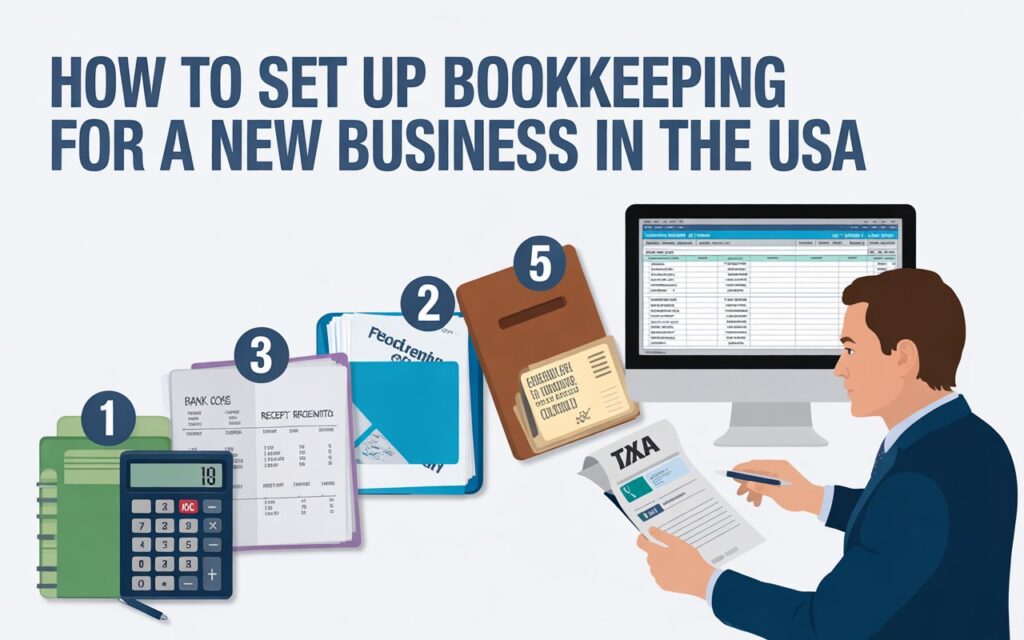
How to Set Up Bookkeeping for a New Business in the USA: Step-by-Step
Follow these seven steps to build a solid, IRS-compliant bookkeeping system from the ground up. Each step is actionable and can be completed within your first week of operation.
Register your business and get an EIN. Before setting up bookkeeping, register your business entity with your state and apply for an Employer Identification Number (EIN) from the IRS at IRS.gov. Your EIN is required to open a business bank account, hire employees, and file business taxes. Sole proprietors without employees can use their Social Security Number, but an EIN adds professionalism and protects your SSN.
Open a dedicated business bank account.
Visit your preferred bank or credit union and open a business checking account using your EIN and business registration documents. Immediately route all business income into this account and pay all business expenses from it. This single step eliminates the most common bookkeeping error.
Choose your accounting method.
Decide whether you will use cash-basis or accrual-basis accounting. For most new US small businesses and self-employed individuals, cash-basis is simpler and sufficient. Consult a tax professional if your business has inventory or complex revenue recognition needs.
Select bookkeeping software. Choose a cloud-based
bookkeeping tool that fits your business size. QuickBooks Online and Xero are the most widely used in the USA and integrate with most banks, payroll systems, and tax tools. FreshBooks works well for freelancers and service providers. Wave is a free option for very simple businesses. Tranzesta’s team works fluently in all major platforms.
Set up your chart of accounts. A chart of accounts
is a categorized list of every financial category your business uses — income, cost of goods sold, operating expenses, assets, liabilities, and equity. Most bookkeeping software includes a default chart of accounts. Customize it to fit your industry, adding categories like ‘Platform Fees’ for content creators or ‘Cost of Goods Sold – Cannabis’ for cannabis operators.
Connect your bank accounts and set up automated feeds.
Link your business bank account and credit card to your bookkeeping software. This enables automatic transaction imports. You still need to categorize each transaction, but the data entry is eliminated. Set a recurring weekly appointment to review and categorize imported transactions.
Schedule monthly reconciliations and quarterly reviews.
At the end of every month, reconcile your bank accounts within your software. At the end of every quarter, review your profit and loss statement, check your tax estimates, and make any necessary adjustments. Tranzesta offers ongoing bookkeeping support so you never fall behind.
How Tranzesta Helps With Bookkeeping Setup for New Businesses
Tranzesta is a US-based tax consultation and bookkeeping firm that specializes in getting new businesses set up correctly from the very first transaction. Our team works with entrepreneurs across the United States — from solo content creators to multi-location cannabis businesses.
We handle complete bookkeeping setup:
chart of accounts configuration, software onboarding, bank feed integration, and ongoing monthly reconciliation. We also ensure your books are structured to maximize every available tax deduction. Visit Tranzesta.com to learn more about our business bookkeeping services.
For OnlyFans creators and digital content professionals, Tranzesta understands the nuances of platform income reporting, merchandise deductions, and home studio expenses. For cannabis businesses in the United States, our team has deep experience with the limitations of IRC §280E and how to structure COGS to legally minimize your tax burden.
For US expats and Americans with foreign income, we provide streamlined bookkeeping solutions aligned with our Streamlined Filing services. Learn more about our Streamlined Filing compliance support at Tranzesta.com.
Ready to get your books set up correctly from day one? Contact our team at hello@tranzesta.com for a free consultation. We’ll design a bookkeeping system built for your specific business, industry, and tax situation.
Bookkeeping Setup New Business USA: Expert Tips for Long-Term Success
Beyond the basics, these advanced practices separate business owners who stay compliant and profitable from those who struggle every tax season. Tranzesta shares these tips with every new client.
Use separate credit cards for different expense types. Some business owners maintain one card for travel and meals, another for software and subscriptions. This makes categorization faster and cleaner at month-end.
Invoice immediately and track receivables.
Outstanding invoices are cash-flow killers. Send invoices the moment work is delivered and follow up within 7 days of the due date. Your bookkeeping software should flag overdue invoices automatically.
Pay estimated quarterly taxes from a separate savings account.
Self-employed US taxpayers must pay estimated taxes four times per year (April, June, September, January). Set aside 25–30% of every payment you receive into a dedicated tax savings account to avoid a shock at filing time.
Photograph and digitize every receipt immediately.
Use apps like Dext, Hubdoc, or your bookkeeping software’s mobile app to capture receipts the moment you make a purchase. Digital records are fully IRS-acceptable and much harder to lose.
Hire a bookkeeper before you think you need one.
Most business owners wait until their books are already a mess. The cost of professional bookkeeping — often $200–$500 per month — is far less than the cost of IRS penalties, missed deductions, or a CPA spending extra hours cleaning up disorganized records.
Review your profit and loss statement every single month.
Your P&L is your business’s financial health report. Reviewing it monthly lets you spot trends, cut unnecessary costs, and make data-driven decisions. Don’t wait until December to find out January was unprofitable.
For complete guidance on record-keeping requirements for US businesses, review the SBA.gov guide to business finances (opens in new tab), which provides a clear overview of financial management best practices for new entrepreneurs.
Conclusion
Setting up bookkeeping for a new business in the USA is one of the most important things you can do in your first week of operation. First, separate your personal and business finances immediately. Second, choose the right accounting method and software for your business type. Third, record and categorize every transaction consistently — monthly reconciliation is not optional.
When your books are clean and current, tax time becomes manageable, your deductions are maximized, and your business decisions are based on accurate data. The alternative — scrambling to reconstruct a year of transactions in March — costs you time, money, and peace of mind.
FAQs
Bookkeeping setup for a new business in the USA involves five key steps: registering your business and getting an EIN from the IRS, opening a dedicated business bank account, choosing an accounting method (cash or accrual), selecting bookkeeping software such as QuickBooks or Xero, and setting up a chart of accounts tailored to your industry. From there, link your bank accounts for automatic transaction imports and establish a routine of weekly categorization and monthly reconciliation.
The best bookkeeping software for a small business in the USA depends on your business size and complexity. QuickBooks Online is the most widely used and integrates with the most third-party tools. Xero is excellent for businesses that need multi-user access and strong bank reconciliation. FreshBooks is ideal for freelancers and service-based businesses. Wave is a free option for very simple, low-volume businesses. Tranzesta works with all major platforms and can recommend the best fit for your specific situation.
You do not legally need an accountant to set up bookkeeping for your new business in the USA, but working with one from the start pays off significantly. A professional accountant or bookkeeper ensures your chart of accounts is structured correctly, your accounting method suits your tax situation, and you’re capturing all deductible expenses from day one. For complex businesses — such as cannabis operators, content creators, or multi-entity structures — professional guidance is strongly recommended to avoid costly errors.
The IRS generally recommends keeping business financial records for a minimum of three years after you file the related tax return. However, records related to employment taxes should be kept for at least four years. Records tied to property, business assets, or situations involving potential fraud should be retained for six to seven years or longer. Digital storage makes record retention easy and cost-effective. Most US tax professionals recommend keeping all records for at least seven years as a conservative standard.
Single-entry bookkeeping records each transaction once — either as income or as an expense. It works for very simple businesses but does not provide a complete financial picture. Double-entry bookkeeping records every transaction twice, as both a debit and a credit, following the fundamental accounting equation. It is the standard used by all professional accountants, required for most business entities, and provides the complete financial data needed for tax returns, financial statements, and business planning. Most bookkeeping software in the USA uses double-entry by default.
One Response