Every year, thousands of foreign individuals and entities
earn income from US sources — and the IRS requires that tax be withheld before a single dollar leaves the country. The rules governing FDAP income withholding tax for foreign persons are among the most misunderstood areas of US international tax law. Missing these obligations can trigger penalties, interest, and even criminal liability.
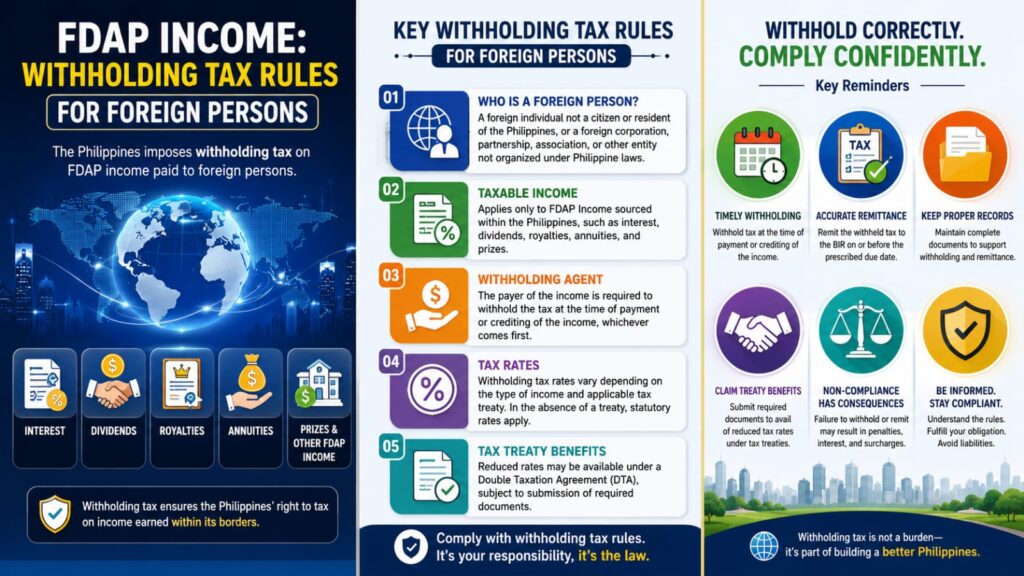
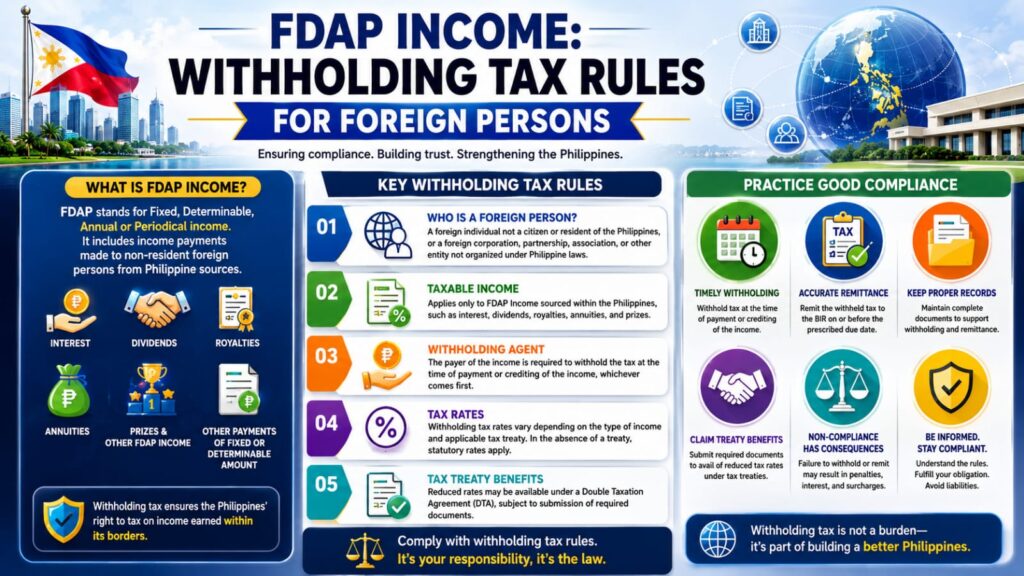
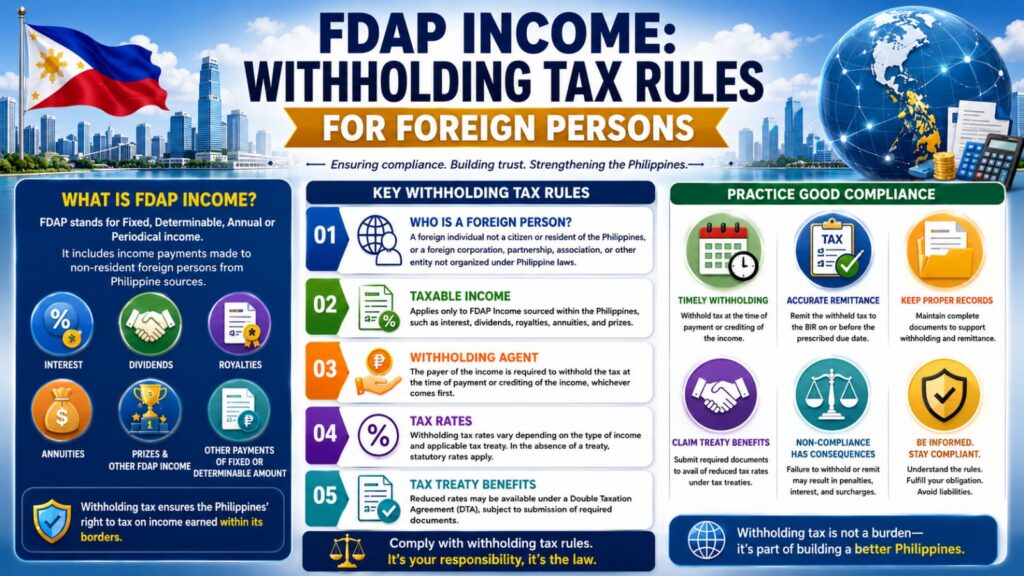
FDAP stands for Fixed, Determinable, Annual, or Periodical income.
It covers a broad range of US-source payments — from dividends and royalties to rent and compensation. Under Internal Revenue Code (IRC) Section 1441, US withholding agents must generally withhold 30% from FDAP payments made to non-resident aliens (NRAs) and foreign entities, unless a treaty or exception applies.
In this guide, you will learn exactly what FDAP income is, which payments trigger withholding, the correct IRS forms to use, common mistakes that lead to penalties, and how Tranzesta helps businesses and foreign persons stay fully compliant with US tax law.
What Is FDAP Income? Understanding the Basics for Foreign Persons
FDAP income is any income that is fixed or determinable in amount and paid on an annual or periodic basis from US sources to a foreign person. The IRS treats this category of income differently from effectively connected income (ECI), which is taxed at graduated rates. FDAP income is subject to a flat 30% gross withholding tax unless a reduced rate applies under a US income tax treaty.
This distinction matters enormously for foreign investors,
content creators with US-based platforms, non-resident business owners, and multinational corporations with US subsidiaries. Getting the classification wrong exposes both the foreign payee and the US withholding agent to significant IRS penalties.
What Types of Payments Count as FDAP Income?
The IRS defines FDAP income broadly under IRC Sections 871 and 881. Common examples include:
Dividends paid by US corporations to foreign shareholders
Interest on US bank deposits or bonds (subject to portfolio interest exception)
Royalties for patents, copyrights, and trademarks used in the United States
Rents from US real property (unless treated as ECI by election)
Compensation for personal services performed in the United States
Annuity payments originating from US sources
Gambling winnings from US sources (with limited exceptions)
Scholarship and fellowship grants are paid to non-resident alien students
Notably, FDAP income does not include gains from the sale of property, which are generally not subject to withholding unless they fall under the Foreign Investment in Real Property Tax Act (FIRPTA) rules.
Who Is Considered a ‘Foreign Person’ Under US Tax Law?
A foreign person for FDAP withholding purposes includes non-resident alien individuals, foreign corporations, foreign partnerships, foreign trusts, and foreign estates. The IRS determines residency status for individuals using the substantial presence test and the green card test. If a person fails both tests, they are classified as a non-resident alien and subject to the FDAP withholding rules on their US-source income.
US persons — including US citizens abroad and resident aliens — are generally not subject to FDAP withholding. However, they must still report all worldwide income on their US tax returns. Tranzesta regularly advises US expats navigating the overlap between FDAP withholding and their own reporting obligations.
FDAP Income Withholding Tax Rules for Foreign Persons: Rates and Exemptions
The default FDAP income withholding tax rate for foreign persons is 30% of the gross payment. This rate applies when no tax treaty exists between the United States and the foreign person’s country of residence, and when no statutory exception applies. The withholding is calculated on the gross amount — no deductions are allowed — making it far more aggressive than the graduated rates that apply to US residents.
However, several important exceptions and reductions can lower or eliminate this burden.
Tax Treaty Reductions
The United States has income tax treaties with over 65 countries, including the United Kingdom, Germany, Canada, Japan, and Australia. These treaties frequently reduce FDAP withholding rates on specific income types. For example, dividends may be subject to only 5% or 15% withholding, and royalties may be reduced to 0% under certain US treaties. To claim a treaty benefit, the foreign person must provide IRS Form W-8BEN (for individuals) or Form W-8BEN-E (for entities) to the US withholding agent before payment is made. Failure to provide this documentation means the full 30% rate applies by default.
Statutory Exemptions Under US Tax Law
Even without a tax treaty, certain FDAP income categories are exempt from withholding or taxed at reduced rates under the IRC. Key exemptions include:
Portfolio interest exemption: Interest on certain US bonds and bank deposits paid to non-resident aliens is exempt under IRC Section 871(h), provided the foreign person qualifies and is not a 10% shareholder.
Original issue discount (OID) on short-term obligations: Generally exempt from FDAP withholding.
Capital gains: Most gains from the sale of US personal property are not treated as FDAP income.
Income effectively connected with a US trade or business (ECI): Taxed at graduated rates, not the 30% FDAP flat rate.
According to IRS Publication 515 — Withholding of Tax on Nonresident Aliens and Foreign Entities — withholding agents must apply due diligence when determining a payee’s foreign status. Reliance on a properly completed W-8 form generally provides a safe harbor from penalties if the information later turns out to be incorrect.
Backup Withholding vs. FDAP Withholding
It is important not to confuse FDAP withholding with backup withholding. Backup withholding at 24% applies primarily to US persons who fail to provide a valid taxpayer identification number. FDAP withholding under Chapter 3 (IRC Sections 1441–1446) is a separate regime that specifically targets payments to foreign persons. Both rules may apply in different circumstances, so US payors must carefully determine which regime controls a given payment.
Common FDAP Withholding Mistakes That Lead to IRS Penalties
Mistakes in FDAP withholding compliance are costly. The IRS can assess penalties equal to the amount of tax that should have been withheld, plus interest. In some cases, the withholding agent — not the foreign payee — bears this liability personally. Below are the most frequent errors Tranzesta encounters when working with clients.
Mistake 1: Failing to Collect a W-8 Form Before Payment
The single most common FDAP withholding error is sending a payment to a foreign person without first collecting a valid Form W-8BEN or W-8BEN-E. Without this documentation, the withholding agent has no basis for reducing the 30% default rate and may be unable to claim treaty benefits on the payee’s behalf. Tranzesta strongly recommends establishing a pre-payment documentation workflow for all international vendor and investor relationships.
Mistake 2: Misclassifying FDAP Income as Exempt
Some US payors incorrectly treat income as exempt from FDAP withholding — for example, assuming that a royalty payment is non-taxable because the foreign payee’s country has a US tax treaty, without confirming that the specific royalty type is covered. Treaty provisions are highly fact-specific. A general treaty may reduce dividend withholding to 15% but still impose 10% on royalties. Payors must review treaty schedules carefully or consult a tax professional.
Mistake 3: Not Filing Form 1042 and Form 1042-S
US withholding agents must file IRS Form 1042 (Annual Withholding Tax Return for US Source Income of Foreign Persons) and Form 1042-S (Foreign Person’s US Source Income Subject to Withholding) for each tax year in which FDAP payments were made. Form 1042 is due by March 15 of the following year. Failure to file, or filing late, results in significant penalties under IRC Section 6651. These forms are separate from standard business tax returns and are frequently overlooked by small and mid-size businesses with occasional foreign payees.
Mistake 4: Ignoring FATCA Obligations
The Foreign Account Tax Compliance Act (FATCA), enacted under Chapter 4 of the IRC (Sections 1471–1474), adds a layer of withholding and documentation requirements on top of traditional FDAP rules. Under FATCA, payments to non-participating foreign financial institutions (FFIs) may be subject to a separate 30% withholding. US payors must also verify FATCA status through W-8 forms and maintain proper documentation. Failing to integrate FATCA compliance into an FDAP withholding system is a serious and increasingly penalized oversight.
Mistake 5: Using Expired or Invalid W-8 Forms
Form W-8BEN and W-8BEN-E expire after three calendar years from the year of signing. Many businesses collect these forms once and never update them, leaving themselves exposed to compliance gaps. A withholding agent that relies on an expired W-8 form generally cannot claim good faith reliance as a penalty defense. Building a documentation renewal system is essential for any business that regularly makes cross-border payments.
How to Comply With FDAP Income Withholding Tax Rules: Step-by-Step
Complying with the FDAP withholding tax rules requires systematic action before, during, and after each payment to a foreign person. The following steps outline a compliance framework that Tranzesta recommends to US businesses and withholding agents.
Step 1: Determine the payee’s US or foreign status.
Collect IRS Form W-9 from US persons and Form W-8BEN or W-8BEN-E from foreign persons before the first payment. Verify that the form is complete, signed, and not expired.
Step 2: Identify the income type.
Classify each payment as FDAP income, ECI, or capital gain. Consult the relevant IRC section and applicable US tax treaty, if any, to confirm the correct withholding treatment.
Step 3: Determine the applicable withholding rate.
Apply the 30% default rate unless a valid treaty claim, statutory exemption, or Form W-8 reduces the rate. Document your analysis and retain supporting materials.
Step 4: Withhold tax at the point of payment.
Reduce the gross payment by the applicable withholding rate. Do not make net-of-tax payments without accounting for the gross-up in your withholding calculation.
Step 5: Deposit withheld taxes with the IRS.
Withheld FDAP taxes must be deposited using IRS Form 8109 (Federal Tax Deposit coupon) or through the Electronic Federal Tax Payment System (EFTPS). Deposits are generally due semimonthly.
Step 6: Furnish Form 1042-S to each foreign payee.
Provide the payee with their Form 1042-S by March 15 of the year following payment. This form documents the income type, gross amount, withholding, and any treaty benefits applied.
Step 7: File Form 1042 with the IRS by March 15.
This annual return summarizes all FDAP payments made during the prior year and reconciles total withholding deposits with amounts reported on Form 1042-S. Retain all W-8 forms and documentation for at least seven years.
These seven steps apply to virtually every US withholding agent making payments to foreign persons. For complex multi-country structures or high-volume payment streams, Tranzesta offers full-service withholding compliance support.
How Tranzesta Can Help With FDAP Income Withholding Tax Compliance
Tranzesta is a US-based tax consultation firm with deep expertise in international tax compliance, including FDAP income withholding tax rules for foreign persons. Our team works with US businesses, self-employed individuals, and foreign payees who need accurate, timely guidance on navigating the complex web of IRC Chapters 3 and elements.
Whether you are a US content creator making royalty payments to foreign collaborators, a cannabis business with international investors, or a corporation managing dividend distributions to non-resident shareholders, Tranzesta provides practical solutions tailored to your specific situation.
Our FDAP-related services include:
W-8 form collection, review, and documentation management
Treaty benefit analysis and withholding rate determination
FATCA compliance integration and foreign payee classification
Form 1042 and Form 1042-S preparation and filing
IRS penalty abatement support for prior-year withholding failures
Learn more about our international tax services at Tranzesta.com, where you can explore how we support US expats, content creators, and business owners with cross-border tax obligations.
Need help with FDAP withholding compliance?
Contact our team at hello@tranzesta.com for a free consultation.
We make US international tax simple — so you can focus on your business.
FDAP Income Withholding Tax for Foreign Persons: Expert Tips for 2026
US international tax rules are not static. Treaty updates, IRS guidance changes, and evolving FATCA enforcement priorities mean that compliance strategies effective in prior years may need updating. Tranzesta.com Here are Tranzesta’s top expert tips for staying ahead in 2026.
Review all W-8 forms annually.
If a form is approaching its three-year expiration, request a renewal from your foreign payee before the deadline — not after.
Do not rely on the 30% rate as a catch-all.
Withholding too much creates issues for your foreign payees and may damage business relationships. Take the time to analyze treaty benefits properly.
Integrate FATCA checks into your onboarding process.
Every new foreign payee relationship should include a FATCA status determination before the first payment is made.
Use EFTPS for all withholding deposits.
Paper deposit coupons are error-prone and carry a higher risk of missed deadlines. EFTPS provides same-day confirmation and electronic records.
Keep a withholding register.
Document every FDAP payment, the applicable rate, the basis for the rate, and the deposit confirmation number. This register is your first line of defense in an IRS audit.
Consult a specialist before making net payments.
If you agree to pay a foreign person a specific net amount and cover the US tax liability yourself, the gross-up calculation is complex. Getting it wrong leads to under-withholding penalties.
International tax compliance is a specialty area where the cost of professional advice is almost always lower than the cost of IRS penalties. Tranzesta has helped dozens of US businesses and self-employed individuals bring their FDAP withholding obligations into full compliance quickly and affordably.
Conclusion: Staying Compliant With FDAP Withholding Rules
FDAP income withholding tax rules for foreign persons sit at the intersection of US tax law, international treaties, and federal compliance requirements. Three takeaways stand above all others: first, the default 30% withholding rate applies unless you have documentation and a valid basis for a lower rate; second, both Form 1042 and Form 1042-S must be filed annually by March 15 for every year in which FDAP payments were made; and third, the withholding agent — not the foreign payee — is typically liable for any failure to withhold.
These rules apply to a wide range of US taxpayers, from small business owners with a single foreign contractor to corporations distributing dividends to international shareholders. Additionally, FATCA obligations layer on top of these requirements, making full compliance increasingly complex without professional support.
The good news is that the rules are manageable with the right systems and guidance in place. Tranzesta specializes in exactly this kind of work, helping US businesses, content creators, and self-employed individuals meet their international tax obligations with confidence.
Ready to get expert help with FDAP withholding compliance?
Email us at hello@tranzesta.com or visit Tranzesta.com
to schedule your free tax strategy session today.
FAQs
FDAP income withholding tax for foreign persons is generally 30% of the gross payment under IRC Section 1441. This rate applies to non-resident alien individuals, foreign corporations, and other foreign entities receiving US-source income such as dividends, royalties, interest, and rent.
Yes FDAP ECI is taxed at the same graduated rates that apply to US residents and is not subject to FDAP withholding. The correct classification depends on the nature and source of the income.
FDAP Additionally, withholding agents should collect Form W-8BEN from foreign individuals and Form W-8BEN-E from foreign entities to document payee status and any applicable treaty claims before making payments.
Yes. FDAP The United States maintains income tax treaties with more than 65 countries, and many of these treaties reduce withholding rates on specific FDAP income categories. To claim treaty benefits,
FDAP The IRS can assess the full amount of unwithheld tax — plus interest and penalties — directly against the withholding agent, even if the foreign payee has already left the United States. Under IRC Section 146. This makes it critical for US businesses.