For US taxpayers living or earning abroad,
double taxation can quietly drain thousands of dollars every year. The biggest question most expats and self-employed individuals face is FEIE vs foreign tax credit—which actually saves more?
The answer isn’t always obvious.
In fact, choosing the wrong strategy can cost you more in taxes, limit future deductions, and even trigger IRS issues.
In this guide, you’ll learn exactly how the Foreign Earned Income Exclusion (FEIE) and Foreign Tax Credit (FTC) work, when to use each, and how to maximize your savings legally in the United States.
Let’s break it down step by step.
What Is FEIE vs Foreign Tax Credit?
FEIE vs foreign tax credit refers to two IRS-approved methods that help US taxpayers avoid double taxation on foreign income. Both reduce your US tax bill, but they work very differently.
The Foreign Earned Income Exclusion (FEIE) allows you to exclude a portion of your foreign income from US taxation. In contrast, the Foreign Tax Credit (FTC) gives you a dollar-for-dollar credit for taxes paid to a foreign country.
What Is the Foreign Earned Income Exclusion (FEIE)?
The FEIE is a tax provision under Internal Revenue Code Section 911. It allows qualifying US taxpayers to exclude up to $126,500 (2024 limit, adjusted annually) of foreign-earned income from US taxes.
To qualify, you must meet one of two tests:
Physical Presence Test (330 days abroad in 12 months)
Bona Fide Residence Test (established residency in another country)
However, the FEIE only applies to earned income, such as wages or self-employment income. It does not apply to passive income like dividends or capital gains.
What Is the Foreign Tax Credit (FTC)?
The Foreign Tax Credit allows you to offset US taxes by claiming a credit for income taxes paid to a foreign government.
For example, if you paid $10,000 in taxes to a foreign country, you can potentially reduce your US tax bill by the same amount.
This credit is claimed using IRS Form 1116 and applies to both earned and unearned income.
How Does FEIE vs Foreign Tax Credit Work?
FEIE vs foreign tax credit works by either excluding income entirely or offsetting taxes paid abroad. Choosing the right one depends on your income level, country tax rates, and long-term strategy.
According to the IRS, US citizens must report worldwide income, regardless of where they live. However, these provisions exist to prevent double taxation.
You can verify details directly through the IRS:
Learn more from the IRS about foreign income rules (opens in a new tab): https://www.irs.gov/individuals/international-taxpayers/foreign-earned-income-exclusion
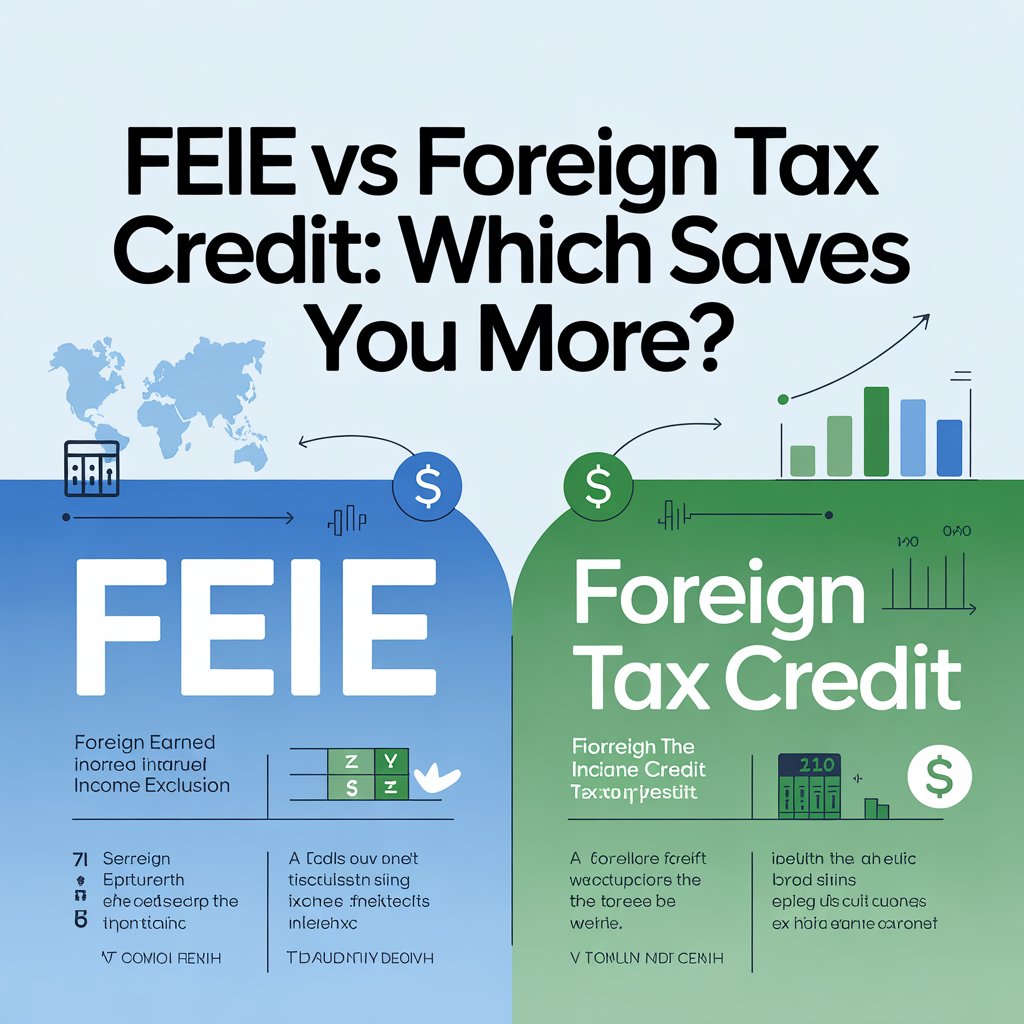
Key Differences Between FEIE and FTC
FEIE reduces taxable income
FTC reduces tax liability directly
FEIE has an income cap
FTC has no strict income limit
FEIE excludes income, FTC preserves deductions
IRS Rules You Must Follow
To stay compliant in the United States, follow these rules:
You cannot double dip—no claiming FEIE and FTC on the same income
FEIE requires Form 2555
FTC requires Form 1116
Self-employed individuals must still pay self-employment tax
Housing exclusions may apply with FEIE
Unused FTC can carry forward up to 10 years
Additionally, the IRS allows carrybacks for one year and carryforwards for ten years on unused credits, which makes FTC a powerful long-term strategy.
Common Mistakes to Avoid
FEIE vs foreign tax credit decisions often go wrong due to a misunderstanding of IRS rules. These mistakes can lead to audits, penalties, or overpaying taxes.
Choosing FEIE Without Considering Future Credits
Many US taxpayers choose FEIE for immediate savings. However, this can limit your ability to claim foreign tax credits later.
Ignoring High-Tax Countries
If you live in a high-tax country like Germany or Canada, the FTC often provides better savings. Choosing FEIE in these cases can actually increase your total tax burden.
Not Accounting for Self-Employment Tax
FEIE does not eliminate self-employment tax, which is currently 15.3% in the USA. Many freelancers and OnlyFans creators overlook this.
Improper Filing of IRS Forms
Filing Form 2555 or Form 1116 incorrectly can trigger delays or penalties. Accuracy matters, especially for expats with complex income streams.
Step-by-Step Guide: How to Choose Between FEIE vs Foreign Tax Credit
To choose between FEIE vs foreign tax credit, you must analyze your income, foreign tax rate, and long-term tax strategy.
Follow these steps:
Step 1: Calculate Your Total Foreign Income
Determine how much income you earned abroad. Include all sources such as freelance work, salaries, and business income.
Step 2: Check the Foreign Tax Rate
Compare your foreign tax rate to US tax rates. If your foreign tax rate is higher, FTC is often the better choice.
Step 3: Apply the FEIE Limit
If your income is below the FEIE cap (around $126,500), exclusion may eliminate your US tax liability.
Step 4: Evaluate Self-Employment Impact
If you are self-employed, remember that FEIE does not remove self-employment tax. FTC may offer better overall savings.
Step 5: Consider Long-Term Strategy
FTC allows unused credits to carry forward. Therefore, it often benefits long-term expats or high earners.
Step 6: Run Both Scenarios
Most importantly, calculate your taxes using both methods. Compare the results before deciding.
How Tranzesta Can Help With FEIE vs Foreign Tax Credit
Tranzesta helps US taxpayers choose the best strategy between FEIE vs foreign tax credit while staying fully compliant with IRS rules.
At Tranzesta, we specialize in helping:
US expats
Cannabis business owners
Self-employed individuals
Our team analyzes your full financial picture to determine whether FEIE or FTC saves you more.
Additionally, we handle:
Streamlined Filing compliance
Foreign income reporting
Business tax and bookkeeping in the USA
IRS audit support
We don’t just file your taxes—we build a strategy that minimizes risk and maximizes savings.
Contact our team at hello@tranzesta.com for a free consultation.
Visit Tranzesta.com to learn more about our streamlined filing services for US expats.
You can also learn more about creator tax compliance strategies at Tranzesta.com to stay fully compliant as a digital entrepreneur.
FEIE vs Foreign Tax Credit: Expert Tips for 2026
FEIE vs foreign tax credit decisions become more powerful when combined with advanced strategies.
Here are expert tips from Tranzesta:
Use FEIE with housing exclusion to reduce taxable income further
Switch to FTC if your income grows above the FEIE limit
Time your residency to meet the IRS qualification tests
Track foreign taxes carefully to maximize FTC claims
Consider state tax implications in the USA
Most importantly, always plan. Tax strategy should be proactive, not reactive.
Additionally, the IRS updates thresholds annually. Staying informed ensures you don’t miss savings opportunities.
Conclusion
Choosing between FEIE vs foreign tax credit can significantly impact how much you pay in taxes as a US taxpayer living abroad.
Here are the key takeaways:
FEIE works best for lower-income and low-tax countries
FTC is ideal for higher-income or high-tax countries
Long-term planning often favors FTC
Ultimately, the best choice depends on your specific situation. A one-size-fits-all approach doesn’t work in international tax planning.
Ready to get expert help? Email us at hello@tranzesta.com or visit Tranzesta.com to schedule your free tax strategy session today.
FAQs
FEIE vs foreign tax credit depends on your income and tax situation. FEIE is better for lower-income or low-tax countries because it excludes income entirely. However, the foreign tax credit is better for high-tax countries since it provides dollar-for-dollar tax offsets. Many US taxpayers benefit more from the FTC in the long term due to carry-forward benefits.
FEIE vs foreign tax credit cannot be applied to the same income. However, you can use both strategically on different types of income. For example, you may exclude earned income using FEIE while claiming FTC on passive income like dividends. Proper planning is essential to avoid IRS issues.
FEIE vs foreign tax credit comparisons show that FEIE does not eliminate all taxes. While it excludes foreign-earned income from federal income tax, it does not remove self-employment tax. US taxpayers who are self-employed must still pay Social Security and Medicare taxes.
FEIE vs foreign tax credit planning requires knowing current limits. The FEIE limit is adjusted annually for inflation. For 2024, it is $126,500, and it typically increases slightly each year. Always check the latest IRS updates before filing.
FEIE vs foreign tax credit analysis shows that FEIE offers long-term benefits. Unused foreign tax credits can be carried back one year and carried forward up to ten years. This makes the FTC especially valuable for US taxpayers with fluctuating income.
Related expertise
Talk to a real, signing professional
AI precision, human accountability — across the US, UK & UAE.
Book a free consultation