
Did you know that US business owners can deduct
up to $1,220,000 in equipment costs in the very year they buy them — instead of waiting decades for depreciation to trickle through? That is the power of the section 179 deduction equipment write-off 2026, and millions of American entrepreneurs are leaving serious money on the table by not using it.
Whether you are a self-employed creator, a cannabis business owner,
or a growing small business, understanding this deduction can transform your tax strategy. In this guide, you will learn exactly how Section 179 works, which equipment qualifies, common mistakes to avoid, and how to claim every dollar you are entitled to. Let’s get into it.
What Is the Section 179 Deduction and Why Does It Matter for 2026?
The Section 179 deduction is a provision in the US tax code — specifically Internal Revenue Code Section 179 — that allows businesses to immediately deduct the full purchase price of qualifying equipment and software in the tax year it is placed in service. Instead of depreciating an asset over five, seven, or even 15 years, you write off the entire cost right now.
For 2026, the deduction limit is $1,220,000,
and the phase-out threshold sits at $3,050,000 in total equipment purchases. These limits adjust annually for inflation, so they represent the most favorable terms yet for American business owners.
This matters enormously in today’s environment.
Equipment costs are rising. Cash flow is tight. And the IRS is actually giving you a tool to recover those costs fast — if you know how to use it.
Who Can Use Section 179?
Any US taxpayer operating a legitimate business can potentially use Section 179. That includes sole proprietors, LLCs, S-Corps, C-Corps, and partnerships. Employees cannot claim it for unreimbursed work expenses, but business owners in virtually every industry can. This includes content creators, cannabis retailers, contractors, restaurants, and professional service providers.
How Section 179 Differs from Bonus Depreciation
Section 179 and bonus depreciation are both accelerated write-off tools, but they work differently. Section 179 is elected by the taxpayer and has a dollar cap. Bonus depreciation — currently at 60% for 2026 under the Tax Cuts and Jobs Act phase-down schedule — applies automatically to eligible property and has no dollar ceiling. Therefore, many businesses use both strategies together to maximize their deductions.
What Equipment Qualifies for the Section 179 Deduction in 2026?
Not everything you buy qualifies, so understanding the rules is critical before you make a purchase.
Qualifying Property Categories
The IRS defines eligible property broadly, and most tangible personal property used in a business qualifies. Here is what generally makes the list:
Machinery and equipment (manufacturing tools, medical devices, construction equipment)
Business vehicles (with weight limits and usage rules)
Computers, software, and technology
Office furniture and fixtures
Off-the-shelf software purchased for business use
Qualified improvement property (certain interior improvements to nonresidential real property)
For OnlyFans creators and content producers, this can include cameras, lighting rigs, computers, editing software, ring lights, microphones, studio furniture, and even smartphones used for content creation. For cannabis businesses, this covers extraction equipment, point-of-sale systems, packaging machinery, and security systems.
What Does NOT Qualify?
Certain property is explicitly excluded. Real property — land and buildings — does not qualify for Section 179. Air conditioning and heating units installed on or in a building generally do not qualify either. Additionally, property you purchased for personal use and only partially converted to business use may have limited eligibility.
Importantly, the property must be used more than 50% of the time for business purposes to qualify. If you use a piece of equipment 60% for business and 40% personally, only 60% of the cost is deductible under Section 179.
Key Rules and Limits for the Section 179 Equipment Write-Off in 2026
Understanding the mechanics prevents costly errors. Here are the most important rules US taxpayers must follow.
The Business Income Limitation
This is one of the most misunderstood rules. Section 179 deductions cannot exceed your net business income for the year. In other words, you cannot use Section 179 to create a net loss. However, any unused deduction carries forward to future tax years, so it is never permanently lost.
Vehicle Deduction Caps
If you buy a vehicle for business use, the Section 179 deduction is subject to special “luxury auto” limits set by the IRS. For 2026, passenger vehicles used for business may have their deduction capped at approximately $12,400 for year one under these rules. Heavy SUVs with a gross vehicle weight rating over 6,000 pounds face a separate cap of $30,500. Always verify exact figures with a tax professional before purchasing a vehicle specifically for this deduction.
The Must-Be-Placed-In-Service Rule
Equipment must be placed in service — meaning actually used in your business — during the tax year you claim the deduction. Ordering equipment in December that does not arrive until January? That equipment counts for next year’s return, not this one.
Financing Does Not Change the Deduction
Many business owners are surprised to learn that you can take the full Section 179 deduction even if you financed the equipment purchase. You do not have to pay cash. As long as the equipment is placed in service in 2026, you can deduct the full cost — while still making monthly payments.
For detailed IRS guidance, refer directly to IRS Publication 946 – How to Depreciate Property (https://www.irs.gov/publications/p946), which covers all depreciation and expensing rules in plain detail.
Common Mistakes That Cost Business Owners Their Section 179 Deduction
Hundreds of US taxpayers make preventable errors every year. Avoiding these mistakes protects your deduction and keeps you out of trouble with the IRS.
Mistake 1: Forgetting to Elect Section 179
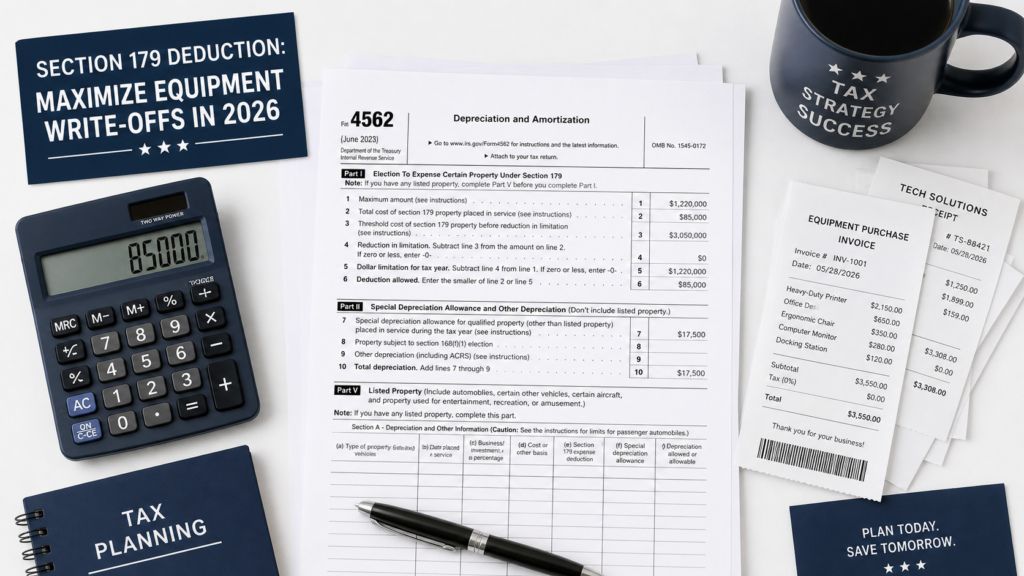
Section 179 is not automatic. You must elect it on your tax return by completing and attaching IRS Form 4562 – Depreciation and Amortization. If you do not file this form, you do not get the deduction — even if your equipment clearly qualifies. Therefore, always confirm with your tax preparer that this form has been filed correctly.
Mistake 2: Claiming Personal-Use Property as Business Equipment
The IRS specifically requires that qualifying property be used more than 50% for business. Claiming your personal laptop or home TV as a business deduction without proper documentation is a fast track to an audit. Keep detailed records showing business use percentages for every piece of equipment you claim.
Mistake 3: Ignoring State-Level Conformity
Not all US states conform to federal Section 179 limits. For example, some states cap their own Section 179 deduction at a much lower figure or do not allow it at all for certain asset types. As a result, your federal deduction and your state tax liability may differ significantly. This catches many business owners off guard during state tax filing season.
Mistake 4: Buying Equipment Too Late in the Year
Equipment must be placed in service — not just ordered or purchased — before December 31 to count for that tax year. Shipping delays, installation requirements, and delivery backlogs in Q4 have cost many business owners their planned deduction. Plan purchases early to avoid this risk.
Mistake 5: Overlooking Recapture Rules
If you claim Section 179 on equipment and then stop using it for business (or sell it) within the asset’s recovery period, the IRS requires you to recapture — that is, repay — a portion of the deduction as ordinary income. This surprises many small business owners who sell equipment after a few years. Always factor recapture risk into your decision.
Step-by-Step Guide: How to Claim the Section 179 Deduction Equipment Write-Off in 2026
Claiming this deduction is straightforward when you follow the right process. Here are the exact steps.
Step 1: Confirm Your Equipment Qualifies
Before anything else, verify that the equipment or software you purchased meets IRS eligibility criteria. It must be tangible personal property, used in a trade or business, placed in service in the US during 2026, and used more than 50% for business purposes. When in doubt, ask a qualified tax professional before the purchase — not after.
Step 2: Track Your Purchase Documentation
Gather and retain all purchase receipts, invoices, financing agreements, and delivery confirmations. The IRS may ask you to substantiate the cost and the date the property was placed in service. Digital records stored securely are perfectly acceptable. Organize these by asset category for easy reference during tax preparation.
Step 3: Calculate Your Total Equipment Costs
Add up all qualifying equipment purchases for the 2026 tax year. Remember the phase-out rule: if your total qualifying purchases exceed $3,050,000, your deduction limit begins to reduce dollar for dollar. Most small businesses will fall well below this threshold, however.
Step 4: Complete IRS Form 4562
Your tax preparer will complete Form 4562 on your behalf, or you will need to complete it yourself if you file independently. Part I of this form specifically covers the Section 179 election. You will list each piece of qualifying property, its cost, and the amount you are electing to expense.
Step 5: Apply the Business Income Limitation
Confirm that your Section 179 deduction does not exceed your net taxable business income. If it does, the excess carries forward automatically to the following tax year. This step is especially important for newer businesses with lower income in their first years.
Step 6: Coordinate with Bonus Depreciation
Evaluate whether layering in bonus depreciation makes sense for your situation. In 2026, bonus depreciation allows an additional 60% immediate write-off on eligible property after applying Section 179. Your tax advisor should model both scenarios to determine the most advantageous approach for your specific tax position.
Step 7: File on Time and Keep Records for at Least 5 Years
File your return — including Form 4562 — by the appropriate deadline, including extensions. Maintain all supporting documentation for a minimum of five years. If the IRS audits your return, you will need to produce evidence of both the purchase and the business use of the equipment.

How Tranzesta Can Help You Maximize the Section 179 Deduction Equipment Write-Off in 2026
At Tranzesta, we work with US business owners every day to identify, plan, and execute deductions exactly like this one — accurately, strategically, and without leaving a single dollar behind.
Our team specializes in tax strategy for industries that
face unique equipment and asset challenges. Content creators and OnlyFans performers need guidance on which studio equipment, tech gear, and home-office assets qualify. Cannabis businesses face a complex intersection of Section 179 rules and IRC Section 280E restrictions that require expert navigation. Self-employed individuals and small business owners need a clear, simple plan to make sure every equipment purchase is documented and claimed correctly.
Tranzesta does not just prepare your taxes.
We help you plan ahead so that your equipment buying decisions are made with tax strategy in mind — not as an afterthought. We also handle the full Form 4562 preparation, state conformity analysis, bonus depreciation coordination, and multi-year planning to maximize your write-offs across tax years.
Most importantly, we keep you audit-ready. Every deduction we recommend comes with documentation protocols to protect you if the IRS comes knocking.
Visit Tranzesta.com to learn more about our business tax and bookkeeping services. You can also explore our guidance on content creator tax services at Tranzesta.com to see how we help OnlyFans creators and digital entrepreneurs keep more of what they earn.
Contact our team at hello@tranzesta.com for a free consultation.
Section 179 Deduction Equipment Write-Off 2026: Expert Tips to Go Further
Once you understand the basics, a few advanced strategies can significantly increase your total deduction.
Time purchases strategically. If you are planning to buy major equipment in early 2027, consider moving that purchase to December 2026 if your income is higher this year. Accelerating the purchase accelerates the deduction into the higher-income year, where it delivers more tax value.
Bundle smaller purchases. Many business owners overlook smaller items — a $400 microphone, a $600 external hard drive, a $900 office chair. However, each of these qualifies individually for Section 179. Bundle them in your documentation to ensure nothing falls through the cracks.
Review your vehicle situation carefully.
If you operate a vehicle that weighs more than 6,000 pounds and use it for business more than 50% of the time, you may qualify for a larger vehicle deduction. Work with a tax professional to confirm the GVWR and mileage logs needed to support the deduction.
Consider a cost segregation study for real property.
While Section 179 does not cover buildings, a cost segregation study can identify components — lighting, flooring, fixtures — that may qualify as personal property eligible for Section 179 or bonus depreciation.
Do not forget software.
Off-the-shelf software is explicitly listed as qualifying property under Section 179. Accounting software, editing suites, security systems, point-of-sale platforms — if you purchased it in 2026 for business use, it likely qualifies.
For additional IRS guidance, review the IRS Small Business and Self-Employed Tax Center at https://www.irs.gov/businesses/small-businesses-self-employed for resources on business deductions and recordkeeping requirements.
Learn more about strategic tax planning at Tranzesta.com, where our tax experts walk through industry-specific deduction opportunities in detail.
Conclusion
The section 179 deduction equipment write-off 2026 is one of the most powerful tax tools available to US business owners — and one of the most underused. Here are the three things to remember:
First, you can deduct up to $1,220,000 in qualifying
equipment costs in the year of purchase — dramatically reducing your taxable income today. Second, the deduction requires a proper IRS Form 4562 election, solid documentation, and awareness of state conformity rules. Third, combining Section 179 with bonus depreciation and smart purchase timing can create a comprehensive equipment tax strategy that saves you thousands.
Do not leave money on the table. Work with experts who understand both the rules and the opportunities.
Ready to get expert help? Email us at hello@tranzesta.com or visit Tranzesta.com to schedule your free tax strategy session today.
FAQs
The Section 179 deduction limit for 2026 is $1,220,000 for qualifying equipment and software placed in service during the tax year. This limit begins to phase out dollar for dollar once total equipment purchases exceed $3,050,000. US taxpayers who stay below the phase-out threshold can deduct the full purchase cost of eligible property in the year it is placed in service, rather than depreciating it over several years.
Section 179 qualifying equipment includes machinery, computers, off-the-shelf software, office furniture, business vehicles (subject to weight and usage rules), and certain qualified improvement property. The equipment must be tangible personal property used more than 50% of the time for business purposes in the United States. Real property such as land and buildings generally does not qualify, though some interior building improvements may be eligible under the qualified improvement property rules.
US taxpayers can claim the full Section 179 deduction even if the equipment was purchased using financing, a loan, or a lease-to-own arrangement. The deduction is not limited to cash purchases. As long as the qualifying equipment is placed in service during the 2026 tax year, you can elect the full expensing deduction on your return — regardless of how the purchase was funded.
Section 179 is a taxpayer-elected deduction capped at $1,220,000, subject to a business income limitation, and applied to specific assets you choose. Bonus depreciation in 2026 is set at 60% under the Tax Cuts and Jobs Act phase-down schedule, applies automatically, and has no dollar cap. Many US business owners use Section 179 first to maximize the deduction on specific assets, then apply bonus depreciation to remaining eligible property for additional write-offs.
Section 179 does apply to business vehicles, but special IRS limits restrict the deduction for most passenger automobiles. For 2026, the first-year cap on passenger vehicles is approximately $12,400. However, heavy SUVs and vehicles with a gross vehicle weight rating over 6,000 pounds have a higher cap of $30,500. Trucks, vans, and other non-passenger commercial vehicles may qualify for a larger or full deduction depending on their classification and business use percentage.
Talk to a real, signing professional
AI precision, human accountability — across the US, UK & UAE.
Book a free consultation