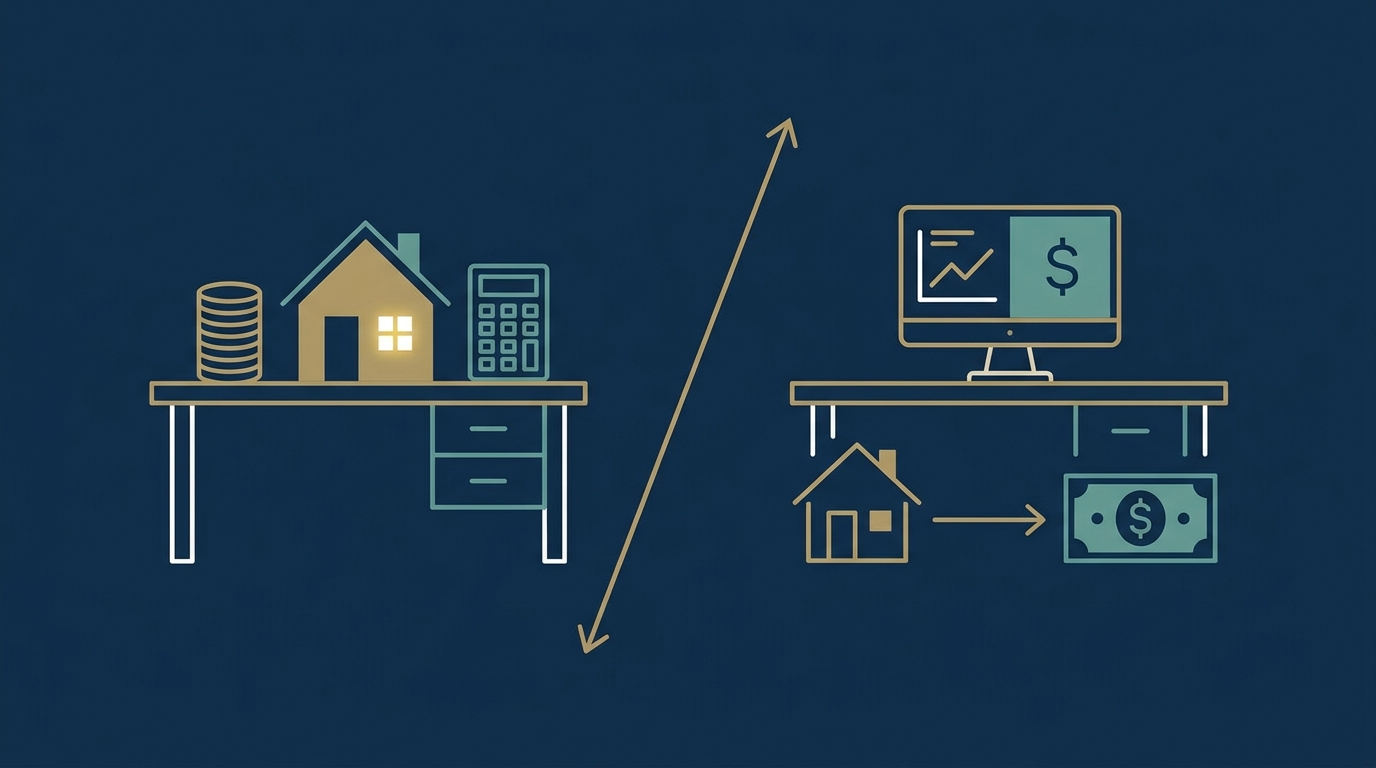
Choosing the right home office deduction method can mean the difference between a tidy, low-effort write-off and a larger refund that takes more bookkeeping to support. If you’re self-employed and run part of your business from home, the IRS gives you two ways to claim the space: the simplified option and the actual-expense option. This guide compares both head-to-head so you can decide which home office deduction method puts the most money back in your pocket for the current tax year.
The home office deduction method you choose is either the simplified option (a set rate per square foot, capped at 300 square feet) or the actual-expense option (a percentage of real home costs plus depreciation). Both require exclusive, regular business use. Self-employed taxpayers qualify; W-2 employees generally do not after the TCJA.
Who qualifies: exclusive and regular use
Before comparing either home office deduction method, confirm you’re eligible. The IRS applies two core tests. First, exclusive use: the area must be used only for business. A desk in the corner of a bedroom that doubles as a guest room generally fails; a converted spare room used solely for work passes. Second, regular use: you must use the space on a continuing basis, not occasionally. The home office also needs to be your principal place of business, or a place where you regularly meet clients, or a separate structure like a detached studio.
Critically, this deduction is for the self-employed, independent contractors, sole proprietors, single-member LLCs, and partners reporting on Schedule C (or partnership/Schedule E equivalents). Because the Tax Cuts and Jobs Act (TCJA) suspended unreimbursed employee business expenses through at least the 2025 tax year, most W-2 employees cannot claim a home office, even if they work remotely full time. Confirm your status and the current rules on IRS.gov before filing. For related write-offs, see our guides on business deductions.
The simplified method explained
The simplified option is the low-admin choice. Instead of tracking every utility bill and mortgage statement, you multiply the square footage of your home office by a flat IRS rate, up to a maximum of 300 square feet. For recent tax years the rate has been $5 per square foot (so a maximum deduction of $1,500), but because that rate and cap can change, always confirm the figure for your filing year on IRS.gov.
Under this home office deduction method you still claim your full home-related itemized deductions (mortgage interest, property taxes) separately on Schedule A if you itemize, you don’t have to allocate them. There’s no depreciation to track and, importantly, no depreciation recapture later when you sell. The trade-off is a hard ceiling: even a large, expensive home office maxes out at the capped square footage.
The actual-expense method explained
The actual-expense option lets you deduct a business-use percentage of your real home costs. You calculate that percentage by dividing the square footage of your office by the total square footage of your home. You then apply it to expenses such as:
- Direct expenses (100% deductible): painting or repairs made only to the office.
- Indirect expenses (deductible at the business-use %): mortgage interest, rent, property taxes, homeowners insurance, utilities, and general repairs.
- Depreciation on the portion of the home used for business (for homeowners).
This home office deduction method can produce a much larger write-off than the simplified version, especially in a high-cost home, but it demands records and introduces depreciation recapture down the road. It’s reported on Form 8829.
The math of each method
The simplified math is one line: square footage (max 300) × current IRS rate = deduction. A 200-square-foot office at $5/sq ft yields a $1,000 deduction.
The actual-expense math has two steps. First, find your business-use percentage: office square footage ÷ total home square footage. A 200 sq ft office in a 2,000 sq ft home is 10%. Second, apply that 10% to your total eligible indirect expenses, then add direct expenses and depreciation. If your annual mortgage interest, taxes, insurance, and utilities total $30,000, then 10% is $3,000, plus depreciation, often well above the simplified cap. Both methods limit the deduction to your net business income; excess can typically be carried forward only under the actual method.
Depreciation and recapture in the actual method
Homeowners using the actual-expense method depreciate the business portion of the home over 39 years (nonresidential real property). This adds to your annual deduction, but creates a future cost: depreciation recapture. When you sell the home, the depreciation you claimed (or were allowed to claim) is recaptured and taxed, generally at a maximum 25% rate, and that portion may not qualify for the home-sale capital gains exclusion. The simplified method avoids this entirely because it claims no depreciation. Factor recapture into any long-term decision and confirm current treatment on IRS.gov.
Which saves more, and when
Use this quick decision framework, then run both numbers:
| Factor | Lean simplified | Lean actual |
|---|---|---|
| Office size | Small (near or over 300 sq ft cap) | Large relative to home |
| Home costs | Low rent/mortgage, low utilities | High mortgage, taxes, utilities |
| Recordkeeping appetite | Minimal | Willing to track receipts |
| Plan to sell soon | Yes (avoids recapture) | Long hold, less concerned |
| Depreciation | None | Wants the added deduction |
Worked example (placeholders, confirm current rate): Jordan, a freelance designer, has a [200] sq ft office in a [2,000] sq ft home (10% business use). Simplified: 200 × $[5] = $[1,000]. Actual: 10% of $[30,000] in indirect expenses = $[3,000], plus $[700] depreciation = $[3,700]. Here the actual method wins by roughly $[2,700], but Jordan accepts recordkeeping and future recapture.
Switching methods between years
You’re not locked in. You can choose a different home office deduction method each tax year, picking simplified one year and actual the next. There are a couple of nuances: you cannot deduct any disallowed carryover of actual expenses in a year you use the simplified option, and once you depreciate under the actual method, that depreciation is still subject to recapture even if you later switch. Re-run both calculations annually, your home costs, office size, and income change year to year.
Recordkeeping for both methods
The simplified option still requires you to document your office’s square footage and that it meets the exclusive- and regular-use tests. The actual method requires far more: keep mortgage or rent statements, utility bills, insurance and property-tax records, repair invoices, and a depreciation schedule. Retain these records for at least three years after filing (longer in some situations). Good records are your best defense if the IRS questions the deduction. For broader strategy that ties deductions to your retirement and entity choices, explore our tax planning resources.
Mistakes to avoid
- Claiming a non-exclusive space. A kitchen table or shared room usually fails the exclusive-use test.
- Being a W-2 employee. Remote employees generally can’t claim this deduction post-TCJA; only self-employed taxpayers qualify.
- Forgetting depreciation recapture. The actual method’s depreciation comes back to tax you at sale.
- Using a stale rate. The simplified rate and cap can change, never assume last year’s figure.
- Skipping the income limit. Your deduction can’t exceed net business income.
- Never comparing. Defaulting to one method without running both often leaves money on the table.
Frequently asked questions
What is the best home office deduction method for most self-employed people?
There’s no universal winner. The best home office deduction method depends on your office size, home costs, recordkeeping appetite, and whether you plan to sell soon. Small offices with low home costs often favor the simplified option; large offices in high-cost homes usually favor the actual method. Run both calculations each year.
Can W-2 employees claim a home office?
Generally no. The TCJA suspended unreimbursed employee business expenses through at least the 2025 tax year, so remote employees typically cannot claim a home office. The deduction is for self-employed taxpayers and business owners. Confirm current rules on IRS.gov.
How much is the simplified method worth?
It’s the current IRS rate per square foot, multiplied by your office area up to 300 square feet. In recent years the rate has been $5/sq ft for a $1,500 maximum, but the rate and cap can change, verify the figure for your tax year on IRS.gov.
Do I have to depreciate my home if I use the actual method?
Homeowners using the actual-expense method generally claim depreciation on the business portion. That depreciation is later subject to recapture when you sell, taxed at up to 25%. The simplified method avoids depreciation and recapture altogether.
Can I switch between the two methods?
Yes. You can choose a different method each tax year. Note that prior actual-method depreciation remains subject to recapture, and disallowed actual-expense carryovers can’t be used in a simplified-method year.
Book a free consultation with Tranzesta
Picking the wrong home office deduction method can cost you hundreds, or trigger an avoidable tax bill at sale. Our US and UK tax specialists will run both calculations, factor in depreciation and recapture, and make sure your records hold up. Book a free consultation today and claim every dollar you’re entitled to.
Disclaimer: This article is for general informational purposes only and is not tax, legal, or financial advice. Tax rates, the simplified-method rate, and thresholds can change; figures shown are illustrative placeholders. Always confirm current amounts on IRS.gov and consult a qualified tax professional about your specific situation.
Talk to a real, signing professional
AI precision, human accountability — across the US, UK & UAE.
Book a free consultation