Nearly 82% of small businesses that fail
do so because of cash flow problems — and most of those problems start with a broken budget.
If your business is still using last year’s numbers as next year’s plan, you may already be falling behind. Smart budgeting for small businesses — specifically choosing between zero-based budgeting and incremental budgeting — is one of the most important financial decisions you will make as an owner. However, most entrepreneurs have never been taught the difference.
In this guide, you will learn exactly what each method is,
how it works, which one fits your business type, and the common mistakes that drain thousands from US small business budgets every year. Additionally, you will discover when to combine both approaches for maximum control. Whether you run a content creation business, a cannabis operation, or a traditional LLC in the United States, this guide gives you the clarity you need.
What Is Budgeting for Small Businesses? Zero-Based vs Incremental Explained
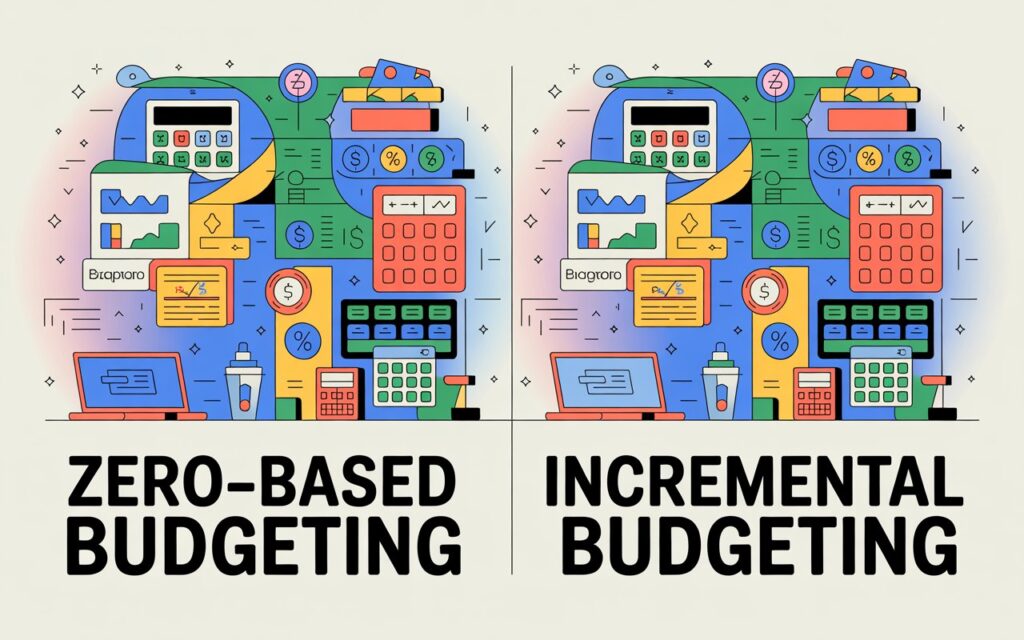
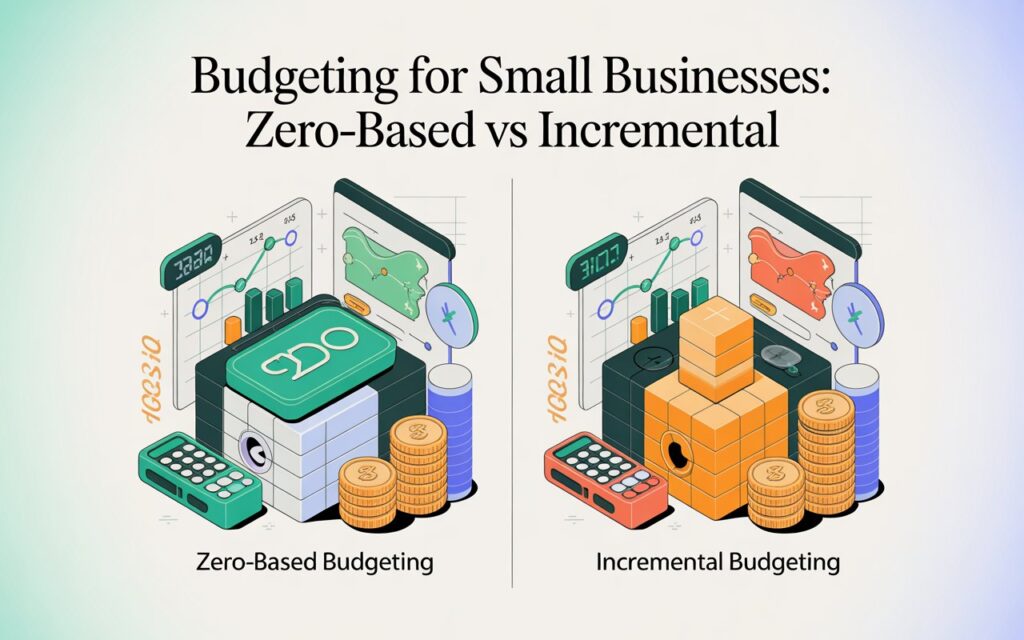
Budgeting for small businesses means creating a structured financial plan that assigns every expected dollar of income to a specific expense, savings goal, or investment. The two dominant methods US business owners use are zero-based budgeting and incremental budgeting — and they work in completely opposite ways.
Understanding the difference between them helps you stop guessing and start controlling your finances with precision. Therefore, let us break each one down clearly before comparing them head-to-head.
What Is Zero-Based Budgeting (ZBB)?
Zero-based budgeting (ZBB) means you start your budget from zero every single period — typically monthly or quarterly. Every expense must be justified from scratch, regardless of what you spent last year. In other words, no cost gets a free pass just because it existed before. You build your entire budget up from nothing, expense by expense, until your income minus your expenses equals zero (meaning every dollar has been intentionally allocated).
For example, instead of automatically renewing your $500/month software subscription, you ask: does this tool still generate value equal to or greater than $500? If not, you cut it. This approach forces accountability at every level of your spending.
What Is Incremental Budgeting?
Incremental budgeting takes the prior period’s budget or actual spending as its baseline and makes small percentage adjustments — typically 3% to 10% increases or decreases — for the upcoming period. It is the most widely used budgeting method among small businesses in the USA because it is fast, familiar, and requires much less analytical work than ZBB.
However, simplicity comes at a cost. Incremental budgeting tends to preserve inefficiencies. If you overspent on a category last year, that overspending becomes baked into the next year’s baseline. As a result, waste compounds over time.
How Does Each Budgeting Method Work for a Small Business?
Both methods follow a logical process, but the steps differ significantly. Here is how each one operates in a real US small business context.
The Zero-Based Budgeting Process
Zero-based budgeting follows a deliberate, analysis-driven process. The IRS recommends that self-employed individuals and small business owners maintain organized records of all income and deductible expenses under IRC Section 162, which makes ZBB a natural complement to compliant tax recordkeeping. Here is how ZBB works step by step:
List every single expense category your business needs to operate — not what you spent last year, but what you actually need this year.
Assign a specific dollar amount and business justification to each category.
Project your total expected revenue for the budget period.
Subtract justified expenses from projected revenue until you reach zero.
Review and approve each line item before locking in the budget.
Repeat from scratch each new budget cycle.
The Incremental Budgeting Process
Incremental budgeting is faster but requires less strategic thinking. Most small business accounting software — including QuickBooks and Xero — is built around this model. The process looks like this:
Pull your prior year’s actual income and expense figures.
Apply a blanket or category-specific adjustment percentage (e.g., 5% increase for inflation).
Add new budget line items for new planned expenses.
Remove line items for discontinued expenses.
Review the totals and confirm they align with revenue projections.
Approve and lock in the budget for the upcoming period.
Zero-Based vs Incremental Budgeting: What Are the Key Differences?
The core difference comes down to one question: does every dollar have to earn its place, or does last year’s spending automatically carry forward? Here is a direct comparison across five critical dimensions.
Time Investment
Zero-based budgeting requires significantly more time upfront. Depending on business complexity, ZBB can take 10 to 40 hours per budget cycle. Incremental budgeting, by contrast, can be completed in under two hours. Therefore, if your business is lean on administrative time, incremental budgeting may be more practical for day-to-day operations.
Cost Efficiency Over Time
Zero-based budgeting consistently outperforms incremental budgeting in eliminating waste. Studies suggest that ZBB can reduce operational costs by 10% to 25% in the first cycle alone. However, incremental budgeting is more stable and predictable for businesses with consistent revenue patterns.
Flexibility and Adaptability
Zero-based budgeting adapts well to fast-changing businesses — such as OnlyFans creators whose monthly income fluctuates significantly, or cannabis businesses in the United States whose regulatory costs shift frequently. Incremental budgeting works better for stable, predictable businesses such as established professional service firms.
Risk Profile
Incremental budgeting carries a higher risk of compounding inefficiency. Each year of unchecked incremental budgeting can lead to 5% to 15% of your budget being allocated to low-value or obsolete expenses. Zero-based budgeting prevents this by requiring annual justification of every cost.
Which Budgeting Method Is Right for Your Small Business?
The right choice depends on your business type, revenue stability, and the amount of time you can realistically devote to financial planning. Here is a breakdown by the most common US small business profiles.
Content Creators and OnlyFans Businesses
If you are a content creator or OnlyFans performer, zero-based budgeting is almost always the better choice. Your income fluctuates month to month, and your expense categories — equipment, software subscriptions, marketing, and platform fees — change frequently. ZBB forces you to match spending to current income rather than hoping last month’s revenue repeats. Additionally, content creators often qualify for self-employment deductions under IRC Section 162, and ZBB makes it easier to track and justify those deductions accurately.
Cannabis Business Owners
Cannabis businesses in the United States face a unique budgeting challenge because of IRC Section 280E, which disallows most standard business deductions for cannabis businesses. This makes budgeting more critical — and more complex — than in other industries. Zero-based budgeting helps cannabis operators meticulously allocate costs to cost of goods sold (COGS), which is the only category generally deductible under 280E. This level of precision is difficult to achieve with incremental budgeting.
Traditional Small Businesses and LLCs
For established businesses with stable, predictable revenue — such as restaurants, retail shops, or professional service firms — incremental budgeting is often sufficient. However, most USA-based small business experts, including advisors at the Small Business Administration (SBA), recommend revisiting your baseline every two to three years using a zero-based approach to flush out accumulated inefficiencies.
Self-Employed Individuals and Freelancers
Self-employed US taxpayers filing Schedule C can benefit greatly from a hybrid approach: use zero-based budgeting for variable expenses and income-sensitive categories, while using incremental budgeting for fixed costs like rent, insurance, and recurring software. This hybrid model gives you the best of both worlds without consuming excessive planning time.
Common Budgeting Mistakes Small Business Owners Make
Knowing which budgeting method to use is only half the battle. Many US small business owners undermine their own financial plans by making avoidable errors. Here are the five most costly mistakes — and how to avoid them.
Mistake 1: Not Separating Personal and Business Finances
Mixing personal and business accounts is one of the most common — and most damaging — budgeting mistakes for self-employed individuals in the USA. It makes it nearly impossible to track actual business expenses, creates problems during tax season, and eliminates legal protections for LLC owners. Always maintain a dedicated business checking account and business credit card.
Mistake 2: Ignoring Quarterly Estimated Tax Payments
Self-employed US taxpayers must pay estimated taxes quarterly using IRS Form 1040-ES. Failing to budget for these payments — which cover both income tax and self-employment tax (currently 15.3% on net self-employment income) — leads to surprise tax bills and potential underpayment penalties under IRC Section 6654. Your budget should always include a tax reserve line item of 25% to 35% of net profit.
Mistake 3: Using Gross Revenue Instead of Net Profit as Your Baseline
Many small business owners budget based on their gross revenue — total income before expenses. However, your available cash for operations and growth comes from net profit, not gross revenue. Building your budget on gross revenue leads to chronic overspending. Always start your budget from projected net profit after cost of goods sold and fixed costs.
Mistake 4: Forgetting Irregular Expenses
Annual software subscriptions, equipment purchases, professional fees, and tax preparation costs are irregular but entirely predictable. Nevertheless, many small business owners forget to include them in their monthly budgets. As a result, cash flow gets disrupted every time one of these bills arrives. Divide annual irregular expenses by 12 and include the monthly equivalent in your budget as a sinking fund.
Mistake 5: Never Revisiting the Budget Mid-Year
A budget is not a set-and-forget document. Revenue changes, costs shift, and opportunities arise. Most financial experts recommend reviewing your small business budget monthly and making adjustments quarterly. If you are using incremental budgeting and have not reviewed your baseline in more than two years, it is almost certainly hiding waste.
How to Build a Small Business Budget Step by Step
Whether you choose zero-based budgeting, incremental budgeting, or a hybrid approach, the following seven-step process gives you a reliable foundation. This process works for any small business in the United States — from solo freelancers to cannabis operations to content creation businesses.
Step 1: Calculate Your Monthly Revenue
Start with your actual or projected monthly income. For businesses with variable income — like content creators — use a three-month average as your baseline. For cannabis businesses subject to 280E, distinguish clearly between gross revenue and revenue attributable to COGS.
Step 2: List Every Fixed Cost
Fixed costs are expenses that do not change month to month: rent, insurance, loan payments, payroll, and recurring software subscriptions. List each one with its exact dollar amount. These form the non-negotiable foundation of your budget.
Step 3: Estimate Variable Costs
Variable costs fluctuate with business activity: marketing spend, supplies, contractor payments, shipping, and platform fees. For each variable category, use your best estimate based on projected activity — or, for ZBB, justify the amount from scratch.
Step 4: Build Your Tax Reserve
US small business owners — especially the self-employed — must reserve for federal income tax, state income tax, and self-employment tax. A safe rule is to set aside 25% to 35% of net profit in a dedicated tax savings account each month. Tranzesta strongly recommends automating this transfer so it happens before you have a chance to spend it.
Step 5: Identify and Eliminate Waste
Compare your expense list against the value each item generates. For ZBB practitioners, this is built into the process. For incremental budgeters, make it an annual exercise. Look specifically at software subscriptions, vendor contracts, and recurring services that may no longer serve your business goals.
Step 6: Set Spending Limits by Category
Assign a specific dollar limit to each expense category. These limits are commitments — not suggestions. Effective budgeting requires discipline. Use accounting software to set category alerts when you approach your limit.
Step 7: Review Monthly and Adjust Quarterly
At the end of each month, compare your actual spending to your budget. Identify variances and understand their causes. Then, at the end of each quarter, adjust your budget to reflect changes in revenue, costs, or business priorities. Additionally, update your tax reserve calculation based on actual year-to-date profit.
Budgeting Small Business Zero-Based vs Incremental: Expert Tips for 2026
The tax and financial landscape for small businesses in the USA continues to evolve. Here are the most valuable strategic insights from the Tranzesta team heading into 2026.
Use zero-based budgeting for any expense category that increased by more than 15% in the prior year — these are the highest-risk areas for waste accumulation.
Cannabis businesses should consult a specialized
accountant before finalizing any budget, as 280E disallowances directly affect which costs belong in COGS versus operating expenses. Even a small misclassification can generate a significant tax liability.
Content creators and OnlyFans business owners
should build a separate budget for content production costs — these are often deductible as ordinary and necessary business expenses under IRC Section 162 when properly documented.
US expats using the Streamlined Filing Compliance Procedures should account for foreign bank account fees, currency conversion costs, and international tax advisor fees in their personal and business budgets.
Set a budget review appointment in your calendar
on the same day each month — treat it like a client meeting. Business owners who schedule formal budget reviews consistently outperform those who review budgets reactively.
Consider a budget dashboard tool like QuickBooks, Wave, or FreshBooks that connects directly to your business bank account. Automated categorization reduces manual errors and gives you real-time budget tracking.
Build a three-month operating reserve into your annual
budget goals — the SBA recommends that small businesses maintain enough cash to cover three months of fixed expenses as a financial cushion.
How Tranzesta Can Help With Small Business Budgeting
Tranzesta is a US-based tax consultation firm that works with small business owners across a wide range of industries — including OnlyFans content creators, cannabis business operators, self-employed freelancers, and US expats. We understand that budgeting is not just about tracking money. It is about building the financial foundation that keeps your business compliant, profitable, and ready for growth.
Our team combines deep tax expertise with practical
bookkeeping support to help you choose the right budgeting approach, implement it correctly, and keep it aligned with your tax obligations throughout the year. Specifically, Tranzesta offers:
Business Tax Strategy & Bookkeeping
We help you design a budget that minimizes your tax liability while keeping your books clean and IRS-ready.
Content Creator Tax Services Tailored
for OnlyFans and digital business owners who need both budgeting guidance and deduction optimization.
Cannabis Accounting — Specialized support for US cannabis businesses navigating 280E compliance, COGS allocation, and multi-state tax requirements.
Streamlined Filing Services — For US expats who need to bring offshore accounts and foreign income into compliance while building a compliant financial plan.
Contact our team at hello@tranzesta.com for a free consultation. Learn more about our business tax and bookkeeping services at Tranzesta.com. Whether you are just starting out or restructuring your finances mid-year, we will help you build a budget that works — and a tax strategy that saves.
Conclusion: Building a Budget That Works for Your Business
Choosing the right budgeting method is one of the highest-leverage financial decisions you will make as a small business owner. Zero-based budgeting gives you maximum control and cost efficiency, but requires more time and discipline. Incremental budgeting is faster and easier, but risks locking in inefficiency over time.
The most important takeaways are these: first, match your budgeting method to your business type and income pattern; second, always reserve for taxes — self-employment tax alone is 15.3% in the USA; and third, review your budget regularly, not just at year-end.
Ready to get expert help? Email us at hello@tranzesta.com or visit Tranzesta.com to schedule your free tax strategy session today.
FAQs
Zero-based budgeting starts from zero each period, requiring every expense to be justified from scratch regardless of prior spending. Incremental budgeting uses the previous period’s budget as a baseline and makes small percentage adjustments. Zero-based budgeting offers more control and eliminates waste, while incremental budgeting is faster and easier to manage. For small businesses with variable income or complex tax situations — such as cannabis businesses or content creators — zero-based budgeting is generally the stronger choice.
Zero-based budgeting is often better for small businesses with variable revenue, rapidly changing cost structures, or tight margins — because it forces every dollar to be justified. However, it requires significantly more time than incremental budgeting. For stable, established businesses with predictable income, incremental budgeting may be sufficient. Most US business tax experts recommend a hybrid approach: use zero-based budgeting annually to reset baselines, then use incremental budgeting for routine monthly updates.
To create a small business budget in the United States, start by calculating your monthly revenue and listing all fixed and variable expenses. Build in a tax reserve of 25% to 35% of net profit to cover federal income tax, state taxes, and self-employment taxes. Assign spending limits to each category, review actuals monthly, and adjust quarterly. Tools like QuickBooks, Wave, or FreshBooks can automate tracking. For complex situations — such as cannabis businesses or self-employed creators — working with a specialized tax advisor like Tranzesta is strongly recommended.
The main disadvantages of zero-based budgeting are the time and analytical work it requires. Building a zero-based budget can take 10 to 40 hours per cycle depending on business complexity. It can also be difficult for businesses that lack detailed expense records to justify costs from scratch. Additionally, zero-based budgeting may create internal friction in businesses with employees, as every department must re-justify its spending. Despite these challenges, the cost savings and financial clarity it provides typically outweigh the drawbacks for most US small business owners.
Small businesses in the United States should review their budgets monthly by comparing actual income and expenses to their budget projections. Quarterly reviews are recommended for making strategic adjustments based on business performance. An annual review — ideally using a zero-based approach — helps reset baselines and eliminate accumulated inefficiencies. Businesses with highly variable income, such as content creators or seasonal businesses, may benefit from bi-weekly budget check-ins. The Small Business Administration (SBA) recommends that all small business owners treat budget reviews as a core business management activity.
Related expertise
Talk to a real, signing professional
AI precision, human accountability — across the US, UK & UAE.
Book a free consultation