
Most US business owners who own commercial
real estate are leaving tens of thousands of dollars in tax savings on the table every single year. A cost segregation study depreciation real estate strategy is one of the most powerful — and most underused — tools in the American tax code. Instead of waiting 39 years to fully depreciate a commercial building, cost segregation allows you to dramatically accelerate those deductions into the first few years of ownership.
In this guide, you will learn exactly what a cost segregation study is, how it works under IRS rules, who benefits most, common mistakes to avoid, and a step-by-step process for getting started. Additionally, you will see how Tranzesta helps US business owners, cannabis operators, and self-employed individuals use this strategy to legally minimize their tax burden.
Let’s start with the fundamentals.
What Is a Cost Segregation Study for Real Estate Depreciation?
A cost segregation study is a detailed engineering and tax analysis that reclassifies components of a commercial building into shorter depreciation categories. In plain terms, it allows you to deduct more of your property’s value faster — rather than spreading it evenly over 27.5 or 39 years.
Under the standard IRS rules,
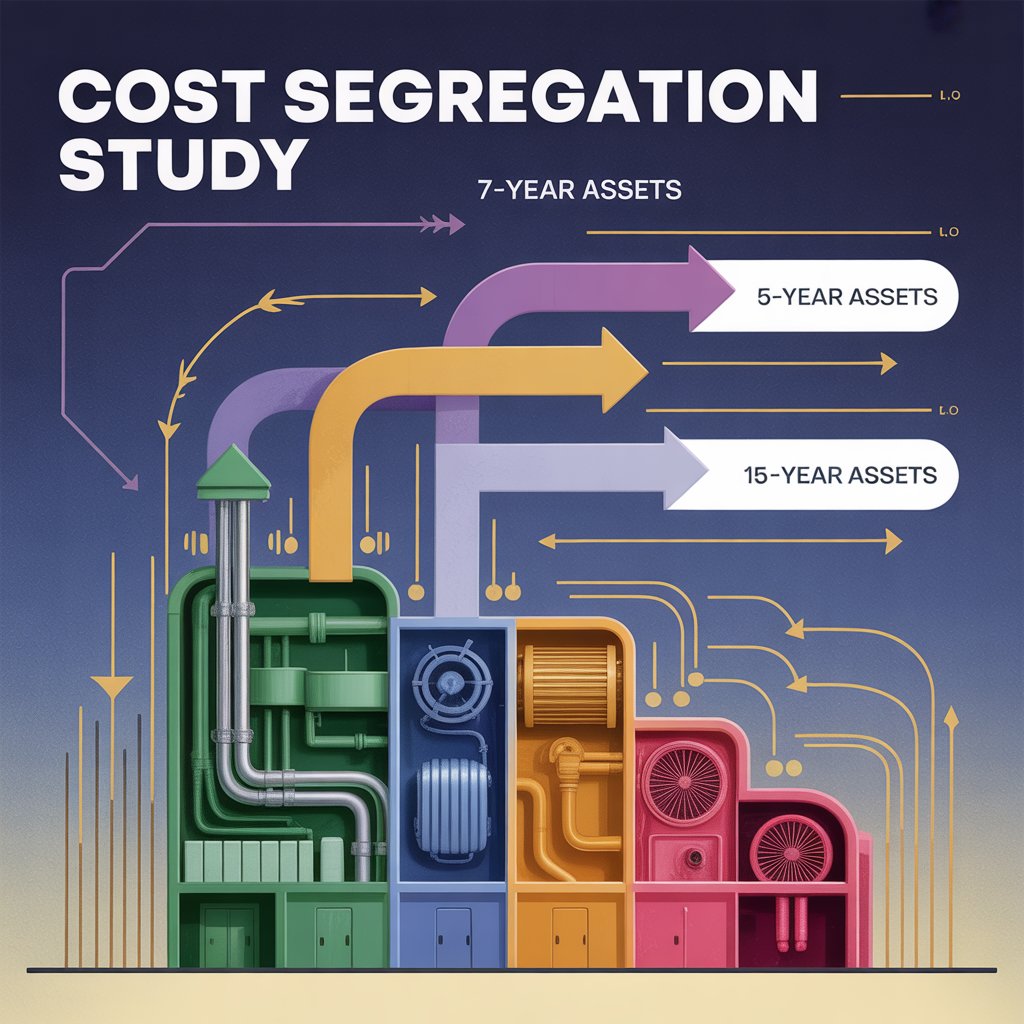
residential rental property depreciates over 27.5 years and commercial property depreciates over 39 years using the straight-line method. However, not every part of a building is a structural element. A cost segregation study identifies personal property components and land improvements that qualify for 5-, 7-, or 15-year depreciation under the Modified Accelerated Cost Recovery System, or MACRS.
The result is a front-loaded deduction schedule that
generates significantly more tax savings in the early years of ownership. For many US taxpayers, this translates to tens or even hundreds of thousands of dollars in additional deductions during the first five years.
What Components Does a Cost Segregation Study Identify?
A qualified cost segregation engineer reviews every component of your building and assigns each one to its proper depreciation class. Components typically reclassified to shorter lives include specialty electrical systems, plumbing for specific equipment, decorative lighting, flooring, wall coverings, and outdoor improvements like parking lots and landscaping.
For example, a restaurant’s specialized kitchen ventilation
system qualifies as a 5-year property rather than a 39-year structural element. Similarly, a cannabis dispensary’s security system and specialized lighting may qualify as 5- or 7-year property. These reclassifications can substantially increase first-year deductions.
Why Does Cost Segregation Matter in 2026?
In 2026, bonus depreciation under IRC Section 168(k) is available at 40% for qualifying property placed in service during the year. This means that 5-, 7-, and 15-year property identified in a cost segregation study can be partially expensed in the year of purchase. Combined with standard MACRS depreciation on the remaining basis, cost segregation delivers powerful and immediate tax relief.
Furthermore, the CARES Act permanently fixed Qualified
Improvement Property (QIP) — interior improvements to nonresidential buildings — to a 15-year life, making it eligible for bonus depreciation. Therefore, 2026 remains an excellent year to commission a cost segregation study before bonus depreciation phases down further.
How Does Cost Segregation Study Depreciation Work Under IRS Rules?
A cost segregation study works by breaking your building purchase price into components with different IRS-approved depreciation lives. Here is how the process works under current US tax law.
The Four Depreciation Categories Used in Cost Segregation
When an engineer completes a cost segregation study, your property’s cost basis is allocated across four main categories. Each category carries a different depreciation timeline and tax impact.
5-Year Property: Personal property directly related to your business operations — such as specialized equipment, carpeting, and certain fixtures — depreciates over five years.
7-Year Property: Office furniture, computers, and certain equipment used in your business are classified as 7-year property under MACRS.
15-Year Property: Land improvements such as parking lots, sidewalks, landscaping, and fencing depreciate over 15 years. These also qualify for bonus depreciation.
27.5-Year or 39-Year Property: The remaining structural components of the building — foundations, walls, roof, and core mechanical systems — continue to depreciate on the standard long-life schedule.
The Role of Bonus Depreciation and Section 179 in 2026
Bonus depreciation under Section 168(k) allows US business owners to immediately deduct a percentage of the cost of qualifying short-life property in the year it is placed in service. In 2026, the bonus depreciation rate is 40%, down from 60% in 2024 and 80% in 2023 as TCJA phase-outs continue. Therefore, acting sooner rather than later maximizes the benefit.
Section 179 expensing, by contrast, allows immediate
deduction of up to $1,220,000 (2024 limit, adjusted annually for inflation) of qualifying personal property. However, Section 179 cannot create a tax loss, while bonus depreciation can. For this reason, many tax advisors use both strategies in combination — and cost segregation identifies exactly which components qualify for each.
What Is a Look-Back Study?
A look-back study — also called a catch-up study — allows business owners who purchased property in prior years without a cost segregation analysis to capture missed deductions retroactively. Under IRS Revenue Procedure 2002-9, you can file a Form 3115 (Change in Accounting Method) to claim all prior-year accelerated depreciation in a single year. Importantly, you do NOT need to amend prior tax returns. This makes look-back studies an extremely valuable option for long-term property owners.
Common Mistakes Business Owners Make With Cost Segregation Studies
A cost segregation study is a high-value strategy — but only when executed correctly. Here are the most costly mistakes US property owners make, and how to avoid them.
Mistake 1: Waiting Too Long After Purchase
The best time to commission a cost segregation study is in the year you purchase or place the property in service. Waiting several years means you miss the opportunity to claim bonus depreciation on short-life components at the highest available rate. However, a look-back study can still recover missed deductions — it is never too late, but acting early always produces the best outcome.
Mistake 2: Using a Non-Qualified Provider
Cost segregation is a specialized discipline that combines engineering analysis with deep knowledge of IRS depreciation rules. Many business owners make the mistake of hiring a general CPA or online tool without engineering credentials. The IRS expects studies to meet the quality standards outlined in the IRS Cost Segregation Audit Techniques Guide. Therefore, always hire a firm with licensed engineers and documented experience in IRS-compliant cost segregation reports.
Mistake 3: Overlooking Qualified Improvement Property (QIP)
Since the CARES Act correction, QIP — which includes interior improvements like lighting, ceilings, and HVAC to non-residential buildings — qualifies for 15-year depreciation and bonus depreciation. Many business owners and even some tax preparers overlook this category entirely. Consequently, they miss out on immediate deductions for renovation costs that could be expensed in the year the improvement is made.
Mistake 4: Ignoring Passive Activity Loss Rules
For real estate investors who are not real estate professionals under IRS rules, depreciation deductions from cost segregation may be classified as passive losses. These passive losses can only offset passive income — not ordinary income — unless the taxpayer qualifies as a real estate professional under IRC Section 469. Failing to account for this limitation can lead to unexpected tax results and poor planning decisions.
Mistake 5: Not Considering Recapture at Sale
When you eventually sell a property, the IRS recaptures accelerated depreciation at a 25% depreciation recapture rate on Section 1250 property and ordinary income rates on Section 1245 property. Business owners who do not plan for depreciation recapture at the time of sale may face a larger-than-expected tax bill. However, a 1031 like-kind exchange can defer both capital gains and depreciation recapture if you reinvest in qualifying replacement property.
How to Commission a Cost Segregation Study: A Step-by-Step Guide
Getting started with a cost segregation study is straightforward when you follow the right process. Here are the key steps US property owners should take.
Step 1 — Determine if Your Property Qualifies:
Cost segregation studies are most cost-effective for commercial properties with a purchase price or construction cost of $500,000 or more. Residential rental properties over $200,000 may also benefit. Additionally, properties that have undergone significant renovations are strong candidates. The higher the property value and the earlier in the ownership period, the greater the potential savings.
Step 2 — Gather Your Property Documents:
Collect your purchase agreement, closing statement (HUD-1 or settlement statement), architectural drawings, construction contracts, and any renovation invoices. These documents allow the cost segregation engineer to accurately allocate costs. If you purchased the property as part of a business acquisition, a business valuation or apportionment may also be needed.
Step 3 — Select a Qualified Cost Segregation Provider:
Choose a provider with licensed engineers and a track record of IRS-compliant reports. Ask whether they perform actual on-site inspections (preferred) or use a document-based review method. Additionally, confirm they are familiar with your property type — whether it is a retail center, warehouse, cannabis facility, medical office, or multifamily building.
Step 4 — Commission the Study and Site Inspection:
The engineer visits your property to photograph, measure, and document individual components. They then prepare a detailed report that lists each component, its cost basis, and its assigned depreciation life. The study typically takes two to six weeks to complete, depending on property complexity.
Step 5 — Review the Study Report with Your Tax Advisor:
Once complete, share the cost segregation report with your CPA or tax preparer. They will use it to update your depreciation schedules and, if applicable, prepare a Form 3115 for look-back catch-up deductions. Confirm that all reclassified assets are properly entered in your depreciation schedules before filing.
Step 6 — File Your Tax Return With Updated Depreciation Schedules:
Submit your return with the revised depreciation schedules attached. If you are using a look-back study and filing Form 3115, the catch-up deduction is reported as a Section 481(a) adjustment on your current-year return. No amended returns are required.
Step 7 — Maintain Documentation for IRS Audit Defense:
Keep your full cost segregation report, site inspection photos, and supporting property documents in your permanent tax file. The IRS may review depreciation claims during an audit — and a properly documented cost segregation study from a qualified provider is your best defense.
How Tranzesta Helps US Business Owners With Cost Segregation and Real Estate Depreciation
Tranzesta is a US-based tax consultation firm that helps business owners, real estate investors, cannabis operators, and self-employed professionals across the United States maximize depreciation and reduce their tax burden. Our team understands that cost segregation is not a one-size-fits-all strategy — it requires expertise, coordination with your tax return, and careful planning around passive activity rules, bonus depreciation, and future property sales.
We work directly with qualified cost segregation engineers
on behalf of our clients and then integrate the study results into their full tax strategy. For cannabis businesses, this is especially valuable. Because IRC Section 280E disallows most business deductions for cannabis operators, depreciation on property used in cultivation, processing, or retail becomes one of the most powerful cost reduction tools available.
For OnlyFans creators and content professionals
who own or lease studio space, Tranzesta identifies opportunities to accelerate deductions on build-outs and specialized equipment. Additionally, for real estate investors and business owners considering a 1031 exchange, our team coordinates depreciation recapture planning alongside cost segregation to minimize taxes on disposition.
Our cost segregation and depreciation services include:
Cost segregation study coordination and tax integration
Look-back study analysis and Form 3115 preparation
Bonus depreciation and Section 179 optimization
QIP identification and depreciation scheduling
Depreciation recapture planning for future property sales
Contact our team at hello@tranzesta.com for a free consultation. Visit Tranzesta.com to learn more about our business tax and bookkeeping services for US entrepreneurs and real estate owners.

Cost Segregation Study Depreciation Real Estate: Expert Tips for 2026
Beyond the basics, experienced tax strategists use advanced techniques to maximize cost segregation benefits. Here are Tranzesta’s top insider strategies for 2026.
Act Before Bonus Depreciation Drops Further:
The 40% bonus depreciation rate in 2026 is scheduled to drop to 20% in 2027 and 0% in 2028 under current law unless Congress acts. Therefore, placing qualifying property in service and completing your cost segregation study in 2026 locks in a higher bonus rate.
Combine Cost Segregation With a 1031 Exchange:
If you plan to sell a property, consider using a 1031 like-kind exchange to defer both capital gains and depreciation recapture. A cost segregation study on your replacement property can restart the accelerated depreciation clock on the new asset, compounding your long-term tax savings.
Use Cost Segregation on New Construction:
Many business owners assume cost segregation only applies to purchased buildings. In fact, it is equally valuable — sometimes more so — on newly constructed properties, where detailed construction cost records make component allocation highly accurate.
Commission a Partial Asset Disposition Study Simultaneously:
When you renovate or replace components of a building you already own, a partial asset disposition election allows you to write off the remaining basis of the retired component immediately. Combining this with a cost segregation study maximizes deductions from both the new and old assets.
Understand the Interaction With the QBI Deduction:
For pass-through business owners, increased depreciation from cost segregation reduces qualified business income (QBI), which in turn reduces the Section 199A deduction. Your tax advisor should model this interaction to ensure cost segregation delivers a net benefit in your specific situation.
Cost segregation is most powerful when it is part of a comprehensive tax strategy — not an isolated action. Therefore, Tranzesta recommends reviewing your depreciation schedule annually to identify new opportunities as your portfolio grows.
Conclusion
A cost segregation study depreciation real estate strategy remains one of the most effective legal tax reduction tools available to US business owners and investors in 2026. The three most important takeaways are: first, cost segregation accelerates deductions by reclassifying building components into shorter depreciation lives; second, bonus depreciation at 40% in 2026 amplifies those savings significantly for qualifying property; and third, look-back studies allow owners of existing property to capture missed deductions without amending prior returns.
However, executing this strategy correctly requires coordination between engineering expertise, IRS compliance knowledge, and your overall tax plan. Mistakes around passive activity rules, depreciation recapture, or improper documentation can undermine the benefits entirely.
Ready to get expert help? Email us at hello@tranzesta.com or visit Tranzesta.com to schedule your free tax strategy session today.
FAQs
A cost segregation study is an engineering and tax analysis that reclassifies components of a commercial or residential investment property into shorter depreciation categories — typically 5, 7, or 15 years — rather than the standard 27.5 or 39 years. By accelerating depreciation, business owners generate larger tax deductions in the early years of property ownership. This reduces taxable income and therefore lowers the amount of federal income tax owed. The IRS explicitly permits this strategy, and the savings can be substantial for properties valued at $500,000 or more.
A cost segregation study typically costs between $5,000 and $15,000 depending on property size, complexity, and the provider’s methodology. For most US business owners with commercial properties valued over $500,000, the study pays for itself many times over in the first year alone. For example, a $2 million commercial building may generate $150,000 or more in additional first-year deductions through cost segregation. At a 30% effective tax rate, that represents $45,000 in tax savings — far exceeding the study cost.
Any US business owner, real estate investor, or taxpayer who owns commercial property, residential rental property, or has made significant leasehold improvements qualifies for a cost segregation study. The strategy is most cost-effective for properties with a purchase price or construction cost of $500,000 or more, though smaller properties may also benefit. Additionally, business owners who purchased property in prior years without a study can commission a look-back study to retroactively capture missed depreciation deductions using IRS Form 3115 without amending prior returns.
Yes. A look-back cost segregation study allows you to capture all the accelerated depreciation you missed since the property was placed in service, even if you have owned it for several years. Under IRS Revenue Procedure 2002-9 and the automatic change procedures, you file Form 3115 to report the cumulative catch-up deduction as a Section 481(a) adjustment on your current-year tax return. You do not need to amend previous returns. This makes look-back studies a highly valuable option for long-term property owners in the United States.
When you sell a property on which you have claimed accelerated depreciation through cost segregation, the IRS recaptures those deductions. However, you can defer both capital gains and depreciation recapture by completing a Section 1031 like-kind exchange into a qualifying replacement property. Proper planning with a tax advisor before sale is essential to minimize this tax exposure.
Talk to a real, signing professional
AI precision, human accountability — across the US, UK & UAE.
Book a free consultation