
Millions of US taxpayers earn crypto staking rewards every year
and most have no idea they owe taxes the moment those rewards hit their wallets. The IRS settled this question definitively in Revenue Ruling 2023-14: staking rewards are taxable income at the time of receipt, full stop. If you stake Ethereum, Cardano, Solana, or any other proof-of-stake cryptocurrency, understanding how crypto staking rewards IRS taxes work is no longer optional.
In this guide, you will learn exactly how the IRS classifies and taxes staking income, what records you need to keep, the most costly reporting mistakes to avoid, and a step-by-step process for reporting staking rewards correctly on your 2026 federal tax return. Whether you are a self-employed professional, a content creator with a growing crypto portfolio, or a US expat staking tokens on a foreign exchange, this guide covers your situation.
Let’s start with the fundamentals.
What Is Crypto Staking and How Does the IRS Define It?
Crypto staking is the process of locking up cryptocurrency in a proof-of-stake (PoS) blockchain network to help validate transactions and secure the network. In return, participants — called validators or delegators — earn staking rewards, typically paid in the same cryptocurrency they staked.
How Proof-of-Stake Works
Proof-of-stake is a consensus mechanism used by blockchains including Ethereum (after The Merge in 2022), Cardano, Solana, Polkadot, Cosmos, and many others. Unlike Bitcoin’s proof-of-work mining, which requires energy-intensive computation, proof-of-stake selects validators based on the amount of cryptocurrency they have locked — or staked — in the network. Validators earn rewards proportional to their stake, typically ranging from 3% to 15% annually depending on the network and current participation rate.
The IRS does not distinguish between different types of staking — direct validation, delegated staking through an exchange, or liquid staking protocols. All staking reward income is treated identically for US federal tax purposes.
Why the IRS Taxes Staking Rewards as Ordinary Income
The IRS issued Revenue Ruling 2023-14 in July 2023, which explicitly stated that a cash-method taxpayer who receives new units of cryptocurrency as staking rewards must include their fair market value in gross income for the year of receipt. The IRS analogizes staking rewards to other forms of self-generated income — similar to a farmer harvesting crops or a business providing a service and receiving payment. Therefore, the IRS taxes staking rewards as ordinary income, not capital gains, at the time you receive them.
This ruling overturned an earlier Tax Court case (Jarrett v. United States) in which the IRS had initially refunded staking taxes to a taxpayer — a position the agency later reversed and codified through RR 2023-14. For official IRS guidance on digital asset income, refer to IRS.gov virtual currency FAQs (irs.gov/businesses/small-businesses-self-employed/virtual-currencies, opens in new tab).
Key IRS Rules Governing Crypto Staking Rewards Taxes
The IRS applies a clear but multi-layered tax framework to staking rewards. Understanding each layer helps you report correctly and avoid costly surprises.
Layer 1 — Ordinary Income Tax at Receipt
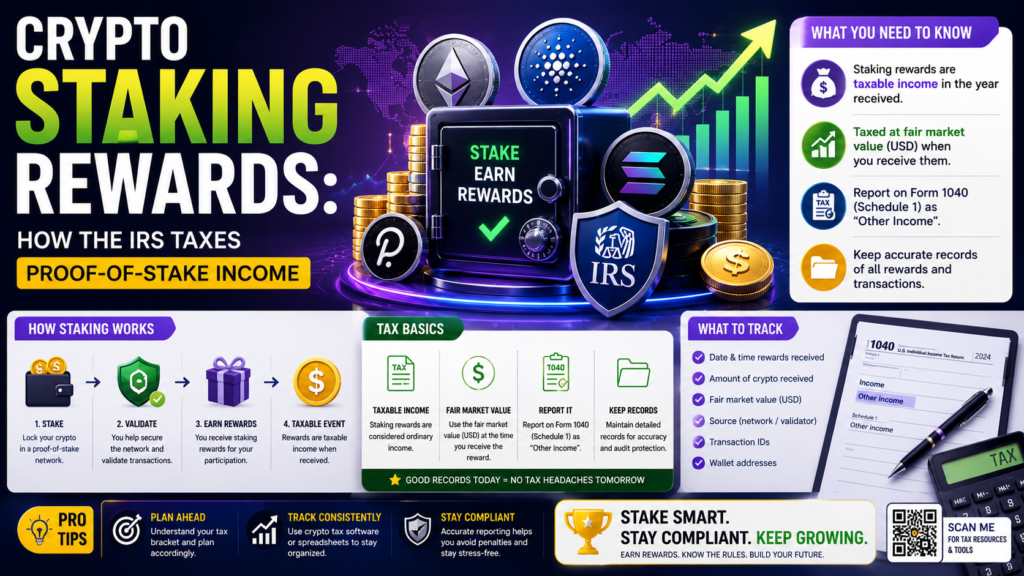
When your staking rewards are deposited into your wallet or credited to your exchange account, you owe ordinary income tax on the fair market value of those rewards on that specific date. For example, if you receive 0.5 ETH as a staking reward on a day when Ethereum trades at $3,200, your taxable income for that event is $1,600. That $1,600 becomes your cost basis in those 0.5 ETH going forward.
The ordinary income rate for US taxpayers ranges from 10% to 37% depending on your total taxable income and filing status in 2026. Tranzesta.com Additionally, if staking is part of a trade or business — meaning you stake professionally or at significant scale — the IRS may also classify the income as self-employment income, triggering the 15.3% self-employment tax on top of ordinary income rates.
Layer 2 — Capital Gains Tax When You Sell
When you eventually sell, trade, or spend the staking rewards you received, a second tax event occurs. At that point, you calculate a capital gain or loss based on the difference between your sale price and your cost basis (the fair market value at the time you received the rewards). The holding period — counted from the date you received the staking rewards — determines whether the gain is short-term (taxed at ordinary income rates) or long-term (taxed at 0%, 15%, or 20%).
This two-layer tax structure means staking income is effectively taxed twice: once as ordinary income when received, and again as a capital gain or loss when sold. Careful planning around both events can significantly reduce your total tax exposure.
Key IRS References and Forms for Staking Income
US taxpayers reporting staking rewards must use the following:
Revenue Ruling 2023-14: The controlling IRS authority on staking reward taxation
Form 1040 — Digital Asset Question: Must answer ‘Yes’ if you received staking rewards in 2026
Schedule 1 (Form 1040) — Additional Income: Report staking rewards as ‘Other Income’ if not a business
Schedule C (Form 1040): Report staking income as business income if staking constitutes a trade or business
Form 8949 and Schedule D: Report capital gains or losses when you later sell the staking rewards
Schedule SE: Required if staking income is classified as self-employment income

Common Mistakes US Crypto Stakers Make With IRS Taxes
Staking taxation is one of the most frequently misunderstood areas of crypto tax law in the United States. These four mistakes are the most expensive — and most avoidable.
Mistake 1: Treating Staking Rewards as Non-Taxable Until Sold
The most common misconception is that staking rewards are only taxable when you sell them. This is wrong under IRS Revenue Ruling 2023-14. The tax obligation begins the moment you receive the rewards, at their fair market value on the date of receipt. Waiting to report until the sale creates both underreporting for the receipt year and potential double-counting errors when you eventually sell. Many US taxpayers have received IRS notices after exchanges reported 1099s that did not match their returns for exactly this reason.
Mistake 2: Not Tracking the Fair Market Value at Time of Receipt
Your cost basis in staking rewards equals their fair market value on the date you received them. If you don’t record this value at the time of receipt, you face two problems: you cannot accurately calculate your original income tax liability, and you cannot correctly calculate your capital gain or loss when you sell. Crypto prices fluctuate dramatically — sometimes by 10% or more in a single day — so using a weekly or monthly average instead of the actual daily price can result in significant inaccuracies that attract IRS scrutiny.
Mistake 3: Ignoring Frequent Small Rewards From Liquid Staking Protocols
Liquid staking protocols — such as Lido (stETH), Rocket Pool (rETH), and similar platforms — distribute rewards continuously, sometimes in real-time or daily. Each distribution is a separate taxable income event. US taxpayers who use these protocols can generate hundreds or even thousands of individual taxable events per year. Failing to track each one, or approximating instead of using actual values, can create material reporting errors. Automated crypto tax software is essentially required to handle this volume accurately.
Mistake 4: Missing the Self-Employment Tax Exposure
If the IRS determines your staking activity constitutes a trade or business — based on factors like scale, regularity, and profit motive — your staking rewards become subject to self-employment (SE) tax of 15.3% on the first $168,600 of net SE income in 2026, plus 2.9% above that threshold. This is on top of ordinary income tax. Many high-volume stakers are surprised to learn they owe SE tax, particularly those who operate validator nodes professionally. Consulting a tax professional before the year closes is the best way to assess your exposure.
How to Report Crypto Staking Rewards on Your IRS Tax Return: Step-by-Step
Filing staking reward income correctly requires accurate records and the right forms. Follow these six steps to stay compliant for your 2026 return.
Step 1 — Export Your Complete Staking
HistoryDownload a full transaction export from every exchange or wallet where you earned staking rewards in 2026 — Coinbase, Kraken, Binance.US, your Ledger wallet, or any DeFi protocol. The export should include the date, amount, and coin for every reward received. If your exchange does not provide this, use a blockchain explorer and cross-reference with historical price data.
Step 2 — Record the Fair Market Value at Each Receipt
DateFor each staking reward entry, look up the fair market value of the token on that specific date using a reliable price source such as CoinMarketCap, CoinGecko, or your exchange’s historical price data. Multiply the number of tokens received by the price to calculate the dollar value of income for each event. This becomes both your taxable income and your cost basis.
Step 3 — Aggregate Your Total Staking Income
for the YearSum all individual staking reward income events to arrive at your total staking income for 2026. If you staked multiple tokens across multiple platforms, calculate each separately and then total them. This total figure is what you report as ordinary income on your federal tax return.
Step 4 — Determine Your Filing Category (Individual vs.
Business)Decide whether your staking activity is a hobby, investment, or trade and business. If you operate a validator node, stake professionally, or earn staking income as a primary income source, consult a tax professional to assess whether Schedule C and Schedule SE apply. Most casual stakers report on Schedule 1 as ‘Other Income.’
Step 5 — Report Income on the Correct IRS FormIf staking
is not a business: report total staking income on Schedule 1, Part I, Line 8z (Other Income) of Form 1040. If staking is a business: report on Schedule C, and complete Schedule SE for self-employment tax. In both cases, answer ‘Yes’ to the digital asset question on the main Form 1040.
Step 6 — Track Cost Basis for Future Capital Gains
ReportingMaintain a log of every staking reward received — date, token, quantity, and fair market value — because you will need this data when you sell those tokens. When you sell, use Form 8949 to report the capital gain or loss, referencing the cost basis established at the time of receipt. Hold for more than one year from the receipt date to qualify for the lower long-term capital gains rate.
Crypto Staking Rewards IRS Taxes: Expert Tips to Reduce Your Bill in 2026
These advanced strategies go beyond basic compliance and help you legally minimize the tax cost of your staking income.
Pro Tips for Minimizing Staking Tax Liability in 2026
• Hold staking rewards for 12+ months before selling: Your cost basis resets at receipt, so a 12-month hold from that date qualifies you for long-term capital gains rates of 0%, 15%, or 20% — significantly lower than ordinary income rates of up to 37%.
• Stack deductions in high-staking years: If you earn significant staking income in a given year, accelerate deductible business expenses, retirement contributions (SEP-IRA, Solo 401k), or charitable donations into the same year to offset the ordinary income hit.
• Use a Crypto IRA for future staking: Some self-directed IRA custodians allow staking within the account. Staking rewards inside a Roth IRA grow tax-free — you never pay ordinary income tax on the rewards, and future appreciation is also tax-free.
• Harvest staking-related capital losses: If tokens you received as staking rewards have declined in value since receipt, selling them at a loss generates a capital loss you can use to offset other capital gains. The wash-sale rule does not currently apply to crypto, so you can repurchase immediately.
• Document your staking as investment activity, not a business, where possible: Business classification triggers self-employment tax. If your staking is passive — through an exchange or delegated protocol — document it as investment income to avoid SE tax unless a tax professional advises otherwise.
Each of these strategies requires careful analysis of your specific situation. The team at Tranzesta.com can run the numbers and help you choose the approach that maximizes your after-tax staking returns in 2026.
Conclusion: Report Your Staking Rewards Right — Starting Now
The three most important takeaways from this guide are: staking rewards are taxable as ordinary income the moment you receive them under IRS Revenue Ruling 2023-14; you face a second tax event — capital gains — when you later sell those rewards; and accurate record-keeping from day one is the only way to report both events correctly.
Furthermore, the IRS is increasingly receiving staking data directly from exchanges through new Form 1099-DA broker reporting requirements. As a result, the risk of undetected underreporting is shrinking fast. US taxpayers who have not reported staking income in prior years should address that exposure proactively rather than waiting for an IRS notice.
Ready to get expert help? Email us at hello@tranzesta.com or visit Tranzesta.com to schedule your free tax strategy session today. The sooner you act, the more options you have — and the lower your risk.
FAQs
Yes — crypto staking rewards are taxable in the United States. Under IRS Revenue Ruling 2023-14, staking rewards must be included in gross income at their fair market value on the date they are received. The IRS classifies staking rewards as ordinary income, not capital gains, at the time of receipt. When you later sell
To calculate taxes on staking rewards, determine the fair market value of each reward on the date you received it. That value is your taxable ordinary income for that event and also your cost basis. Multiply the number of tokens received by the price on that date to get the dollar amount. When you sell, calculate capital gain or loss from your cost basis.
Most US taxpayers report crypto staking rewards on Schedule 1 (Form 1040), Part I, Line 8z as ‘Other Income’ if staking is a passive investment activity. The distinction depends on your facts and circumstances, so consult a tax professional if you are unsure.
You can file amended returns (Form 1040-X) for the affected years and pay the taxes owed, plus interest. For larger amounts or multiple years, the IRS Voluntary Disclosure Program or Streamlined Filing Compliance Procedures may reduce penalties. Acting proactively is always preferable to waiting for an IRS notice or audit. Tranzesta helps US taxpayers catch up on unreported crypto income safely and efficiently.
There is no legal way to avoid ordinary income tax on staking rewards received in a taxable account under current IRS rules. However, there are legal ways to reduce the overall tax impact. Staking within a Roth IRA eliminates ordinary income tax on rewards entirely, since the account is funded with after-tax dollars and grows tax-free. Additionally, offsetting staking income with deductible business expenses or retirement contributions reduces your net taxable income.
Talk to a real, signing professional
AI precision, human accountability — across the US, UK & UAE.
Book a free consultation