Every year, small business owners across the United
overpay sales tax — simply because they don’t know which sales tax exemptions small businesses are entitled to claim. In fact, the U.S. has over 13,000 state and local tax jurisdictions, each with its own exemption rules. Missing even one exemption can cost your business hundreds — or thousands — of dollars annually.
In this guide, you’ll learn exactly what qualifies
for sales tax exemptions in the USA, which industries benefit most, how to apply for exemptions properly, and the most common mistakes businesses make. Whether you’re a sole proprietor, an LLC, a content creator, or a cannabis business owner, this guide covers the ground you need.
Let’s break it all down — clearly and without the jargon.
What Are Sales Tax Exemptions for Small Businesses?
Sales tax exemptions allow qualified businesses or transactions to be excluded from state and local sales tax obligations. In other words, when an exemption applies, neither the seller nor the buyer owes sales tax on that transaction.
For small businesses in the United States, understanding exemptions is critical. Sales tax is administered at the state level — not federally — which means rules vary dramatically from state to state. Currently, 45 states and the District of Columbia impose a general sales tax. Alaska, Delaware, Montana, New Hampshire, and Oregon do not collect statewide sales tax, though some local jurisdictions in Alaska do.
Sales tax exemptions are not automatic.
Most require the buyer to present a valid exemption certificate to the seller at the time of purchase. Without that certificate on file, sellers may be liable for uncollected tax during an audit.
Why Sales Tax Exemptions Matter for Small Businesses
For small businesses operating on thin margins, sales tax exemptions can represent meaningful savings. A retailer buying $200,000 worth of inventory annually could save $16,000 or more in states with an 8% sales tax — simply by claiming the correct resale exemption.
Additionally, understanding exemptions helps small businesses stay compliant. Collecting sales tax on an exempt transaction can expose you to customer disputes and refund obligations. Not collecting it when required can trigger penalties and back-tax assessments.
Who Can Claim Sales Tax Exemptions?
Exemptions are available to a wide range of businesses and individuals, including wholesalers, retailers, manufacturers, nonprofits, agricultural businesses, government contractors, content creators, and cannabis operators — depending on the state. The key is knowing which category your business falls under and having the right documentation in place.
What Qualifies? The Main Categories of Sales Tax Exemptions Small Businesses Should Know
Sales tax exemptions fall into several major categories. Each one applies to specific transactions, industries, or business types. Below is a comprehensive breakdown of the most important exemptions for US taxpayers who own or operate a small business.
1. Resale Exemption
The resale exemption is the most widely used in the United States. It allows businesses to purchase goods without paying sales tax if those goods will be resold to a customer — who will then pay tax at the point of sale.
For example, a clothing boutique buying wholesale inventory does not pay sales tax on that purchase. The boutique collects sales tax from the end customer instead. To claim this exemption, the buyer must provide the seller with a resale certificate (also called a reseller’s permit or exemption certificate).
Each state has its own certificate format, though many states accept the Streamlined Sales Tax (SST) Exemption Certificate. You can find state-specific forms through your state’s Department of Revenue website.
2. Manufacturing and Production Exemptions
Most states exempt equipment, machinery, and supplies used directly in the manufacturing process. The key phrase is “directly used” — items must be integral to production, not merely useful in running a business.
For instance, a packaging machine on the production floor is likely exempt. However, a printer in the front office generally is not, even if it prints order labels. States like Texas, Ohio, and Illinois have detailed rules about what qualifies as “direct use” in manufacturing.
3. Agricultural Exemptions
Farms and agricultural businesses receive broad sales tax exemptions in most states. Eligible purchases often include seeds, fertilizers, livestock feed, pesticides, and farm machinery. Tranzesta.com States like Iowa, Nebraska, and Florida offer some of the most generous agricultural exemption programs in the country.
To qualify, a business typically must show that the purchased item is used primarily in farming or ranching operations. A farm-use exemption certificate or a tax-exempt buyer registration is usually required.
4. Nonprofit and Government Exemptions
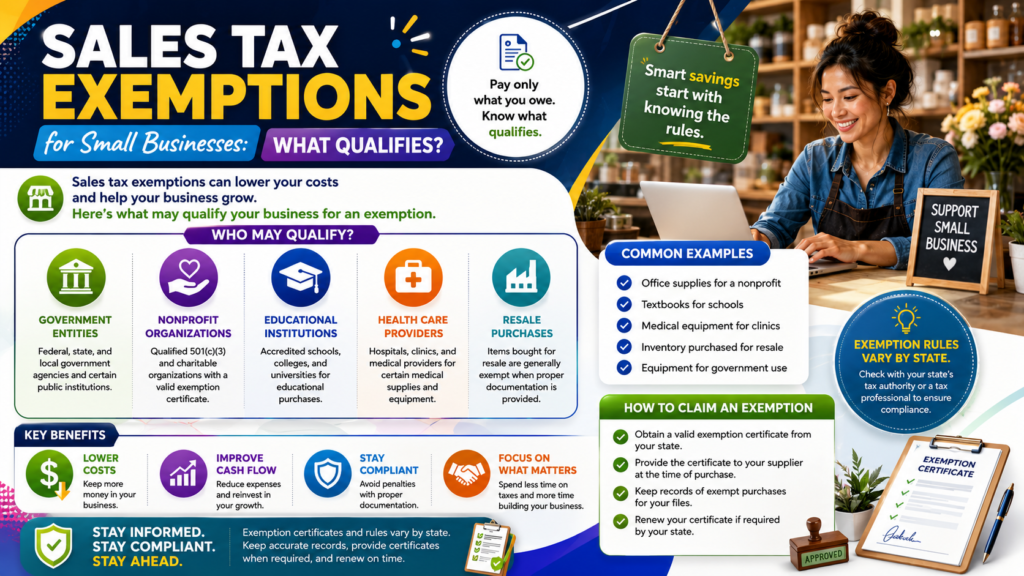
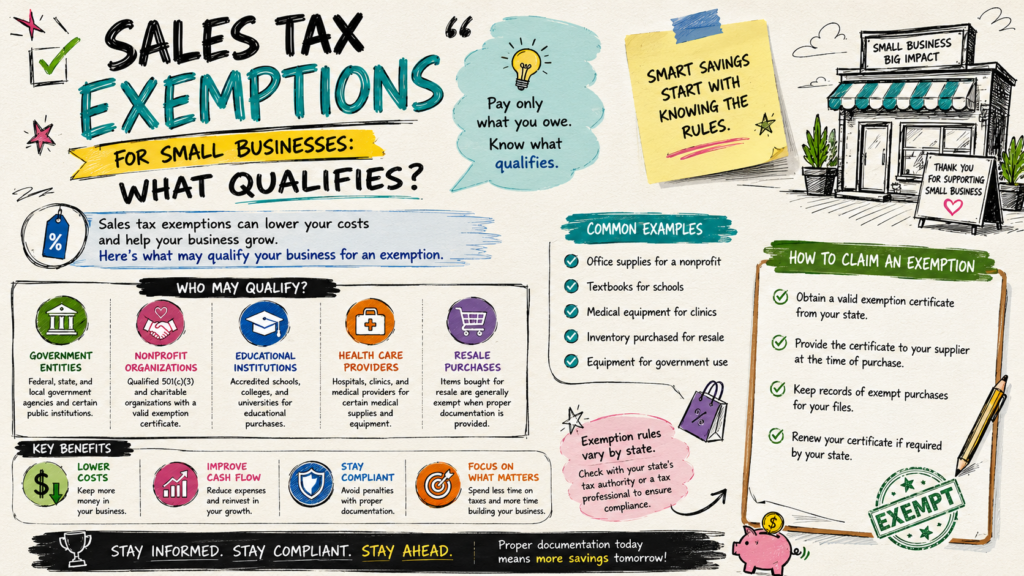
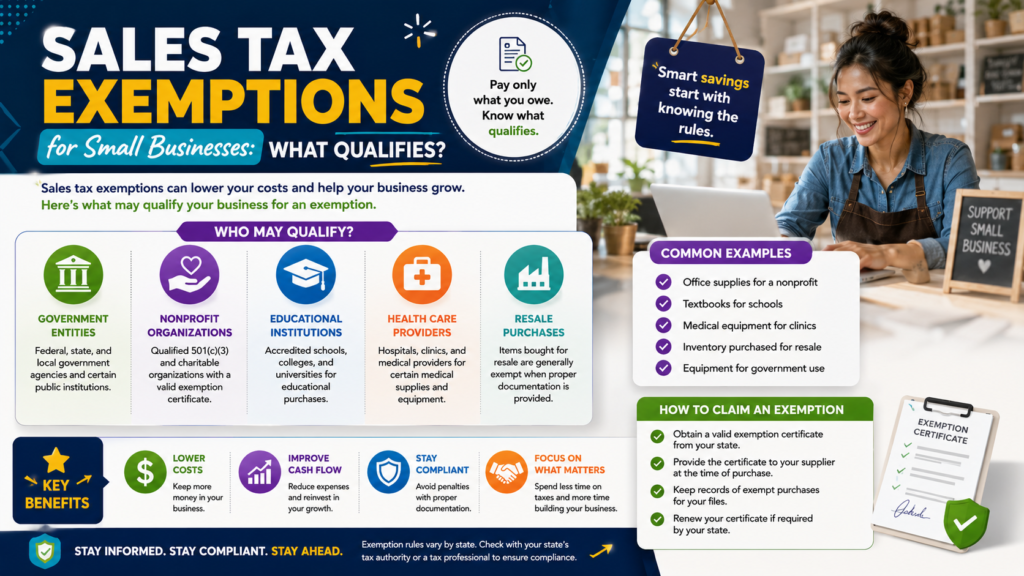
Qualified nonprofit organizations — including 501(c)(3) entities — are exempt from paying sales tax on purchases in most states. Government agencies at the federal, state, and local levels are also typically exempt.
Nonprofits generally must register separately with their state’s revenue department to receive an exemption certificate. Simply having IRS tax-exempt status (Form 1023 approval) is not always sufficient at the state level.
5. Services vs. Tangible Goods
Here’s something many small business owners overlook: most states only tax tangible personal property, not services. However, this is changing. Several states — including Hawaii, New Mexico, and South Dakota — tax a broad range of services.
Content creators and freelancers should pay particular attention here. Digital services, software-as-a-service (SaaS), and downloadable digital products are taxed in some states but not others. As of 2026, more than 30 states impose sales tax on at least some digital goods and services.
6. Cannabis Industry Exemptions
The cannabis industry operates under a uniquely complicated tax environment. While cannabis businesses in most states pay excise taxes rather than standard sales tax exemptions, some states offer limited exemptions on business-to-business cannabis transactions — such as a licensed cultivator selling wholesale flower to a licensed dispensary.
Cannabis operators must navigate both state sales tax rules and special excise tax frameworks, which vary widely. California, Colorado, and Illinois each have distinct cannabis tax structures. Given the complexity, many cannabis businesses work with a specialized accountant to ensure they’re not leaving exemptions on the table.
Common Mistakes Small Businesses Make With Sales Tax Exemptions
Even well-intentioned business owners make costly errors when it comes to sales tax exemptions. Here are the most common pitfalls to avoid in the United States.
Mistake 1: Not Collecting Exemption Certificates
One of the most frequent audit triggers is missing exemption certificates. If a customer claims an exemption and you don’t have a valid certificate on file, your state’s Department of Revenue can hold you liable for the uncollected tax — plus interest and penalties. Always collect and store certificates before completing an exempt sale.
Mistake 2: Using Expired or Invalid Certificates
Exemption certificates do expire. Many states require certificates to be renewed every one to five years. Additionally, certificates issued in one state may not be valid in another, even under multi-state agreements. Verify that each certificate you hold is current, complete, and issued for the correct state.
Mistake 3: Misclassifying Taxable Items as Exempt
Not every item that sounds agricultural, educational, or manufacturing-related is automatically exempt. States publish detailed taxability matrices. For example, in many states, safety equipment for manufacturing employees does not qualify for the manufacturing exemption — even though it’s used in the production facility.
Mistake 4: Ignoring Nexus Rules
After the Supreme Court’s 2018 ruling in South Dakota v. Wayfair, economic nexus rules changed the landscape entirely. Even small businesses without a physical presence in a state may be required to collect that state’s sales tax if they exceed certain economic thresholds — often $100,000 in annual sales or 200 transactions. Failing to understand nexus means potentially owing tax in states where you’ve never set foot.
Mistake 5: Assuming Digital Sales Are Always Tax-Free
This is especially critical for content creators and online businesses. Many sellers assume digital goods — such as downloadable courses, presets, or digital content subscriptions — are tax-free. However, as of 2026, the majority of US states impose sales tax on at least some digital products. Failing to collect can result in back-tax liability.
How to Claim Sales Tax Exemptions: Step-by-Step for Small Businesses
Claiming sales tax exemptions isn’t automatic — it requires deliberate action. Follow these steps to ensure your business captures every exemption it qualifies for.
Step 1: Identify Your State’s Exemptions
— Start by visiting your state’s Department of Revenue website or the IRS.gov resource center for sales tax guidance. List every exemption category your business may qualify for, based on your industry, purchase types, and business structure.
Step 2: Obtain the Correct Exemption Certificates
Download and complete the exemption certificate forms required by your state. If you sell into multiple states, research each state’s accepted format. The Streamlined Sales Tax Governing Board (SSTGB) offers a uniform exemption certificate accepted in 24 member states, which simplifies multi-state compliance.
Step 3: Provide Certificates to Your Suppliers
Give your completed, signed exemption certificate to each vendor before completing a purchase that qualifies for exemption. Tranzesta.com Your vendor must retain this on file to legally make an exempt sale.
Step 4: Collect Certificates From Your Tax-Exempt Customers
If your customers claim exemptions from you, collect their certificates before processing the sale. Verify that each certificate is completed correctly and has not expired.
Step 5: Store All Certificates Securely
Maintain organized digital and/or physical records of every certificate — both certificates you provide to suppliers and certificates you receive from customers. During an audit, missing documentation is treated as if the exemption was never valid.
Step 6: Renew Certificates Before Expiration
Track expiration dates for all certificates. Set calendar reminders to request updated certificates at least 30 days before they expire. Many states allow “blanket” certificates that cover ongoing purchases — but these still require renewal.
Step 7: Review Your Exemption Status Annually
Tax laws change. New exemptions get added; existing ones get modified or repealed. Make it a habit to review your exemption eligibility at the start of each tax year — ideally with a qualified tax professional who speciali
Contact our team at hello@tranzesta.com for a free consultation.
Learn more about our business tax and bookkeeping services at Tranzesta.com.zes in your industry.
Sales Tax Exemptions for Small Businesses: Expert Tips for 2026
Beyond the basics, experienced tax professionals use several advanced strategies to maximize sales tax savings. Here are the most actionable tips for the 2026 tax year.
Know your state’s “direct pay” permit option
Some states allow large buyers to obtain a direct pay permit, letting them remit use tax directly to the state rather than paying it to vendors. This gives businesses more control and flexibility over their tax obligations.
Use software to manage exemption certificates
Manual certificate tracking leads to errors. Platforms like Avalara, TaxJar, and Vertex automate certificate collection, storage, and expiration alerts. For high-volume sellers, this is a significant risk management tool.
Understand the difference between sales tax and use tax
Use tax applies when you purchase taxable goods or services without paying sales tax (often from out-of-state vendors) and use those items in a taxable state. Many small businesses unknowingly owe use tax on online purchases.
Apply for exemptions proactively
Don’t wait until you’ve already purchased to research exemptions. Applying retroactively is possible in some states but it is far more time-consuming and may not be permitted for all transaction types.
Work with an industry-specialized accountant
General bookkeepers are often not up to date on niche exemption rules for industries like cannabis, digital content, or agriculture. A specialist like Tranzesta stays current on the laws that directly affect your bottom line.
For authoritative IRS guidance on business tax topics, visit IRS.gov Business Tax Center (opens in new tab).
You can also explore the Small Business Administration’s resources at SBA.gov for state-by-state tax filing guidance (opens in new tab).
Conclusion
Sales tax exemptions for small businesses are one of the most underutilized tax tools available to US entrepreneurs. Three key takeaways stand out: first, exemptions vary by state and require proper documentation to be valid; second, industries like cannabis, agriculture, manufacturing, and digital content each have unique exemption opportunities that require specialized knowledge; and third, missing an exemption — or claiming one without proper certificates — can be just as costly as overpaying.
The good news is that with the right guidance,
your business can capture every exemption it qualifies for, build airtight documentation practices, and approach any state audit with confidence.
Ready to get expert help? Email us at hello@tranzesta.com or visit Tranzesta.com to schedule your free tax strategy session today.
FAQs
Items exempt from sales tax for businesses commonly include goods purchased for resale (using a resale certificate), raw materials used in manufacturing, agricultural supplies like seeds and farm equipment, and items purchased by qualified nonprofit organizations. Additionally, most services are not subject to sales tax in the majority of US states, though this varies. Always verify with your state’s Department of Revenue, as exemptions differ significantly by state.
Yes, small businesses in the United States are generally required to collect sales tax if they have nexus in a state that imposes sales tax and they sell taxable goods or services. After the Supreme Court’s South Dakota v. Wayfair decision in 2018, even businesses without a physical presence may owe sales tax in states where they exceed economic thresholds — typically $100,000 in annual sales or 200 individual transactions in that state.
A sales tax exemption certificate is a document provided by a buyer to a seller that authorizes the seller to collect no sales tax on a transaction. The certificate identifies the buyer, the reason for the exemption (such as resale or agricultural use), and is signed by an authorized representative. Sellers must retain these certificates on file as proof of why no tax was collected — especially important during a state tax audit.
Not necessarily. As of 2026, more than 30 US states impose sales tax on certain digital products, including downloadable software, digital subscriptions, and streaming services. Sales tax on digital goods is a rapidly evolving area of law. Online sellers — including content creators on platforms like OnlyFans — should carefully review the digital goods tax rules in every state where they have customers or economic nexus before assuming their sales are tax-free.
To apply for a sales tax exemption, first identify which exemption category applies to your business (such as resale, manufacturing, or nonprofit). Then obtain the appropriate exemption certificate form from your state’s Department of Revenue website. Complete and sign the form, and provide it to your vendors before making an exempt purchase. If you are selling to exempt buyers, collect their certificates before completing the transaction. Renew certificates periodically as required by your state.
Talk to a real, signing professional
AI precision, human accountability — across the US, UK & UAE.
Book a free consultation