Did you know that failing to register for a sales tax
permit can result in penalties of up to 25% of the unpaid tax, plus interest? Whether you run an e-commerce store, a cannabis dispensary, or a content creation business, understanding how to get a sales tax permit in every US state is one of the most critical compliance steps you will face as a business owner.
Most US entrepreneurs assume sales tax only applies
to physical storefronts. However, the landmark 2018 South Dakota v. Wayfair Supreme Court decision changed everything. As a result, nearly every state now requires businesses to collect and remit sales tax — even without a physical presence.
In this guide, you will learn exactly what a sales tax
permit is, which states require one, how to register step by step, and the most common mistakes to avoid. Additionally, you will discover how Tranzesta helps business owners across the United States stay fully compliant.
What Is a Sales Tax Permit in Every US State?
A sales tax permit — also called a seller’s permit, sales tax license, or sales and use tax certificate — is an official authorization issued by a state government that allows a business to collect sales tax from customers. Without this permit, you are legally prohibited from charging sales tax, yet you may still owe the state the tax amount that should have been collected.
Currently, 45 US states plus the District of Columbia
impose a statewide sales tax. Only five states — Alaska, Delaware, Montana, New Hampshire, and Oregon — have no statewide sales tax. However, Alaska allows local municipalities to levy their own sales taxes, so businesses there are not completely off the hook.
For most US taxpayers running a business,
the question is not whether to register — it is where and how quickly. Tranzesta specializes in helping self-employed individuals, content creators, and business owners navigate this complex landscape across all 50 states.
Economic Nexus: The Rule That Changed Everything
“Nexus” is a tax term meaning a sufficient connection between your business and a state that obligates you to collect sales tax there. Before 2018, Nexus required a physical presence — a store, warehouse, or employee. After South Dakota v. Wayfair, most states adopted “economic nexus” thresholds based on sales revenue or transaction volume.
The most common threshold is $100,000 in annual sales
or 200 separate transactions in a state. Therefore, if your Etsy shop, OnlyFans account, or e-commerce brand crosses these limits in any state, you must register for a sales tax permit there — even if you have never set foot in that state.
Physical Nexus vs. Economic Nexus
Physical nexus applies when you have a tangible presence — an office, employees, inventory, or a trade show presence in a state. Economic nexus applies purely based on your sales figures. In contrast, affiliate nexus (in some states) applies when a third-party website in that state refers customers to you.
Most importantly, you may have nexus in multiple states simultaneously. This is especially common for online sellers, cannabis companies with multi-state operations, and digital content creators who sell to customers nationwide.
Key Rules and Requirements for Sales Tax Permits Across the United States
Sales tax rules vary significantly by state, but several core requirements apply in most jurisdictions. Understanding these fundamentals will help you build a solid compliance foundation for your business.
What Information Do You Need to Register?
Most states require the following information to issue a sales tax permit:
Federal Employer Identification Number (EIN) — or Social Security Number for sole proprietors
Business legal name and trade name (DBA) if applicable
Business address — both registered and physical locations
Business structure (LLC, sole proprietor, corporation, partnership)
NAICS code — the industry classification code for your business
Estimated monthly sales figures
For cannabis businesses, additional state-specific licenses are typically required before a sales tax permit can be issued. Cannabis companies must coordinate between state cannabis control boards and state revenue departments — an area where Tranzesta has deep expertise.
How Much Does a Sales Tax Permit Cost?
The good news is that most states issue sales tax permits for free. For example, California, Texas, Florida, New York, and Illinois all charge no application fee. However, a few states do charge a nominal fee. For instance, Alabama charges $10, while Connecticut charges $100 for a two-year permit.
Additionally, some states require a security deposit — particularly if you have a history of late tax payments. Therefore, it is best to register proactively and maintain a clean compliance record from the start.
Filing Frequencies: Monthly, Quarterly, or Annual?
Once you hold a sales tax permit, each state assigns you a filing frequency based on your expected sales volume. High-volume sellers typically file monthly, while smaller businesses file quarterly or annually. Missing a filing deadline — even with zero sales to report — triggers penalty notices in most states.
For reference, you can review general sales tax filing guidance at the IRS Small Business and Self-Employed Tax Center (IRS.gov/businesses/small-businesses-self-employed), which provides links to state tax agencies. However, each state operates independently, so you must register and file directly with each state’s revenue department.
Common Mistakes to Avoid When Getting a Sales Tax Permit
Many US business owners make costly errors when navigating sales tax permits. Fortunately, most of these mistakes are avoidable with proper guidance. Here are the five most damaging pitfalls we see at Tranzesta.
Mistake 1: Assuming You Only Need One Permit
Many business owners register in their home state and assume that covers them everywhere. This is incorrect. If you sell products or taxable services in multiple states and exceed the economic nexus thresholds, you must register in each of those states separately. For online sellers with customers across the country, this can mean registering in 10, 20, or even 40+ states.
Mistake 2: Waiting Until You Are Audited to Register
States have become aggressive about enforcement since the Wayfair decision. Many states purchase third-party data to identify businesses selling into their borders without a permit. As a result, back taxes, penalties, and interest can accumulate for multiple years before you even realize you have a problem. Register proactively — as soon as you cross the nexus threshold.
Mistake 3: Misclassifying Taxable vs. Exempt Products or Services
Not all products and services are taxable in every state. For example, groceries are tax-exempt in many states but taxable in others. Digital goods — like OnlyFans subscriptions, online courses, or downloadable software — are taxable in some states but not all. Charging tax when you should not, or failing to charge when you should, creates compliance exposure on both ends.
Mistake 4: Letting Your Permit Expire or Lapse
Some states issue permits with expiration dates — particularly states that charge renewal fees. Additionally, if you fail to file returns for an extended period, states may revoke your permit. Selling without a valid permit, even unintentionally, carries the same penalties as never registering at all.
Mistake 5: Ignoring Local Sales Taxes Within States
Many states allow counties and cities to impose additional local sales taxes on top of the state rate. For example, in California, the statewide rate is 7.25%, but local rates can push the total as high as 10.75% in some districts. Therefore, simply applying the state rate is not enough — you need to use the correct combined rate for each customer’s location.
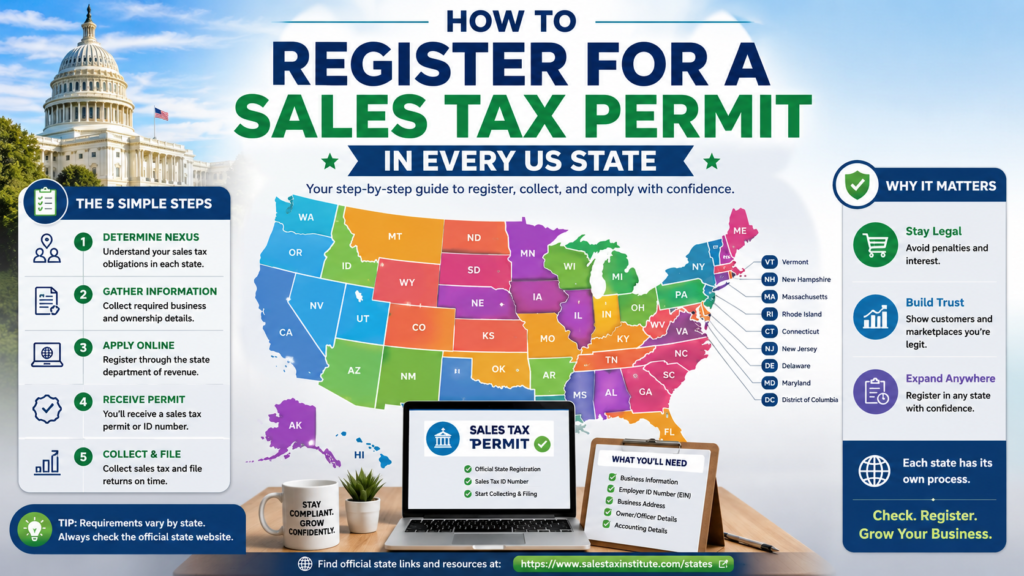
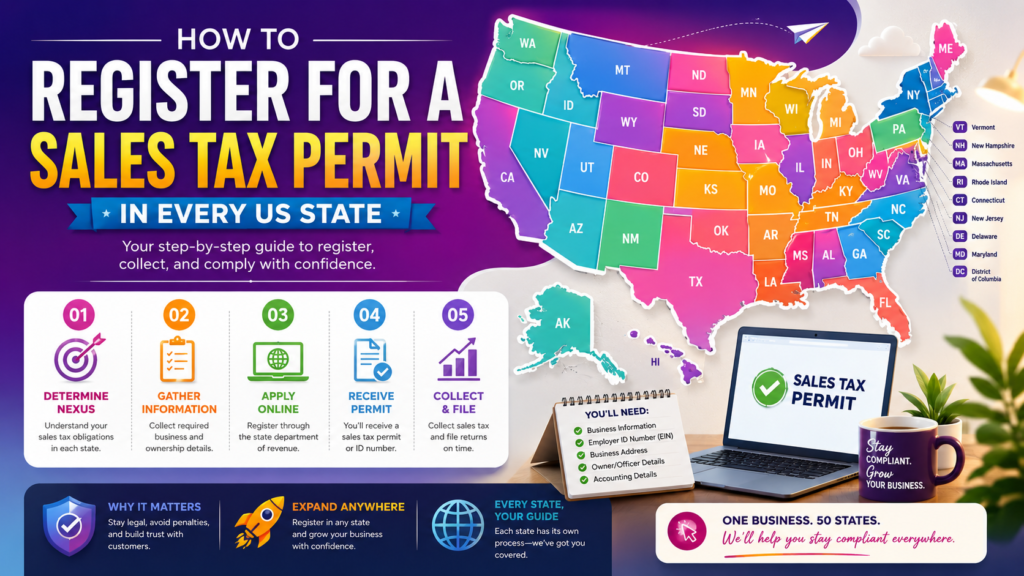
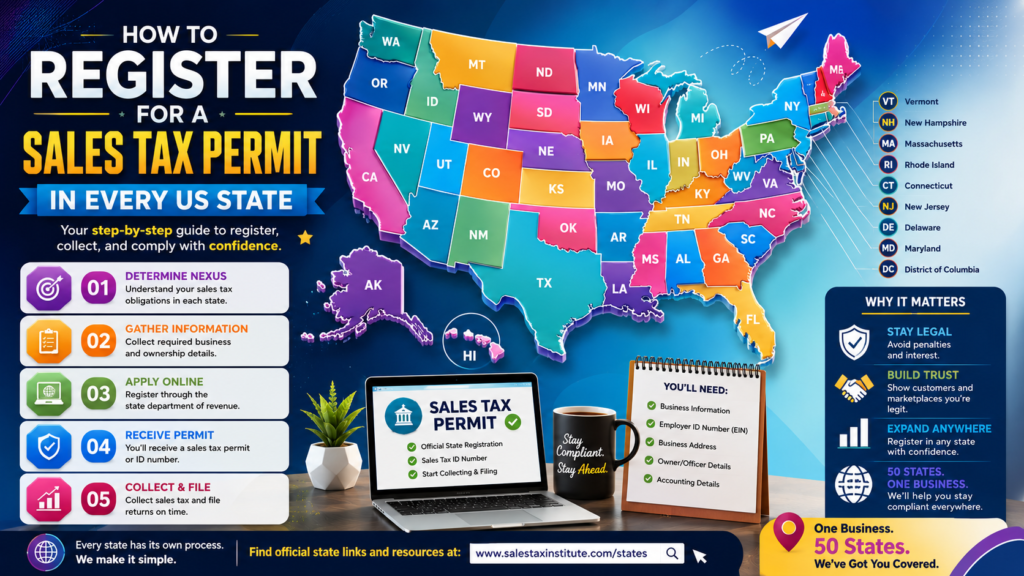
Step-by-Step: How to Register for a Sales Tax Permit in Every US State
Registering for a sales tax permit is more straightforward than most business owners expect — once you know the exact process. Follow these seven steps to register correctly in any US state.
Step 1: Determine Where You Have Nexus
Before registering anywhere, conduct a nexus analysis. Review your sales data for the past 12 months and identify every state where you exceeded $100,000 in revenue or 200 transactions (thresholds vary slightly by state). This analysis tells you exactly where you need to register — not just where you feel like you might need to.
Step 2: Gather Your Business Documents
Collect your EIN (from IRS Form SS-4), business formation documents (Articles of Incorporation or LLC Operating Agreement), and your business bank account information. Additionally, have your NAICS business activity code ready — you can look this up at census.gov/naics.
Step 3: Visit Each State’s Revenue Department Website
Each state maintains its own online registration portal. For example, California uses the CDTFA Online Services portal, Texas uses eSystems, and New York uses the Business Online Services account. Most states now offer fully digital registration — paper applications are rare. The registration itself typically takes 15–30 minutes per state.
Step 4: Complete the Application Accurately
Fill out each field carefully, particularly your business start date (the date you first made sales in that state) and your expected monthly sales volume. Underreporting your sales volume can result in an incorrect — often too infrequent — filing schedule, which leads to underpayment penalties. Always err on the side of accuracy.
Step 5: Pay Any Required Fees and Submit
Most states process applications for free, but pay any applicable fees by credit card or ACH bank transfer on the portal. After submission, most states provide an immediate or same-day permit number. Some states — particularly those with paper processes — may take 2–6 weeks to issue your permit.
Step 6: Display or Store Your Permit as Required
Some states require physical businesses to display the permit visibly on the premises. For online businesses, simply keep a digital copy of each permit in a secure file. You will need your permit number when filing returns, applying for resale certificates, and during any state tax audit.
Step 7: Set Up Systems to Collect and Remit Sales Tax
After registration, configure your e-commerce platform or point-of-sale system to collect the correct sales tax for each customer location. Platforms like Shopify, WooCommerce, and Square integrate with tax automation tools such as TaxJar or Avalara. Additionally, calendar your filing due dates immediately so you never miss a deadline.
Contact our team at hello@tranzesta.com for a free consultation. Tranzesta.com We will review your nexus exposure, identify where you need to register, and handle the entire process for you.
Sales Tax Permit in Every US State: Expert Tips for 2026
Sales tax compliance is evolving rapidly in 2026. States are investing heavily in enforcement technology, and the days of flying under the radar are over. Here are our top expert strategies to keep your business protected.
Use a Marketplace Facilitator exemption when it applies.
If you sell exclusively through Amazon, Etsy, or eBay, those platforms collect and remit sales tax on your behalf in most states. However, this does not eliminate your obligation if you also sell direct-to-consumer.
Register retroactively through a Voluntary Disclosure Agreement (VDA).
If you missed registering in prior years, most states offer VDA programs that cap lookback periods and waive penalties. This is far better than waiting to be audited.
Streamlined Sales Tax (SST) simplification.
Twenty-four states participate in the Streamlined Sales and Use Tax Agreement (SSUTA), which standardizes definitions and filing to reduce compliance burdens. Registering through the SST portal simultaneously registers you in all 24 member states.
Monitor your nexus exposure quarterly.
Your nexus footprint can change as your business grows into new markets. Review your state-by-state sales figures every quarter, not just at year-end.
Keep detailed records of exemption certificates.
If you sell to resellers or tax-exempt organizations, collect and store resale certificates. During an audit, missing certificates can result in you owing the tax that the buyer should have paid.
Conclusion: Take Control of Your Sales Tax Compliance Today
Sales tax compliance is not optional for US business owners — and the consequences of non-compliance grow steeper every year. The three most important takeaways from this guide are: first, determine your nexus footprint before assuming you are compliant; second, register proactively in every state where you exceed the economic nexus thresholds; and third, maintain accurate records and never miss a filing deadline after you hold a permit.
Whether you are an e-commerce seller, a content creator, a cannabis business, or a traditional brick-and-mortar expanding online, the process of obtaining a sales tax permit in every US state you operate in is a non-negotiable step toward sustainable, audit-proof business operations.
Ready to get expert help? Email us at hello@tranzesta.com or visit Tranzesta.com to schedule your free tax strategy session today.
FAQs
Yes, selling online does not exempt you from sales tax obligations. Since the 2018 South Dakota v. Wayfair decision, most US states enforce economic nexus rules requiring online sellers to register and collect sales tax once they exceed $100,000 in sales or 200 transactions in that state within a calendar year. This applies to e-commerce stores, content creators, and digital service providers alike. You may need to register in multiple states even without any physical presence there.
Most states that offer online registration issue a sales tax permit number immediately or within 1–3 business days. States like California, Texas, and Florida provide instant permit numbers upon online application approval. However, some states with paper-based processes — or states that require additional verification — can take 2–6 weeks. You should not collect sales tax until your permit is officially issued.
Selling without a sales tax permit when you are legally required to have one exposes you to back taxes for all uncollected tax, penalties of up to 25% of the unpaid amount, and interest charges that compound over time. Some states also treat willful non-registration as a criminal offense for large tax liabilities. Additionally, your business may be barred from government contracting until fully compliant. Registering voluntarily through a Voluntary Disclosure Agreement usually reduces or eliminates penalties.
No, digital products and services are not taxable in every state, but the rules are highly inconsistent. As of 2026, approximately 28 states tax digital goods such as downloaded software, streaming subscriptions, and online content. States like Texas, New York, and Pennsylvania tax most digital products, while states like California generally do not. For content creators and SaaS businesses, determining taxability state-by-state before collecting sales tax is essential to avoid both over- and under-charging customers.
No, a sales tax permit issued by one state is only valid in that state. You must register separately in each state where you have nexus and obtain a separate permit for each. However, the Streamlined Sales Tax (SST) program allows businesses to register in all 24 participating states through a single online application at streamlinedsalestax.org. This simplifies multi-state registration significantly, though you will still need separate permits for non-SST states like California and New York.
Talk to a real, signing professional
AI precision, human accountability — across the US, UK & UAE.
Book a free consultation