Most small business owners in the United States
lose money every tax season — not because they earned less, but because their books are a mess. Disorganized records lead to missed deductions, penalties, and last-minute panic. The solution is simple: a consistent monthly bookkeeping checklist for your small business that keeps you on top of your finances every 30 days, not just in April.
In this guide, you’ll get a complete, actionable monthly bookkeeping checklist built for US small businesses, freelancers, content creators, and cannabis operators. You’ll also learn what the IRS requires, the most common mistakes to avoid, and how professional bookkeeping support from Tranzesta can eliminate the chaos entirely. Let’s dive into what monthly bookkeeping actually involves.
What Is a Monthly Bookkeeping Checklist for Small Business?
A monthly bookkeeping checklist is a structured list of financial tasks a business owner completes at the end of each month to keep their records accurate, current, and IRS-compliant. It transforms bookkeeping from an annual panic into a simple, predictable monthly routine.
Why Monthly Bookkeeping Matters More Than Annual Catch-Up
Many US business owners treat bookkeeping as a once-a-year task before tax filing. However, this approach leads to missing receipts, uncategorized transactions, and hours of stressful reconciliation. In contrast, monthly bookkeeping catches errors in real time, keeps your cash flow picture current, and ensures every deductible expense is captured before it’s forgotten.
The IRS requires businesses to maintain accurate, contemporaneous records that support every income item and deduction reported on a tax return. According to IRS Publication 583 (opens in new tab), records must be kept for a minimum of three years from the filing date — and some records even longer. Monthly bookkeeping ensures those records exist and are organized when you need them.
Who Needs a Monthly Bookkeeping Checklist?
Every US business with income or expenses needs one. That includes sole proprietors, single-member LLCs, S-Corps, partnerships, freelancers, OnlyFans creators, cannabis business operators, and self-employed professionals. In fact, the smaller your business, the more important the monthly rhythm is, because you likely don’t have a dedicated accounting team to catch errors for you.
Tranzesta works with small business owners across the United States to implement exactly this kind of monthly routine — and the results are consistently fewer errors, more deductions captured, and far less stress at tax time.
The Complete Monthly Bookkeeping Checklist for Small Business
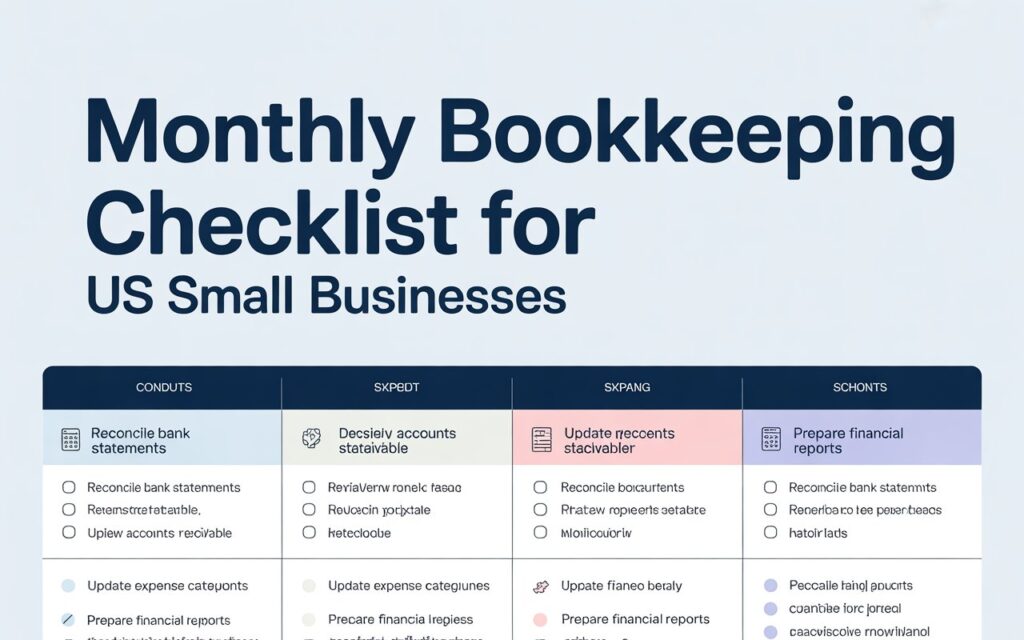
Work through this checklist at the end of every calendar month. Each task builds on the previous one, so complete them in order. Print it, save it as a PDF, or use it as a template inside your bookkeeping software.
What Are the Most Common Monthly Bookkeeping Mistakes Small Businesses Make?
Even business owners with the best intentions make bookkeeping errors every month. Here are the most damaging ones — and how to avoid them.
Mistake 1: Skipping the Bank Reconciliation
Bank reconciliation — the process of matching your bookkeeping records to your actual bank and credit card statements — is the single most important monthly task. Without it, duplicate transactions, missed entries, and even fraud can go undetected for months. Every business must reconcile every account, every month. No exceptions.
Mistake 2: Mixing Business and Personal Transactions
This is the most common bookkeeping error across all US business types. Using a personal account or card for business purchases makes categorization a nightmare and can lead the IRS to question whether an expense was truly business-related. Maintain completely separate accounts and run every business transaction through them.
Mistake 3: Ignoring Accounts Receivable
Many business owners record invoices when sent but never follow up when they go unpaid. As a result, outstanding receivables grow and cash flow suffers. Your monthly checklist should always include an aged receivables review — identifying invoices that are 30, 60, or 90+ days overdue and following up promptly.
Mistake 4: Forgetting Estimated Quarterly Tax Payments
Self-employed US taxpayers must pay estimated income taxes four times per year. The due dates in 2026 are April 15, June 16, September 15, and January 15, 2027. Failing to make these payments on time results in underpayment penalties from the IRS, even if you pay in full at filing. A monthly bookkeeping habit of reviewing your net income and setting aside tax savings prevents this entirely.
Mistake 5: Not Saving Digital Receipts in Real Time
The IRS accepts digital receipts, but only if they are legible and match the claimed expense. Waiting until the end of the month to gather receipts almost guarantees some will be lost. The best practice is to photograph and upload every receipt immediately after purchase, using your bookkeeping software’s mobile app or a dedicated tool like Dext or Hubdoc.
How to Build a Monthly Bookkeeping Routine That Actually Sticks
Knowing what to do is half the battle. The other half is building a routine you’ll actually follow every single month. Here’s how Tranzesta’s bookkeeping professionals recommend structuring the habit.
Block dedicated bookkeeping time on your calendar.
Treat your end-of-month bookkeeping session like a client appointment. Block two to four hours on the last business day of each month. Set a recurring calendar reminder the week before so nothing surprises you.
Set up your bookkeeping software before the first month.
You cannot follow a checklist if your software isn’t configured. Before your first session, ensure your chart of accounts is customized, your bank feeds are connected, and your opening balances are correct. Tranzesta’s team handles this setup for every new client.
Work through the checklist in the same order every month.
Consistency prevents missed steps. Start with income, move to expenses, then payroll and compliance, then reconciliation and reporting. After two or three months, the process becomes routine and takes significantly less time.
Use automation wherever possible.
Modern bookkeeping software like QuickBooks Online and Xero automatically imports bank transactions, categorizes recurring expenses, and flags anomalies. Automation handles the data entry — you focus on reviewing and confirming. Additionally, receipt-scanning apps eliminate the manual receipt-tracking burden.
Review your P&L statement every single month without fail.
Your Profit & Loss statement is your business’s health report. Reviewing it monthly lets you spot revenue dips, runaway expenses, and margin changes before they become serious problems. Don’t just file it — read it and act on what you find.
Communicate unusual items to your accountant immediately.
If something in your books doesn’t make sense — a large unexpected expense, a one-time income item, or a transaction you’re unsure how to categorize — flag it for your accountant the same week. Waiting until tax season to raise these questions costs extra time and money.
Transfer estimated taxes monthly, not quarterly.
Instead of scrambling to move a large sum when your quarterly payment is due, set aside 25–30% of every net income deposit into a dedicated tax savings account throughout the month. This makes quarterly payments painless and ensures you’re never caught short.
How Tranzesta Handles Monthly Bookkeeping for Small Businesses
Tranzesta is a US-based tax consultation and bookkeeping firm that provides complete monthly bookkeeping services for small businesses, self-employed professionals, content creators, and cannabis operators across the United States.
Our team takes the entire monthly checklist off your plate.
We import and categorize transactions, reconcile all accounts, prepare monthly financial statements, and flag any items requiring your attention. We also track your estimated tax liability throughout the year so there are no surprises at filing time. Visit Tranzesta.com to learn more about our monthly bookkeeping services.
For OnlyFans creators and digital content professionals,
Tranzesta understands the specific income streams, platform fee structures, and deduction categories unique to creator businesses. For cannabis businesses operating under the restrictions of IRC §280E, our team maintains the precise COGS records and expense segregation needed to legally minimize your federal tax burden.
For US expats with foreign income,
we align monthly bookkeeping with our Streamlined Filing compliance services to ensure your books support your international tax position. Learn more about our Streamlined Filing compliance services at Tranzesta.com.
Ready to hand off your monthly bookkeeping entirely? Contact our team at hello@tranzesta.com for a free consultation. We’ll review your current situation and design a monthly bookkeeping system built for your specific business and industry.
Monthly Bookkeeping Checklist Small Business: Expert Tips for 2026
Beyond the standard checklist, these advanced practices separate the businesses that stay consistently organized from those that scramble at year-end. Tranzesta shares these strategies with every new bookkeeping client.
Add an annual calendar of key tax deadlines to your bookkeeping folder. Know every federal and state deadline for the year before January 1. For 2026, mark estimated tax due dates, W-2 and 1099 mailing deadlines (January 31), and corporate filing deadlines. A tax calendar prevents costly late-filing penalties.
Reconcile your accounts receivable aging report monthly.
Don’t just track invoices sent — track how old each outstanding invoice is. Any invoice over 60 days should trigger an immediate follow-up. Invoices over 90 days may need to be written off as bad debts, which are deductible under certain conditions for accrual-basis businesses.
Track owner’s draws and distributions carefully.
Sole proprietors and LLC members frequently move money between personal and business accounts. Each transfer must be properly classified as an owner’s draw (not an expense) to keep your books accurate and prevent overstated deductions.
Run a year-to-date comparison every quarter.
At the end of March, June, and September, compare your year-to-date income and expenses to the same period last year. This lets you identify trends early and make proactive adjustments to your business strategy.
Save a PDF of your monthly P&L and Balance Sheet.
Even if your bookkeeping software stores historical reports, export and save a PDF copy each month in a dedicated folder. This creates a clean audit trail and ensures you can access historical financial data even if you switch software providers.
Review your subscription and recurring expense list quarterly.
Most businesses carry software subscriptions, memberships, and services they no longer actively use. A quarterly review of recurring charges typically finds $50 to $300 per month in waste that can be eliminated immediately.
For official IRS guidance on record-keeping requirements for US businesses, consult the SBA.gov guide to managing business finances (opens in new tab), which outlines financial management best practices for small business owners across the United States.
Conclusion
A monthly bookkeeping checklist for your small business is not optional — it’s the foundation of financial health and tax compliance in the USA. First, complete every item on the checklist at the same time each month without exception. Second, reconcile every account monthly to catch errors before they compound. Third, set aside estimated taxes from every payment received so quarterly deadlines never catch you off guard.
The business owners who stay financially healthy year-round are not necessarily smarter or more experienced. They simply follow a consistent monthly routine. This checklist gives you exactly that routine. All you have to do is use it.
Ready to get expert help? Email us at hello@tranzesta.com or visit Tranzesta.com to schedule your free bookkeeping consultation today. Tranzesta’s team will handle your monthly books so you can focus on running your business.
Lorem ipsum dolor sit amet, consectetur adipiscing elit. Ut elit tellus, luctus nec ullamcorper mattis, pulvinar dapibus leo.
FAQs
A monthly bookkeeping checklist for a small business should include: recording all income received, sending and following up on invoices, importing and categorizing all bank and credit card transactions, reconciling bank accounts to bookkeeping records, reviewing accounts receivable and payable, processing payroll and contractor payments, confirming estimated quarterly tax savings, and reviewing the monthly Profit & Loss statement and Balance Sheet. Completing each of these tasks consistently every month keeps your books accurate and your business tax-ready year-round.
Monthly bookkeeping for a small business typically takes two to four hours per month for a business with straightforward transactions and a low volume of income and expenses. Businesses with higher transaction volumes, employees, or inventory may require four to eight hours or more. Using automated bookkeeping software like QuickBooks Online or Xero reduces manual data entry significantly. Many US small business owners choose to outsource monthly bookkeeping to a professional firm like Tranzesta, which handles the entire process for a predictable monthly fee.
Every small business in the USA should review three key financial reports each month. First, the Profit and Loss (P&L) statement, which shows income, expenses, and net profit for the month. Second, the Balance Sheet, which shows assets, liabilities, and owner equity at month-end. Third, the Accounts Receivable Aging Report, which shows outstanding invoices and how long each has been unpaid. Together, these three reports give a complete picture of business financial health and flag issues before they become serious problems.
You do not legally need an accountant for monthly bookkeeping, but working with one typically saves money in the long run. A professional bookkeeper ensures every transaction is categorized correctly, all accounts are reconciled, and your estimated tax liability is tracked accurately throughout the year. For complex businesses — such as cannabis operators under IRC §280E, content creators with multiple income streams, or US businesses with international transactions — professional bookkeeping is strongly recommended to avoid costly errors and missed deductions.
Bank reconciliation means matching every transaction in your bookkeeping software to the corresponding entry on your actual bank statement. To reconcile, open your bank statement for the month and compare it line by line to your bookkeeping records. Confirm every deposit, withdrawal, and fee appears in both places. Investigate any discrepancies immediately. Most bookkeeping software like QuickBooks and Xero automates most of this process through bank feed integration, reducing reconciliation to a review-and-confirm task rather than a manual matching exercise.
Talk to a real, signing professional
AI precision, human accountability — across the US, UK & UAE.
Book a free consultation