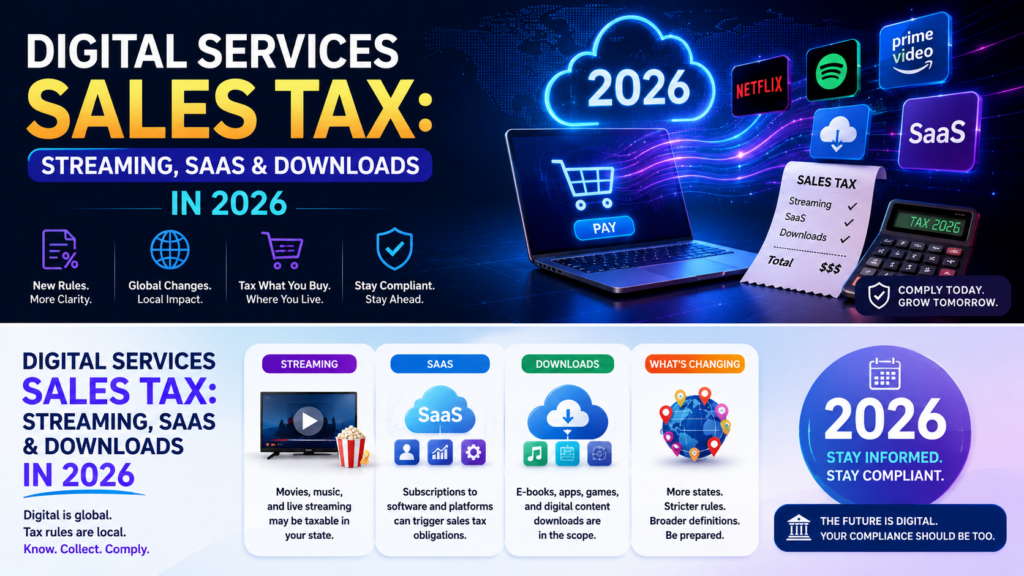
If you sell software subscriptions, stream content,
or deliver digital downloads to customers across the United States, you may owe sales tax in far more states than you realize. Digital services sales tax on SaaS, streaming, and downloads in 2026 is one of the fastest-moving and most confusing areas of US tax law — and the gap between what businesses owe and what they actually remit runs into hundreds of millions of dollars annually.
As of 2026, approximately 30 US states impose sales tax
on at least some category of digital goods or services. However, the specific rules differ dramatically by state — what is taxable in Texas may be fully exempt in California, and what qualifies as a taxable SaaS product in New York might be treated as a nontaxable service in Florida.
In this guide, you will learn which states tax digital services and why, how the rules differ across streaming, SaaS, and downloadable content, the most common compliance mistakes businesses make, and how Tranzesta helps digital businesses and content creators across the USA stay fully compliant. Let’s start with the fundamentals.
What Is Digital Services Sales Tax? SaaS, Streaming, and Downloads Explained
Digital services sales tax refers to state-imposed sales or use tax applied to products and services delivered electronically — including software-as-a-service (SaaS), streaming media, downloaded software, e-books, online courses, digital music, and subscription content. Unlike physical goods with clear taxability rules, digital products have been categorized inconsistently across US states since the internet economy emerged in the 1990s.
SaaS — Software as a Service is a cloud-based
software delivery model where customers pay a subscription to access software hosted remotely, rather than purchasing and installing it locally. Streaming refers to audio or video content delivered in real time over the internet, such as music subscriptions or video platforms. Downloads refer to digital files transferred permanently to the buyer’s device, such as software, e-books, or music files.
These distinctions matter enormously for tax purposes.
Some states tax downloads but not streaming. Others tax SaaS but exempt downloaded software. Still others have blanket exemptions for all digital goods. Getting the classification wrong — in either direction — creates either compliance exposure or unnecessary customer overcharges.
Why Are Digital Services Taxed Differently From State to State?
Digital services fall into a regulatory gray area because most state sales tax laws were written decades before digital commerce existed. States have adopted three broad approaches. Some states passed specific digital economy tax legislation. Others applied existing tangible personal property or software tax rules by analogy. And others determined that digital products do not fit their existing tax code and therefore exempted them by default.
As a result, there is no uniform national rule for digital services sales tax in the United States. The Streamlined Sales and Use Tax Agreement (SSUTA) — an interstate compact currently covering 24 member states — has worked to standardize some definitions, but non-member states including California and Florida continue to apply their own frameworks independently.
Who Does Digital Services Sales Tax Affect Most?
Digital services sales tax directly impacts SaaS companies, streaming platforms, app developers, OnlyFans creators, online course sellers, digital music distributors, e-book publishers, and any business that delivers a product or service electronically to US customers. It also affects the buyers of those services — particularly businesses that purchase SaaS tools and cloud software from vendors who do not collect the applicable sales or use tax in the buyer’s state.
Tranzesta serves all of these business categories,
including OnlyFans and digital content creators who frequently underestimate their sales tax exposure, and cannabis technology companies that rely heavily on SaaS tools and need accurate use tax tracking alongside their sales tax obligations.
Key Rules: Which States Tax Digital Services Sales Tax SaaS Streaming 2026?
The taxability of digital services varies significantly across the 45 sales-tax-imposing states in the USA. However, the landscape has become clearer in recent years as more states have enacted specific digital economy legislation. Here is a breakdown of the major categories.
States That Broadly Tax Digital Services
The following states impose sales tax on most categories of digital services — including SaaS, downloaded software, streaming, and digital content — as of 2026:
Texas: Taxes SaaS as a “data processing service” at 80% of the sales price (an effective rate of about 6.25% x 0.80). Also, taxes downloaded software and most digital content.
New York: Taxes prewritten (off-the-shelf) software sold as a download, and taxes some digital content. SaaS is generally taxable when it functions as a software license.
Pennsylvania: Taxes digital downloads broadly, including music, video, e-books, and downloaded software. SaaS taxability is determined case-by-case based on functionality.
Washington State: Has among the broadest digital services tax regimes in the USA — taxes SaaS, downloaded software, streaming, and most digital goods under its extended definition of “digital automated services.”
Tennessee and Minnesota: Both tax a wide range of digital products including subscriptions, downloaded software, and streaming services.
For US taxpayers selling to customers in these states,
registering for a sales tax permit and configuring your billing system to collect the correct tax on digital transactions is a non-negotiable compliance step. Learn more about sales tax permit registration for digital businesses at Tranzesta.com.
States That Partially Tax or Specifically Exempt Digital Services
California — the largest US state by GDP — currently does not impose sales tax on most digital services, including SaaS and streaming. However, California does tax prewritten software delivered on physical media and has historically taxed digital goods transferred as part of a mixed transaction with tangible property. This exemption makes California an outlier that confuses many sellers into assuming digital goods are universally exempt nationwide.
Florida exempts most electronically delivered
software and digital content from sales tax, but taxes software delivered as a “service” under its communications services tax framework in some circumstances. Illinois takes a hybrid approach, taxing downloaded software and some digital goods but exempting most SaaS under a 2021 ruling that remains subject to ongoing legislative scrutiny.
The IRS provides a state tax agency directory at IRS.gov/businesses/small-businesses-self-employed/state-and-local-governments that links to each state’s revenue department — the authoritative source for each state’s current digital goods tax rules. However, given how rapidly these rules change, professional guidance from a firm like Tranzesta is essential for businesses operating in multiple states.
How Does the Streamlined Sales Tax Agreement Help?
The Streamlined Sales and Use Tax Agreement (SSUTA) is a multistate compact that standardizes tax definitions to simplify multi-state compliance. Member states — currently 24 — have adopted uniform definitions for “specified digital products,” including digital audio works, digital audiovisual works, and digital books. Within SSUTA states, these categories are treated consistently, reducing the state-by-state research burden for sellers.
However, SaaS remains outside the SSUTA’s standardized framework,
meaning even within member states the taxability of cloud-hosted software varies. Additionally, 21 non-SSUTA states — including California, Texas (partially), and Florida — apply entirely independent rules. Tranzesta.com Therefore, multi-state digital sellers must still conduct state-specific research for every jurisdiction where they have nexus.
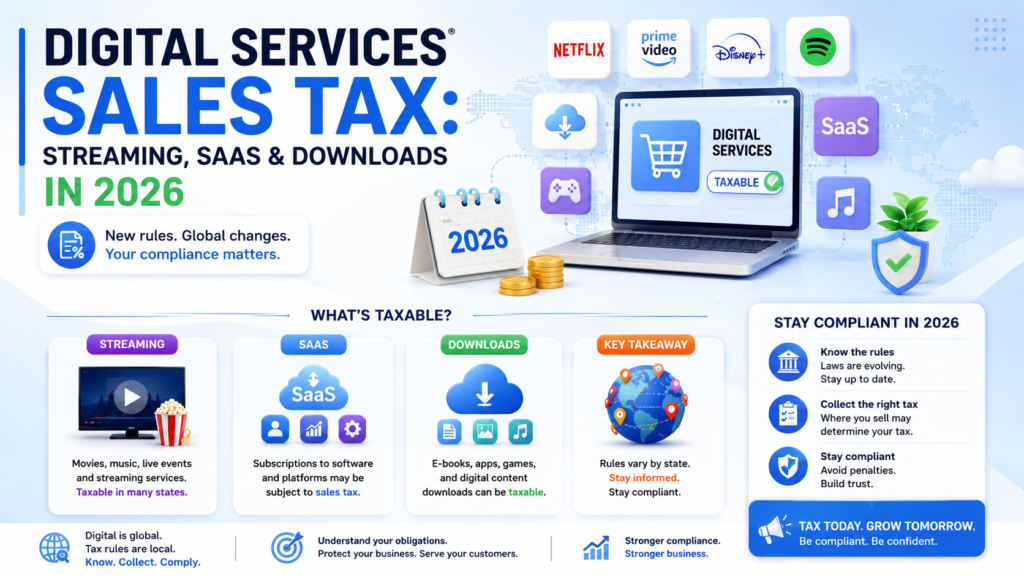
Common Digital Services Sales Tax Mistakes That Cost Businesses Money
Even tech-savvy businesses with sophisticated billing platforms frequently make critical digital services sales tax errors. Here are the four most damaging mistakes Tranzesta identifies in client reviews.
Mistake 1: Applying a Single Tax Setting to All Digital Products
Many SaaS businesses configure their billing platform — Stripe, Recurly, or Chargebee — with a single tax setting applied uniformly across all customers, regardless of state. This approach invariably produces errors. A blanket “taxable” setting overcharges customers in exempt states like California. A blanket “exempt” setting fails to collect in taxable states like Texas and Washington — leaving the seller liable for uncollected tax on all past transactions.
The correct approach requires product-level and state-level tax configurations within your billing system, ideally powered by a real-time tax calculation API such as Avalara or TaxJar. Without this level of granularity, compliance at scale is impossible.
Mistake 2: Treating All SaaS Products the Same
Not all SaaS products receive the same tax treatment — even within the same state. Some states distinguish between SaaS that functions like a software license (taxable), SaaS that provides access to a database or information service (sometimes exempt), and SaaS bundled with professional services (may be partially taxable or fully exempt depending on how the price is structured). Texas, for example, taxes SaaS as a data processing service at 80% of the sales price — but only if the SaaS meets the state’s definition of that category.
Additionally, if you bundle SaaS with implementation,
onboarding, or consulting services, the taxability of the entire bundle may depend on whether the software or the service component represents the greater value — a determination that varies by state. Tranzesta helps SaaS businesses map their specific product offerings to the correct tax category in every state where they have nexus.
Mistake 3: Ignoring Use Tax on SaaS and Digital Tools Your Business Purchases
This mistake runs in both directions. While many businesses worry about collecting sales tax from their customers, they overlook their own use tax obligations on the digital tools they buy. If your business subscribes to a SaaS platform — accounting software, project management tools, CRM systems — from a vendor without nexus in your state, and that vendor does not charge your state’s sales tax, you likely owe use tax on those subscription fees.
In states like New York and Washington,
where SaaS is broadly taxable, a business spending $50,000 annually on SaaS subscriptions from non-collecting vendors may owe $4,000–$5,000 in unreported use tax. This exposure accumulates quietly and only surfaces during a state audit.
Mistake 4: Failing to Update Tax Settings When Laws Change
Digital services tax laws are among the most actively changing areas of US state tax law. In 2024 alone, multiple states updated their digital goods definitions, and several more states introduced legislation that took effect in 2025. A business that correctly configured its billing system in 2022 may be out of compliance today simply because the rules in one or more states have changed — without anyone noticing.
Therefore, digital businesses must treat their tax configuration as a living system that requires annual review — at minimum — and ideally ongoing monitoring through a tax compliance service or firm like Tranzesta.
Step-by-Step: How to Manage Digital Services Sales Tax for Your Business in 2026
Building a compliant digital services sales tax system requires a structured approach. Here are six actionable steps to get it right from the ground up.
Step 1: Classify Every Digital Product or Service You Sell
Create a product inventory list and classify each item into one of these categories: downloaded software, SaaS or cloud-hosted software, streaming media (audio/video), digital content (e-books, courses, images), or bundled products (digital plus physical or digital plus services). This classification drives every subsequent tax determination — without it, you cannot accurately assess your obligations.
Step 2: Identify the States Where You Have Economic Nexus
Review your prior 12 months of customer revenue by state. In most states, the economic nexus threshold is $100,000 in annual sales or 200 transactions. For digital services, every state where your customers are located is a potential nexus state — even without a physical office or warehouse. Identify all states where you exceed those thresholds.
Step 3: Research Taxability for Each Product in Each Nexus State
For every product category and every nexus state, determine whether your product is taxable, partially taxable, or exempt. Use each state’s official revenue department website for current guidance. Pay particular attention to SaaS taxability, streaming subscription rules, and any recent legislative changes. Document your research findings — this documentation forms the basis of your audit defense if you are ever questioned.
Step 4: Register for Sales Tax Permits in Required States
Register with each state’s revenue department before collecting sales tax there. Most states provide online registration through their revenue portals. For the 24 Streamlined Sales Tax member states, you can register simultaneously through the SST portal at streamlinedsalestax.org. Keep records of every permit number — you will need them for filing and for your tax automation configuration.
Step 5: Configure Your Billing Platform With Product-Level and State-Level Tax Rules
Connect a tax automation API — TaxJar, Avalara, or Vertex — to your billing platform. Within the API, configure each product using the appropriate tax code for its category. Map each state’s taxability rules to each product code. Test the configuration by running sample transactions for customers in high-risk states like Texas, New York, and Washington before going live. Incorrect configurations that go undetected will compound quickly across thousands of transactions.
Step 6: Automate Filing and Set Up Quarterly Compliance Reviews
Enable AutoFile for each state where you are registered to ensure returns are filed and tax is remitted on time. Additionally, schedule quarterly reviews to check for new nexus thresholds, law changes, and any billing system sync errors. For SaaS businesses with rapidly growing customer bases, quarterly nexus checks are essential — you may cross a new state’s threshold mid-year and need to register within 30–60 days.
How Tranzesta Helps Digital Businesses Navigate Digital Services Sales Tax
Digital services sales tax is one of the most technically complex areas of US state tax law — and it is evolving faster than most businesses can track on their own. Tranzesta is a US-based tax consultation firm that specializes in helping digital businesses, content creators, and SaaS companies build accurate, defensible tax compliance systems.
For OnlyFans creators and digital content sellers, Tranzesta maps the taxability of subscriptions, pay-per-view content, digital merchandise, and downloadable files across all states where the creator has nexus. We configure billing systems and automation tools to collect the correct amounts — preventing both audit exposure from under-collection and customer trust damage from overcharges.
For SaaS companies and software businesses, Tranzesta conducts product-level tax classification reviews, identifies where SaaS nexus exists based on customer location data, handles multi-state registration, and configures tax automation APIs for accurate real-time collection. We also identify use tax obligations on the digital tools your business purchases — an often-overlooked liability that surfaces aggressively during state audits.
Additionally, for businesses with prior years of uncollected digital services sales tax, Tranzesta facilitates Voluntary Disclosure Agreements with state revenue departments to cap lookback periods and reduce penalties. Visit Tranzesta.com to learn more about our business tax and compliance services for digital businesses and content creators.
📧 Contact our team at hello@tranzesta.com for a free consultation. We will review your digital product lineup, assess your nexus exposure in all taxing states, Tranzesta.com and build a compliance system that scales with your business.
Digital Services Sales Tax SaaS Streaming 2026: Expert Tips to Stay Compliant
The digital services tax landscape in 2026 is more active than at any point in the past decade. States are aggressively expanding their digital tax bases, and enforcement is intensifying. Here are the most critical expert strategies to stay ahead.
Request a private letter ruling for ambiguous product categories.
If you are unsure whether your specific SaaS product or streaming service is taxable in a given state, most revenue departments will issue a written ruling in response to a formal inquiry. That ruling protects you from penalties if the state later changes its position — a significant protection in a rapidly evolving area of law.
Watch the Illinois SaaS tax situation closely.
Illinois has had an evolving and contested approach to SaaS taxation since a 2021 ruling. Legislative proposals in 2025 and 2026 may change the taxability framework there. Businesses with significant Illinois customer bases should monitor developments and update their configuration promptly when changes take effect.
Separate your invoicing for bundled products.
If you sell a package that includes both SaaS and professional services, issue separate line items for each component. Many states tax the software portion but exempt the service portion — or vice versa. A bundled price with no itemization often results in the entire amount being taxed at the least favorable rate.
Implement a digital goods taxability review as part of your annual tax planning.
Each year before January 1, review your product list against any state law changes that took effect in the new year. Even one state updating its digital goods definition can affect thousands of transactions across your customer base.
Train your customer-facing teams on tax-related questions.
Customers frequently contact billing or support teams with questions about sales tax on their invoices. Equipping those teams with accurate, state-specific answers prevents confusion and demonstrates the professionalism that builds long-term customer trust.
Most importantly, partner with a firm that tracks digital services tax law changes as a core competency — not as an afterthought. Tranzesta monitors state legislative developments in digital services taxation as an ongoing practice, ensuring our clients are never caught off guard by a law change that affects their compliance position.
Conclusion: Digital Services Sales Tax Is Not Going Away — Plan Accordingly
The three most important takeaways from this guide are: first, approximately 30 US states tax at least some form of digital service in 2026, and the number is growing; second, SaaS, streaming, and downloadable content are classified differently in each state — requiring product-level, state-level tax configurations rather than blanket rules; and third, the cost of non-compliance — back taxes, penalties, and interest — far exceeds the cost of getting it right from the start.
Whether you sell SaaS subscriptions, stream original content, distribute digital downloads, or operate as a content creator, digital services sales tax compliance is a real and enforceable obligation across the United States. Businesses that plan proactively will scale cleanly. Those who ignore it will face an accelerating wave of state enforcement actions in 2026 and beyond.
Ready to get expert help? Email us at hello@tranzesta.com or visit Tranzesta.com to schedule your free tax strategy session today.
FAQs
SaaS is subject to sales tax in many US states, but the rules are not uniform. States like Texas, New York, Washington, Pennsylvania, and Tennessee broadly tax SaaS products, though the definitions and rates vary. States like California, Florida, and Virginia generally do not impose sales tax on SaaS, though Florida applies its communications services tax to some cloud services. As of 2026, approximately 22 states tax SaaS to some degree. Businesses selling SaaS must conduct a state-by-state analysis based on their specific product type and customer locations.
Whether you owe sales tax on streaming service revenue depends on the states where your subscribers are located. States like Tennessee, Minnesota, and Wisconsin broadly tax streaming subscriptions. Texas taxes streaming under its amusement services rules. California and Florida generally do not impose sales tax on streaming revenue. As a streaming platform or content creator, you must identify where your subscribers are located, assess each state’s streaming tax rules, and register and collect where required. The $100,000 or 200-transaction threshold still determines whether you have economic nexus in each state.
Digital downloads are taxable in many US states, including Pennsylvania, New York, Texas, Washington, and Tennessee. These states treat downloaded software, music, movies, e-books, and other digital files as taxable digital goods subject to their standard sales tax rate. In contrast, California generally does not tax digital downloads delivered electronically without a physical component. The taxability of digital downloads depends on both the state and the specific category of content — downloaded music may be treated differently than downloaded software in the same state.
The sales tax rate on digital products equals the state’s standard sales tax rate in most states that tax them. For example, Washington State’s combined rate is approximately 10.25% in many jurisdictions, Pennsylvania’s is 6%, and Tennessee’s is 7% plus local rates. Texas applies its 6.25% state rate but only on 80% of the SaaS sales price when the product qualifies as a data processing service — creating an effective rate of 5%. Local city and county taxes may stack on top of the state rate depending on the customer’s location.
To determine if your digital product is taxable in a specific state, start by classifying your product as SaaS, downloaded software, streaming media, or digital content. Then review that state’s department of revenue website for its current digital goods tax guidance. Many states publish specific guidance documents or FAQs for digital products. For complex or ambiguous products — such as a SaaS platform with embedded AI tools or a bundled software-plus-services offering — a private letter ruling from the state or consultation with a tax professional like Tranzesta provides the most reliable answer.